
Enterprise App Development Services Guide
Discover how enterprise app development services drive business growth. This guide covers how to choose the right partner, tech, and strategy for your success.Enterprise app development services are about more than just building software; they're about forging a strategic partnership to design, build, and maintain custom applications that run your entire business. These aren't your everyday mobile apps. They are powerful systems engineered from the ground up for massive scale, airtight security, and deep integration with your core operations.
What Are Enterprise App Development Services
Think about it like this: a small business might buy a fleet of standard delivery vans. They get the job done. But a global logistics empire? They would commission a custom-built fleet of autonomous drones, designed specifically for their unique routes, package sizes, and operational workflows. That custom fleet is faster, more efficient, and can scale up or down instantly. That’s the difference.
Enterprise app development services are the custom drone fleet for your business. These aren't off-the-shelf solutions; they are complex software systems tailor-made to solve specific, large-scale challenges. These applications become the digital backbone of a company, built to handle enormous workloads and connect seamlessly with all the other software you already use.
The Core Components of an Enterprise App
An application doesn't get the "enterprise" label just because it's big. It has to earn it by possessing a few critical characteristics that are non-negotiable for supporting a large organization.
Immense Scalability: The software must handle growth gracefully. A practical example is a retail app that functions perfectly during a normal Tuesday but also withstands the massive traffic surge of a Black Friday sale without crashing. Whether you have a thousand users today or a million tomorrow, it must perform without a hiccup.
Ironclad Security: Enterprise apps handle sensitive data. This means implementing multi-factor authentication (MFA), role-based access control (RBAC), and end-to-end encryption. They require robust security protocols and full compliance with industry regulations like HIPAA for healthcare or GDPR for customer data to keep that information safe.
Seamless Integration: The app must talk to everything else. For example, when a new sale is made on your e-commerce platform, the app should automatically update inventory levels in your ERP, log the customer interaction in your CRM, and trigger a shipping order with your logistics provider—all without manual intervention.
The goal is to create a unified digital ecosystem that streamlines operations, not another isolated software silo. This level of integration is a hallmark of true enterprise-grade solutions.
A Strategic Business Decision
Building a custom enterprise application is a significant investment, and it's a move more and more companies are making. The global enterprise application market was valued at around USD 320.40 billion in 2024 and is expected to nearly double by 2030, according to data from GrandViewResearch. This trend shows a clear shift in thinking: custom software is no longer just an expense, but a vital asset for creating a real competitive advantage.
This is why choosing the right partner is so important. A great development team is more than just a group of coders; they are a strategic ally who can translate your complex business needs into a functional, secure, and future-proof application. To learn more about the specifics of the creation process, check out our guide on finding the right mobile app development company.
The Real ROI of Custom Enterprise Applications
Investing in a custom enterprise application isn't just about getting new tech; it's a strategic move that can fundamentally change your business for the better. While off-the-shelf software might seem like an easy fix, it often forces you into a box, creating workarounds and hidden costs down the line. A custom-built app, on the other hand, is a direct investment in your company's unique strengths, paving the way for greater efficiency and a serious competitive edge. It solves the exact problems that generic solutions can't touch.
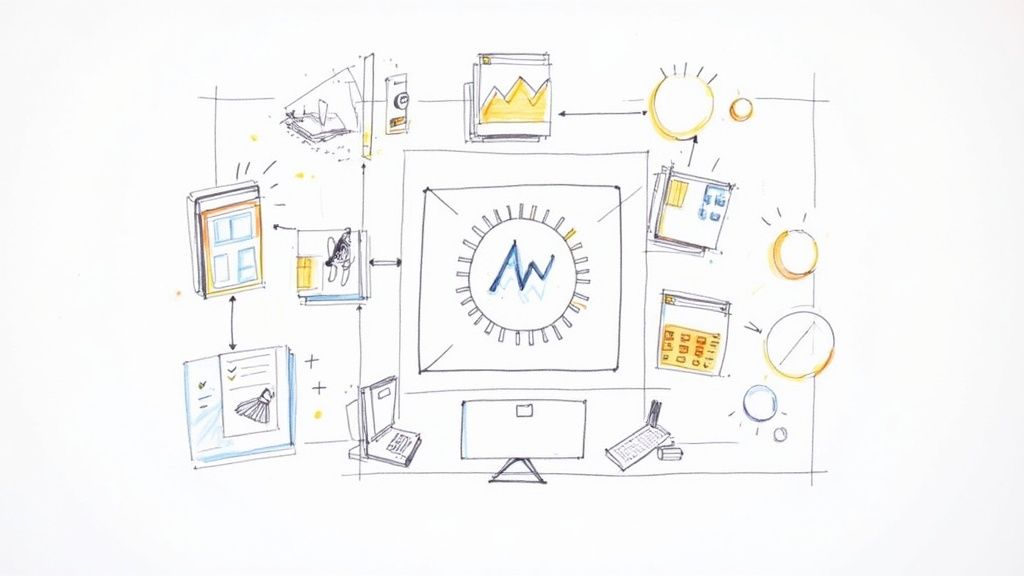
This value shows up in three main ways. First, a custom app can seriously boost how your teams get work done. Second, it gives you the freedom to grow without being held back. And finally, it can become a powerful advantage that sets you apart from everyone else in your industry.
Supercharge Operational Efficiency
Every business has its own way of doing things—those specific, sometimes quirky, workflows that make your company what it is. Off-the-shelf software often makes you bend your processes to fit its rigid design. A custom enterprise app does the exact opposite. It’s built from the ground up to match and automate your specific workflows, getting rid of tedious manual steps and the errors that come with them.
Here's a real-world example. A large manufacturing company was bogged down by a clunky quality control process. Inspectors were using paper forms, technicians were manually keying data into spreadsheets, and managers were spending hours cobbling together reports. They built a custom app that completely digitized this entire flow.
Inspectors now capture issues in real-time on tablets with digital checklists.
The app instantly sends alerts to the right maintenance crews.
Managers have live dashboards that show production line health and quality trends at a glance.
The result? They saw a 40% reduction in reporting time and a 15% drop in product defects. This freed up their best people to solve real problems instead of shuffling paperwork. That's a clear and direct return on their investment.
Achieve True Scalability Without Penalties
Growth is the goal, but it can be incredibly painful when your software can't keep up. Many off-the-shelf tools hit you with punishing per-user licensing fees that make you pay more as you succeed. Your costs skyrocket as you add employees or customers, eating away at your bottom line. Custom applications are designed with your growth in mind from day one.
A custom solution liberates your business from the "growth tax" imposed by third-party software licenses. You own the asset, giving you the freedom to scale your operations without facing exponentially rising subscription costs.
This ownership is a game-changer. You can add thousands of users or process millions of transactions without having to ask a vendor for permission or pay more for every seat. The infrastructure is built to handle your future, giving you a stable foundation to support your ambition, not restrict it.
Build a Moat Around Your Business
In a crowded market, a proprietary application can be your secret weapon. It allows you to offer a unique service, deliver a better customer experience, or create internal efficiencies that your competitors simply can't replicate. This creates a sustainable advantage—a "moat" that protects your market share and profits.
Sometimes, an internal tool can even become a new business entirely.
Consider this: a logistics firm developed a custom app to optimize its delivery routes and manage its fleet. The system was so good at cutting fuel costs and delivery times that the company started licensing it to smaller, non-competing logistics businesses. What started as an internal tool to improve efficiency transformed into a successful SaaS product, opening up an entirely new revenue stream. That's the ultimate ROI—turning an operational cost into a profit center.
Choosing Your Development Partnership Model
Deciding how you'll work with a development partner is just as critical as choosing the technology itself. The engagement model you pick sets the tone for the entire project, influencing everything from budget and flexibility to how hands-on your own team will be.
When you're looking for enterprise app development services, you'll typically run into three main ways of structuring the partnership. Each one is built for different kinds of projects and business goals. Making the right call upfront saves a world of headaches and misaligned expectations down the road.
It really comes down to matching your project's DNA—is it a straightforward, well-defined task or a sprawling, evolving system?—with a partnership style that can actually support it.
To help you decide, let's break down the three most common engagement models. Each has its place, and understanding the trade-offs is key to making a smart choice.
Comparing Enterprise App Development Engagement Models
Model | Best For | Budget Control | Flexibility | Client Involvement |
|---|---|---|---|---|
Fixed Price | Small, well-defined projects with a static scope (e.g., MVPs). | High (cost is set upfront). | Low (changes are difficult and costly). | Low (mostly during the initial planning phase). |
Time & Materials | Long-term, complex projects where requirements are likely to change. | Medium (ongoing management needed). | High (can adapt to new needs easily). | High (requires active participation and feedback). |
Dedicated Team | Large-scale, ongoing development needing a long-term, integrated team. | Medium (predictable monthly cost). | High (team adapts to shifting business priorities). | High (team acts as an extension of the company). |
Each model offers a unique balance of control, cost, and collaboration. Let’s dive a little deeper into what each one feels like in practice.
The Fixed Price Model
Think of the Fixed Price model like commissioning a custom piece of furniture. You give the craftsman exact specifications—dimensions, materials, finish—and they give you a single, all-in price to build it. It’s perfect for projects where you know exactly what you need, everything is documented, and changes are highly unlikely.
An actionable example: building a simple internal dashboard that pulls data from three specific APIs and displays it in a predefined chart. The scope is clear and contained, making it an ideal candidate for a fixed price. The biggest draw is predictable budgeting; you know the total cost before a single line of code is written. The downside, however, is its rigidity. Any deviation from the original plan requires a new contract and added costs, which can really stall momentum.
The Time and Materials Model
In complete contrast, the Time & Materials (T&M) model is like hiring a contractor for a major home renovation. You have a vision, but you're prepared for surprises and new ideas along the way. You pay for the hours your team works and the resources they use, which gives you incredible flexibility.
This is the go-to model for complex, long-term enterprise projects where requirements are expected to evolve, such as building a new CRM from scratch. It supports an agile workflow, allowing you to pivot, add features, and adjust priorities based on real user feedback. The core benefit here is adaptability. The trade-off? It demands more active involvement from you to manage the budget and keep the project on track.
The Dedicated Team Model
Finally, the Dedicated Team model is the ultimate partnership for large-scale, continuous development. This is like hiring an entire specialized crew that works exclusively for you, becoming a true extension of your own company. The development partner assembles a team of engineers, designers, and managers who are 100% committed to your success.
This model is perfect for a company building a core digital product that will require ongoing updates and new features for years to come. It often gives you the best of both worlds: the specialized expertise of an external agency combined with the focus and deep integration of an in-house team. To learn more about whether this approach fits your strategic vision, you can explore the pros and cons of outsourcing product development.
Understanding the Modern Enterprise Tech Stack
Picking the right technologies for your enterprise app is a lot like building a custom race car. You wouldn't just grab any engine off the shelf. You’d carefully select the engine, the chassis, and the navigation system to work in perfect harmony. That specific combination of technologies is your tech stack, and it’s the single biggest factor determining how fast, reliable, and future-proof your application will be.
This isn't just a nerdy decision for the IT department; it's a core business strategy. The right stack lets you scale, innovate, and pivot when the market shifts. It's not about jumping on the latest, shiniest trend. It's about making deliberate choices that directly support your company's goals. For anyone looking into enterprise app development services, getting a handle on these components is key to asking the right questions and knowing if a potential partner truly has the chops.
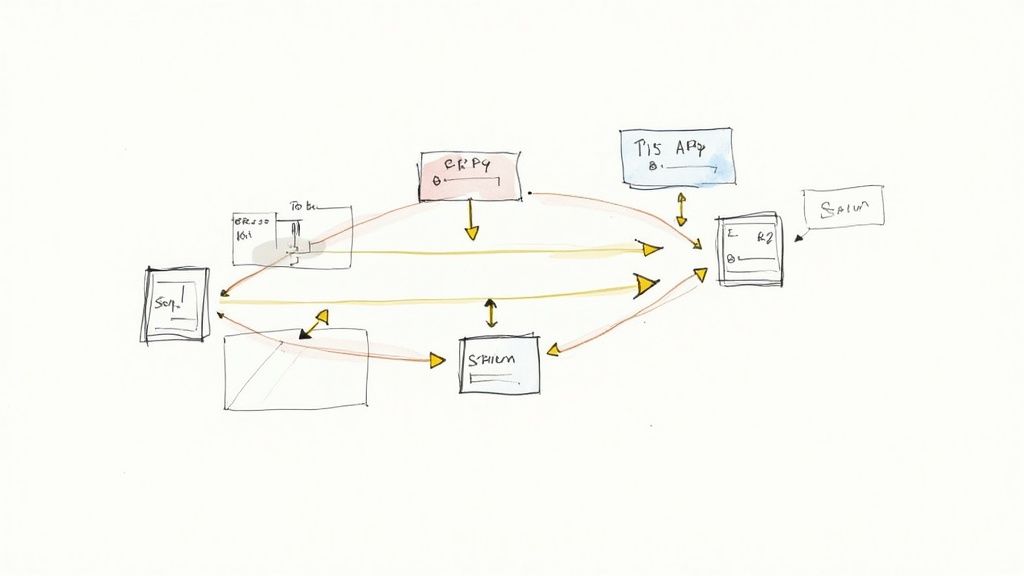
The Foundational Layers of Your Application
Every enterprise application, no matter how complex it seems on the surface, is really built on four fundamental pillars. Think of it like a building: you have the facade everyone sees, the internal plumbing and wiring, the foundation holding it all up, and the land it sits on.
Frontend (The User Interface): This is everything your users actually see and touch—the buttons they click, the dashboards they view, and the forms they fill out. It's the public face of your app, usually built with frameworks like React or Angular to create a smooth and intuitive experience.
Backend (The Engine Room): Tucked away behind the scenes, this is the powerhouse where the real work happens. It processes data, handles business logic, and talks to the database. Popular workhorses for the backend include languages like Java, Python, or Node.js.
Database (The Central Library): This is where all your company’s critical information lives. It needs to be organized, secure, and fast. Whether it's a traditional SQL database like PostgreSQL for structured data or a more flexible NoSQL database like MongoDB for varied data types, its performance is non-negotiable.
Infrastructure (The Foundation): This is the server environment where your application runs. These days, that foundation is almost always in the cloud, on platforms like Amazon Web Services (AWS), Microsoft Azure, or Google Cloud Platform (GCP).
Getting these layers right is the first step. But the real magic—and the competitive advantage—comes from how you connect them.
Microservices: The Modern Architectural Blueprint
In the old days, enterprise software was often built as one giant, interconnected block of code called a monolith. The problem? If one tiny part broke, the whole system could go down. And pushing updates was a slow, terrifying process.
The modern way forward is microservices architecture. Imagine breaking that massive application apart into a collection of small, independent services. Each one does just one job—like handling payments or authenticating users—and they all communicate through clean, simple channels (APIs).
This approach is a total game-changer for speed and resilience. Need to update the inventory management feature? You can work on just that one service without any risk to the customer order system. This means faster development, easier maintenance, and no more single point of failure that can bring the entire business to a halt.
This modular design is absolutely essential for building enterprise systems that can grow and adapt without becoming a tangled mess.
Embracing Cloud-Native and Intelligent Systems
The final piece of the puzzle is tapping into the power of the cloud and artificial intelligence. Cloud-native development isn't just about running your app on a cloud server; it's about designing it from the ground up to take full advantage of services from AWS, Azure, or GCP. This gives you incredible scalability, reliability, and cost savings, since you only pay for what you actually use. Digging into custom web application development options can show you just how these cloud platforms become the backbone for truly powerful applications.
Beyond the cloud, AI is no longer a futuristic buzzword; it's a practical tool. For instance, a logistics app could use an AI model to predict delivery times based on real-time traffic data, or a CRM could use machine learning to identify which sales leads are most likely to convert. This is what separates a good enterprise app from a great one. The most forward-thinking development partners are already using these tools to build smarter, more effective software that gives their clients a real edge.
How to Select the Right Development Partner
Picking a partner for your enterprise app development is one of the most critical business decisions you'll make. This isn't just about finding a team that can sling code; it's about finding a strategic ally who gets your industry, buys into your goals, and has the discipline to see it through. A flashy portfolio is nice, but the real proof is in their experience, technical chops, and process.
In today's world, enterprise software is no longer a simple IT expense. It's the central nervous system of your entire competitive strategy. That means you need sophisticated, scalable, and deeply integrated solutions. This shift has turned the process of choosing a development partner into a core strategic move that defines your company's ability to innovate and stay agile. You can see more on this from top enterprise software development companies.
To make the right call, you need a solid framework for vetting potential partners.

Verify Deep Industry Experience
General-purpose developers won't cut it. Enterprise applications are built to solve complex, industry-specific problems, so your partner absolutely must have a proven track record in your field. Think about it: a team that has built successful logistics platforms will understand supply chain nuances in a way a fintech-focused agency simply can't.
Demand detailed case studies that are directly relevant to your project. Look for hard evidence that they have:
Solved similar business challenges: Can they show you a project where they automated a complex billing workflow or integrated with a legacy system like SAP?
Navigated industry-specific regulations: Have they built applications that meet standards like HIPAA in healthcare or SOC 2 in finance? This isn't optional.
Delivered measurable results: You're looking for concrete numbers here, like a 25% increase in operational efficiency or a significant drop in manual data entry errors.
Scrutinize Their Technical Command and Process
A potential partner's tech expertise has to be modern and grounded in best practices. They should be able to clearly explain why they recommend a particular tech stack for your project, walking you through the strategic trade-offs of different frameworks and architectures.
A truly skilled partner doesn't just build what you ask for. They challenge your assumptions and guide you toward a solution that's more scalable, secure, and ready for the future. Their process should be transparent, disciplined, and built on clear communication.
Just as important is their project management discipline. Ask them about their development methodology. Do they follow Agile principles that allow for flexibility and constant feedback? A well-defined process is your best insurance against scope creep, budget overruns, and blown deadlines. For a closer look at what building a strong foundation involves, check out the services offered by a digital product studio like Pixel One.
Evaluate Communication and Post-Launch Support
The work isn't over when the app goes live. A real partnership includes a solid plan for what happens next. Before you sign anything, make sure you have a crystal-clear understanding of their post-launch support and maintenance structure.
Get straight to the point and ask direct questions to set expectations:
What does your communication look like during the project? Will there be daily stand-ups, weekly progress reports via a shared Slack channel, or a formal review meeting every two weeks?
Who will be our dedicated point of contact?
What do your support-level agreements (SLAs) cover after launch? This should specify response times for critical bugs (e.g., "1-hour response for system-down issues") and routine maintenance.
Can you provide client references we can speak with directly?
Talking to past clients is non-negotiable. It's the only way to get unfiltered insight into how they really perform, how reliable they are, and—most importantly—how they handle things when challenges pop up.
Best Practices for a Successful Partnership
Hiring an enterprise app development team isn't like placing an order and waiting for delivery. The most successful projects happen when you're an active, strategic partner, not just a client with a checklist. Shifting your mindset from customer to collaborator is the single biggest thing you can do to keep your project on track, within budget, and aimed squarely at your business goals.
We've seen countless projects over the years, and a few key practices consistently separate the smooth, successful engagements from the frustrating ones. Think of these not as suggestions, but as the ground rules for building something great together. They create a foundation for clear communication, shared ownership, and ultimately, an exceptional final product.
Define Crystal-Clear Requirements
In software development, ambiguity is the enemy. Fuzzy goals are the number one cause of scope creep, where a project slowly balloons with new features and unexpected changes, wrecking your timeline and budget. The best way to kill this risk before it starts is to define your requirements with absolute precision.
Forget broad statements. Start thinking in user stories. This simple technique forces you to frame every feature from the perspective of the person who will actually use it, making it clear what to build and why.
Don't say this: "We need a reporting feature."
Instead, say this: "As a regional sales manager, I want to generate a quarterly sales report filtered by product category so I can track performance against my targets."
See the difference? That small shift gives the development team invaluable context, a clear purpose, and a solid definition of what "done" looks like.
Commit to an Agile Methodology
Modern software isn't built with a massive, rigid plan that's set in stone. The best work happens through iterative progress. When you commit to an Agile methodology, you're agreeing to build the project in small, manageable cycles known as "sprints," which allows for constant feedback and adjustments along the way.
Your active participation in regular sprint reviews and planning sessions is non-negotiable. This is where you see the work, give your input, and make sure the project is headed in the right direction. Waiting until the final reveal to voice concerns is a recipe for disaster.
This collaborative rhythm keeps everyone on the same page and ensures the final application is a product of continuous refinement, not just outdated initial assumptions.
Champion User-Centric Design from Day One
What good is a powerful application if nobody wants to use it? The drive for user adoption has to start from the very first meeting. User Experience (UX) and User Interface (UI) design can't be an afterthought; they need to be a core priority.
A user-centric approach is all about building an app that is intuitive, efficient, and genuinely solves problems for the people using it every single day.
Don't do this: Get lost in a long list of technical features.
Do this: Bring actual end-users into the design process. Run workshops, conduct interviews, and let them test prototypes to get direct, honest feedback.
This focus guarantees you're building a tool that doesn't just work correctly but actually empowers your team. For more on creating effective digital products, check out the articles on the Pixel One blog.
Weave Robust Security into Everything
In the enterprise space, security can't be tacked on at the end like a fresh coat of paint. It has to be baked into every stage of the development lifecycle. This philosophy, known as DevSecOps, means your development partner should be thinking about security from the get-go.
Security shouldn't be a final checklist item but a constant, ongoing process. This includes everything from secure coding habits and automated vulnerability scans to regular penetration testing. Taking a proactive stance on security is the only way to protect your data, stay compliant, and earn the trust of your users.
Frequently Asked Questions
When you're considering a big project like custom enterprise software, you're bound to have questions. It's a major investment, and it's smart to get clear answers before you dive in. Here are some of the most common questions we hear from business leaders.
How Much Does Enterprise App Development Cost?
The price tag for a custom enterprise app can swing wildly, all depending on how complex it is, what features you need, and the kind of partnership you set up. A more straightforward application might begin around $75,000, but sophisticated systems with deep integrations can easily run past $750,000.
The real conversation, however, shouldn't be about the initial cost. It should be about the return on that investment. For example, if a $200,000 app saves 10 employees 5 hours per week each (at an average loaded cost of $50/hr), that's a saving of $130,000 per year. The app pays for itself in just over 18 months. A good development partner will help you build that business case from the start.
Should We Build In-House or Outsource?
For the vast majority of companies, outsourcing is the smarter play. Trying to build a top-tier development team from scratch is a long, expensive road filled with recruiting headaches, training, and the constant challenge of keeping specialized talent. It can take months, if not years, to get a truly capable team in place.
When you partner with an enterprise app development services firm, you get a full team of seasoned experts on day one. They bring proven workflows and deep knowledge of modern technology, letting your own people stay focused on what they do best—running your business.
Outsourcing isn't just a cost-cutting move. It’s about getting to market faster and gaining access to specialized skills that would be nearly impossible to develop internally on a tight timeline.
What Is a Typical Timeline for Development?
You should plan for a timeline of 6 to 12 months or more for a full-featured enterprise application. The key is that development almost never happens all at once. It’s broken down into phases to get value into your hands sooner and minimize risk.
A popular strategy is to launch a Minimum Viable Product (MVP) within the first 4-6 months. An MVP isn't a stripped-down version; it's a focused one, containing only the most essential features. For a logistics app, an MVP might include only core route tracking and delivery confirmation, leaving driver performance analytics for a later phase. This lets you get the core concept in front of real users, gather feedback, and make sure you're building what people actually need.
How Do I Ensure Application Security?
Security can't be a line item you check off at the end. It has to be woven into the fabric of the development process right from the beginning. When you're talking to potential partners, don't be shy about asking for their security protocols and track record.
Here are the non-negotiables you should look for:
Secure Coding Standards: Following industry best practices like the OWASP Top 10 to shut down common vulnerabilities from the start.
Regular Code Reviews: A second (or third) pair of expert eyes checking for potential security flaws.
Penetration Testing: Proactively hiring "ethical hackers" to find weaknesses before the bad guys do.
Data Encryption: Making sure your data is protected both at-rest (on a server) and in-transit (moving across the internet).
Compliance with Standards: Meeting the specific regulations for your industry, like SOC 2, GDPR, or HIPAA.
A partner who takes security seriously builds these practices into every single step, not just as a final QA check.
At Pixel One, we turn complex business problems into elegant, scalable digital solutions. Our teams are with you at every step—from initial strategy to final launch—making sure your enterprise application drives real, measurable results. Discover how we can help you build the future of your business.