
product launch checklist: 10 Essential Steps for Success
The product launch checklist walks you through 10 critical steps - from market research to post-launch optimization - designed to boost your launch success.Launching a product is a high-stakes, multi-faceted process that demands more than just a great idea. Without a structured plan, even the most innovative products can fail to gain traction, leading to wasted resources and missed opportunities. The difference between a memorable launch and a forgotten one often comes down to meticulous preparation and a clear, actionable strategy that covers every stage of the process. This isn't just about a single "launch day" event; it's about building momentum and ensuring sustainable success.
This article provides a comprehensive, phase-based product launch checklist designed to guide you from initial strategy to post-launch optimization. We will break down the entire journey into 10 essential, chronological steps. Each item is packed with actionable insights and practical examples to ensure nothing falls through the cracks.
Whether you're a startup founder introducing a new app or an enterprise product manager rolling out a major software update, this checklist will serve as your strategic roadmap. It will help you navigate the complexities of bringing a product to market, align your teams, and ultimately, achieve your most critical business goals. Let's dive into the anatomy of a flawless launch.
1. Market Research and Competitive Analysis
Before a single line of code is written or a prototype is designed, a successful product launch begins with a deep understanding of the market landscape. This foundational phase involves a comprehensive analysis of your target audience, their unmet needs, existing competitor offerings, and prevailing market trends. This step is crucial; it establishes the strategic bedrock for every subsequent activity in your product launch checklist, ensuring your product is built for a real audience with a clear value proposition.
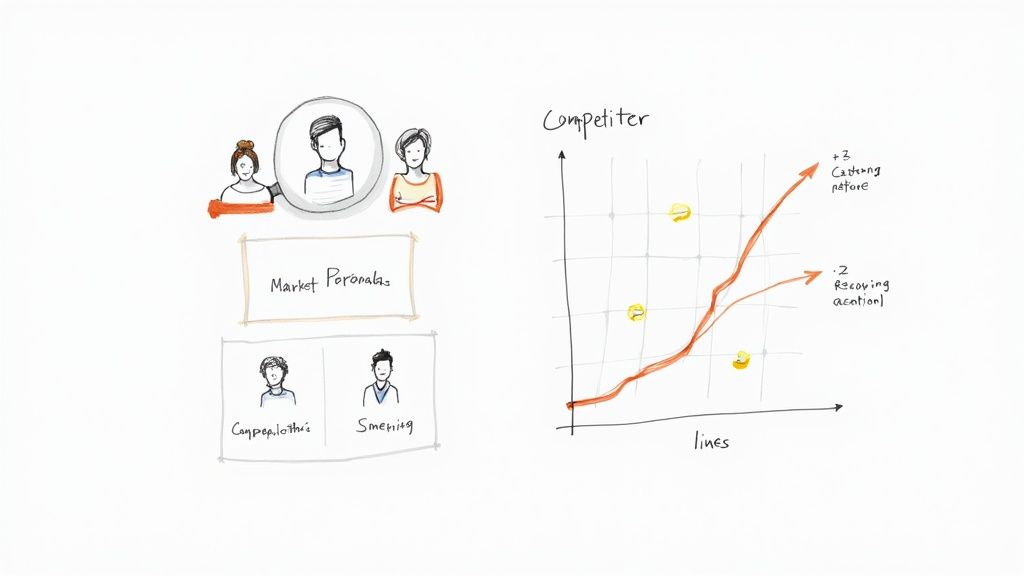
Think of Tesla’s entry into the electric vehicle market. They didn’t just build an electric car; their research identified that early adopters were not just eco-conscious but also desired high-performance, luxury vehicles. By focusing on performance, range, and design, they appealed to a premium segment that competitors had ignored, directly informing the Model S's successful launch.
How to Implement This Step
Your goal is to gather both quantitative and qualitative data to validate your assumptions. A multi-faceted approach prevents blind spots and provides a holistic view of the market. For a deeper dive into this critical first step, you can learn more about how to validate your business idea and ensure you're on the right track from the start.
- Customer Interviews: Speak directly with 20-30 potential customers. Ask open-ended questions like, "Walk me through how you currently handle [the problem your product solves]" to uncover their true pain points and workflows.
- Competitive Matrix: Create a detailed spreadsheet comparing your top 3-5 competitors. Go beyond features and pricing—analyze their customer reviews on G2 or Capterra to find recurring complaints that represent opportunities for you.
- Surveys & Analytics: Use tools like Google Trends to see if search interest for your solution is growing. Run a targeted survey on a platform like SurveyMonkey, offering a small incentive, to quantify market demand for a specific feature.
- Document Everything: Centralize your findings in a shared knowledge base (like Notion or Confluence) that the entire team can access. This document becomes the source of truth for product, marketing, and sales decisions.
2. Product Positioning and Messaging Strategy
Once you understand the market, the next critical step is to define your product's place within it. This involves developing a clear, compelling value proposition and messaging strategy that communicates how your product solves customer problems differently and better than alternatives. This narrative framework becomes the foundation for all your marketing, sales, and communication efforts, ensuring everyone on your team tells the same powerful story.
Think of Dropbox’s initial positioning. Instead of focusing on technical terms like "cloud synchronization" or "remote storage," their message was simply, “Your files, anywhere.” This actionable, benefit-focused approach was easy to understand and instantly conveyed the value to users, cutting through the jargon of competitors. This clear messaging was a cornerstone of their successful product launch checklist execution.
How to Implement This Step
Your goal is to craft a narrative that resonates deeply with your target audience by focusing on their problems, not just your features. This strategy, popularized by frameworks like Donald Miller's StoryBrand, ensures your message connects on an emotional and practical level.
- Start with the Customer Problem: Frame your entire message around the pain point you solve. For example, instead of "We offer real-time collaboration," say "Stop wasting time in endless email chains." Slack’s “Be less busy” is a perfect example of focusing on the outcome.
- Create a Messaging Hierarchy: Define your primary message (your one-liner), secondary points (key benefits), and tertiary points (specific features or proof points). This structure provides consistency. For example: Primary: "Effortless project management for small teams." Secondary: "Stay on schedule without the complexity." Tertiary: "Includes Gantt charts, task dependencies, and automated reminders."
- Test Your Messaging: Before finalizing, run a simple A/B test on a landing page with two different headlines or use a tool like Wynter to get feedback on your messaging from your target audience.
- Develop a Messaging Playbook: Document your positioning statement, value proposition, brand voice, and key messages in a central playbook. This guide ensures that everyone, from sales to support, communicates a consistent and compelling brand story.
3. Go-to-Market (GTM) Strategy Development
With a validated product and clear positioning, the next critical piece of your product launch checklist is a comprehensive go-to-market (GTM) strategy. This is your master plan detailing precisely how you will reach, acquire, and retain customers. It orchestrates all your launch activities, from pricing and sales channels to marketing campaigns and timelines, ensuring every effort is synchronized and aligned with your overarching business goals.
Think of Zoom's explosive growth. Their GTM strategy was centered on a powerful freemium model that eliminated friction for initial adoption. By making the core product free and easy to use, they fueled rapid, viral user acquisition, which in turn drove enterprise sales as organizations sought more advanced features and controls. This strategic approach was the engine behind their market dominance.
How to Implement This Step
A successful GTM strategy is a living document, not a one-time plan. It requires assigning clear ownership and building in flexibility to adapt based on early market feedback. For a more detailed guide, you can learn more about how to bring a product to market and structure your approach effectively.
- Define Launch Phases: Break your launch into stages. For instance: Phase 1 (Alpha): Internal testing only. Phase 2 (Closed Beta): Invite-only for 100 power users. Phase 3 (Public Launch): Open to everyone. Set clear goals for each phase, like "Achieve 80% weekly active users in beta before public launch."
- Map the Buyer Journey: Create a detailed flowchart of how a customer will move from awareness to purchase. For example: Awareness (social media ad) -> Consideration (reads a blog post) -> Decision (watches a demo video and signs up for a trial).
- Build a Reverse Timeline: Start with your target launch date (e.g., June 1st) and work backward in a project management tool like Asana. If the launch is June 1st, press outreach must begin by May 1st, and the final press kit must be ready by April 15th.
- Assign Clear Ownership: Every task in your GTM plan must have a Directly Responsible Individual (DRI). For example: "Social media teaser campaign: Owner = Jane Doe, Due Date = May 25th."
4. Pre-Launch Testing and Quality Assurance
A brilliant product idea can be completely undermined by a buggy or unstable launch. Pre-launch testing and Quality Assurance (QA) is the systematic process of validating your product’s functionality, performance, and usability before it reaches the market. This phase is your final line of defense against critical errors, ensuring the product meets quality standards and delivers a seamless customer experience, thereby preventing reputational damage and costly post-launch fixes.
Think of Microsoft's extensive Windows Insider Program. Before a major OS update is released to billions of users, it is first tested by millions of volunteers who identify bugs across an immense variety of hardware configurations. This large-scale beta testing catches major issues that internal QA teams might miss, preventing catastrophic launch failures and ensuring a more stable final product for the general public.
How to Implement This Step
The goal is to move beyond simple bug hunting and holistically validate the end-to-end user experience. This requires a structured approach that combines automated checks with real-world human feedback. A robust testing plan is a non-negotiable part of any serious product launch checklist.
- Implement a Hybrid Testing Model: Combine automated testing for core functionality (like login and checkout processes) with manual testing for usability. For example, have a team member try to complete a key task without any instructions to see where they get stuck.
- Establish a Beta Testing Program: Recruit 20-50 real customers using a tool like BetaList. Give them specific tasks to complete (e.g., "Create a new project and invite a team member") and ask for structured feedback via a survey.
- Create a Bug Tracking System: Use tools like Jira or Asana to log all identified issues. Each bug report should include clear steps to reproduce, the expected vs. actual result, severity level (e.g., Critical, High, Medium), and a screenshot or video recording.
- Define Quality Gates: Establish a non-negotiable checklist that must be completed before launch. For instance: "Zero known critical bugs," "Page load speed under 3 seconds on a standard connection," and "Successful completion of all 5 core user flows."
5. Sales Team Training and Enablement
Your product can be revolutionary, but if your sales team can't articulate its value, it will never reach its potential. This step involves equipping your sales representatives with the knowledge, tools, and confidence to sell the new product effectively from the moment it goes live. Comprehensive training ensures they understand the product's features, ideal customer profile, and unique selling proposition, turning them into credible, persuasive advocates for your launch.
Consider how Salesforce prepares its global teams for new feature rollouts. They don't just send an email; they deploy comprehensive certification programs in their Trailhead platform, including interactive modules, hands-on demos, and quizzes. This level of sales enablement ensures that every representative can expertly navigate customer conversations and position the new offering as the clear solution to their problems.
How to Implement This Step
The goal is to move beyond a simple feature overview and build true selling competence. A robust enablement strategy transforms product information into sales performance, which is a critical part of any successful product launch checklist. You can learn more about building a high-performing sales team with the right training to ensure they are ready for launch day.
- Host Interactive Training Sessions: Conduct role-playing sessions where one person acts as a skeptical customer raising common objections (e.g., "It's too expensive," "How is this different from Competitor X?"). This builds confidence and prepares the team for real-world calls.
- Develop Competitive Battle Cards: Create concise, one-page PDFs that summarize a competitor's strengths and weaknesses. Include specific talking points like, "When they say X, you say Y," to equip your team with effective responses.
- Create a Sales Playbook: Centralize all essential information in a digital playbook (e.g., in a shared Google Doc or Notion page), including ideal customer profiles, key messaging, demo scripts, and pricing details.
- Establish Ongoing Support: Set up a dedicated Slack channel like
#new-product-q&afor post-launch questions. Share early sales wins and the tactics used to achieve them to build momentum and spread best practices.
6. Marketing Campaign and Content Creation
With a solid product and a clear go-to-market strategy, the next step is to build and execute an integrated marketing campaign. This phase involves creating a diverse range of content designed to generate awareness, nurture interest, and drive demand across paid, owned, and earned media channels. This is a critical component of any product launch checklist; it's how you translate your pre-launch planning into tangible market excitement and initial customer acquisition.
Consider GoPro's launch strategy. They didn't just sell cameras; they built a movement around user-generated content. They created thrilling "Video of the Day" compilations shot by their customers, demonstrating the product's value in a more authentic and powerful way than traditional advertising ever could. This content-first approach was central to their rapid growth and market dominance.
How to Implement This Step
Your goal is to create a cohesive narrative that resonates with your target audience at every touchpoint. This requires a strategic blend of content formats and distribution channels tailored to your specific goals. You can find more comprehensive guidance by exploring these effective startup marketing strategies to ensure your campaign is built on a solid foundation.
- Start Early: Begin writing blog posts targeting your core keywords 3-6 months before launch to build SEO authority. This way, you'll already have organic traffic coming in on launch day.
- Build a Pre-Launch Email List: Create a simple landing page with a compelling headline like "The future of [your industry] is coming. Get exclusive early access." Use this to capture emails from interested prospects.
- Create Pillar Content: Develop one major asset, like a comprehensive "Ultimate Guide to [Your Topic]" e-book. Then, repurpose it into 10 blog posts, 20 social media updates, an infographic, and a webinar to maximize its reach.
- Implement the 70/20/10 Rule: Structure your content calendar so that 70% is helpful, educational content (how-to guides), 20% is community-focused content (customer stories), and only 10% is directly promotional ("Buy now!").
- Coordinate PR and Media Outreach: Align your launch day blog post, email announcement, and social media blitz to go live at the exact same time (e.g., 9:00 AM EST) to create a concentrated burst of activity and maximize visibility.
7. Customer Support and Success Infrastructure Setup
A product launch doesn’t end when the customer clicks "buy"; it begins. A robust customer support and success infrastructure is the safety net that catches users, answers questions, and turns initial friction into long-term loyalty. This phase involves setting up all the systems, documentation, and processes needed to help customers onboard successfully and resolve issues quickly. It’s a critical component of any product launch checklist, as a poor initial support experience can lead to immediate churn and negative reviews.
Consider how Intercom built its brand around proactive customer engagement. They didn't just offer a support ticket system; they created a customer communications platform that provides in-app guidance and proactive messaging. This infrastructure was key to their own launch, demonstrating the value of immediate, context-aware support and making it an integral part of their product's appeal.
How to Implement This Step
Your goal is to be prepared for the inevitable influx of customer inquiries from day one, ensuring every user feels heard and valued. Building this framework in parallel with product development is essential for a seamless launch. A well-prepared support system is one of the most effective strategies you can use, and you can learn more about how to reduce customer churn on pixelonelabs.com.
- Create Documentation Early: As developers build a new feature, have your support team create a corresponding help article with screenshots. This ensures your knowledge base is complete and accurate by launch.
- Establish Processes: Use a ticketing system like Zendesk or Help Scout to set up automated rules. For example, any ticket containing the word "billing" is automatically routed to the finance team, with a service-level agreement (SLA) of a 4-hour response time.
- Train Your Team: Hire and fully train support staff at least 2-4 weeks before launch. Have them handle tickets from your beta testers to gain real-world experience before the public launch.
- Implement In-App Guidance: Use tools like Appcues or Pendo to create a welcome tour for new users that highlights the three most important "first actions" they should take to experience the product's value.
8. Launch Event and Public Relations
A powerful product launch is more than just making a new item available; it's about creating a moment. This is where a well-orchestrated launch event and a strategic public relations campaign come into play. This phase is designed to generate significant buzz, attract media attention, and frame your product as a newsworthy story, transforming a simple release into a memorable industry event.

Think of Apple’s iconic keynotes. Steve Jobs didn't just announce the iPhone; he created a spectacle that captivated the world, generating massive earned media coverage and establishing the product as a cultural phenomenon before it even hit shelves. This approach builds credibility and excitement that paid advertising alone cannot achieve.
How to Implement This Step
Your goal is to build a narrative that journalists, influencers, and your target audience want to share. This requires meticulous planning, from crafting the message to managing the execution on launch day. A successful PR push is a key part of any comprehensive product launch checklist.
- Pre-Launch Briefings: Identify 10-20 key journalists and analysts who cover your industry. Offer them a one-on-one demo under embargo a week before launch. This gives them time to write a thoughtful story that can be published the moment you go live.
- Create a Compelling Press Kit: Assemble a digital press kit in a shared folder (e.g., Google Drive). Include a press release with a unique angle (e.g., "Company X launches first AI to solve Y problem"), high-res product screenshots, executive headshots, and your company logo.
- Strategic Event Timing: Schedule your launch announcement for a Tuesday or Wednesday morning around 10 AM EST. Mondays are too busy, and news cycles slow down by the end of the week. Avoid major holidays or industry conferences.
- Prepare Key Spokespeople: Create a one-page document with anticipated tough questions (e.g., "How are you different from Amazon?" "What about data privacy?") and draft clear, concise answers for your CEO.
- Launch Day Coordination: Create a specific hashtag like
#ProductXLaunchand use it across all social media. Schedule posts from your company, CEO, and key employees to all publish within the same 10-minute window to create a concentrated wave of buzz.
9. Performance Metrics and Launch Monitoring
You cannot optimize what you do not measure. Establishing key performance indicators (KPIs) and real-time monitoring dashboards is the crucial step that transforms a launch from a "fire and forget" event into a dynamic, data-driven operation. This phase is about defining success in quantifiable terms and creating the feedback loops necessary to react swiftly to real-world user behavior, ensuring your product launch checklist translates into measurable business outcomes.
Think of Amazon's meticulous tracking during Prime Day. They don't just launch the event; they monitor store performance, conversion rates, and server load in real-time in a "war room." This allows them to instantly identify a broken checkout link or spotlight a popular deal, optimizing the customer experience and maximizing revenue on the fly.
How to Implement This Step
The objective is to move from guesswork to informed decision-making by tracking a focused set of metrics that reflect the health of your launch. This involves setting up dashboards before launch day and establishing a clear cadence for reviewing the data. For a critical metric like customer acquisition, it's vital to have a clear understanding of your spending. You can learn more about how to calculate customer acquisition cost and ensure your launch is economically viable from the start.
- Define Core Metrics: Select 5-7 crucial KPIs. For a SaaS product, this could be: 1. New trial sign-ups, 2. Trial-to-paid conversion rate, 3. User activation rate (e.g., percentage of users who complete a key action within 24 hours), 4. Customer acquisition cost (CAC), and 5. Number of support tickets.
- Set Up Dashboards: Use a tool like Google Analytics or Mixpanel to build a real-time dashboard that displays your core KPIs. Make this dashboard visible on a large screen in the office or share a link in a company-wide Slack channel for transparency.
- Establish Baselines: If you have an existing product, track your core metrics for a month before launch to establish a baseline. This allows you to say, "Our launch drove a 200% increase in daily sign-ups above our normal average."
- Create Alert Systems: Set up automated alerts. For example, configure an alert in your analytics tool to send an email to the engineering team if the server error rate exceeds 1% for more than five minutes.
- Schedule Review Cadence: Implement a daily 15-minute stand-up meeting at 9 AM during launch week to review the numbers. Follow this with a weekly one-hour deep-dive for the first month to identify trends and decide on actions.
10. Post-Launch Optimization and Iteration Planning
The launch day is not the finish line; it’s the starting point for growth. Post-launch optimization is the systematic process of gathering data, collecting customer feedback, and running experiments to continuously improve your product and marketing. This iterative approach ensures you maintain momentum, adapt to user behavior, and steadily increase value over time, turning an initial release into a long-term success story.
Think of how Slack evolved. Its initial launch was just the beginning. The company meticulously analyzed user feedback and engagement data, leading to rapid iterations that refined the user experience, added crucial features like threads, and ultimately fueled its viral adoption. This commitment to continuous improvement is a core part of any effective product launch checklist.
How to Implement This Step
The goal is to establish a feedback loop where user insights directly inform product development and marketing priorities. This requires a structured, data-driven approach rather than relying on guesswork. A disciplined iteration cycle allows you to test hypotheses, learn quickly, and deliver enhancements that resonate with your audience.
- Establish Iteration Cycles: Implement short, two-week development sprints immediately after launch. This allows you to quickly ship bug fixes and small improvements based on early user feedback, demonstrating responsiveness.
- Create Feedback Channels: Use a tool to tag support tickets by feature request or complaint (e.g., "UI confusion," "request-for-integration-X"). Once a month, run a report to see which issues are most common and use this data to prioritize your roadmap.
- Run Concurrent A/B Tests: Immediately start testing key elements. For example, run an A/B test on your pricing page: Version A has three tiers, while Version B has a simplified two-tier structure. Let it run until you have a statistically significant result.
- Prioritize Ruthlessly: Create a simple impact/effort matrix. Plot potential changes on a 2x2 grid. Focus on the "High Impact, Low Effort" quadrant for quick wins in the weeks immediately following the launch.
- Document and Share Learnings: Maintain a "Launch Learnings" document in your shared knowledge base. For every experiment, record the hypothesis, result, and next steps. Share this widely to build a culture of continuous improvement.
10-Point Product Launch Checklist Comparison
| Task | Implementation Complexity | Resource Requirements | Expected Outcomes | Ideal Use Cases | Key Advantages |
|---|---|---|---|---|---|
| Market Research and Competitive Analysis | Medium–High: multi-method research and analysis | Moderate–High: research tools, analysts, budget, time | Customer segments, positioning gaps, market forecasts | New product or market entry, pricing and positioning decisions | Reduces launch risk; informs strategy and messaging |
| Product Positioning and Messaging Strategy | Medium: iterative workshops and testing | Low–Moderate: marketers, copywriters, customer tests | Clear UVP, message hierarchy, internal alignment | Differentiation in crowded categories; brand launches | Ensures consistent messaging; simplifies sales conversations |
| Go-to-Market (GTM) Strategy Development | High: cross-functional planning and sequencing | High: sales, ops, finance, channel partners, budget planning | Coordinated launch plan, milestones, KPI targets | Complex launches requiring channels and pricing strategies | Aligns teams; optimizes resource use; identifies bottlenecks |
| Pre-Launch Testing and Quality Assurance | Medium–High: extensive functional and performance testing | High: QA engineers, automation, beta testers, tools | Validated stability, security, usability; fewer post-launch issues | Mission-critical systems, high-scale apps, regulated products | Prevents launch failures; improves customer satisfaction |
| Sales Team Training and Enablement | Medium: curriculum build and delivery | Moderate: trainers, playbooks, demo environments, CRM setup | Faster ramp to quota, consistent pitches, higher win rates | B2B sales, complex products, partner/channel enablement | Accelerates revenue; improves close rates and confidence |
| Marketing Campaign and Content Creation | Medium: multi-channel content production and coordination | High: creative team, content production, ad spend, tools | Greater awareness, qualified leads, brand authority | Consumer launches, demand generation, lead acquisition | Drives demand and sustained interest; measurable performance |
| Customer Support and Success Infrastructure Setup | Medium: platform setup and process design | Moderate–High: ticketing, KB, trained support staff, tools | Faster onboarding, lower churn, structured feedback loop | SaaS/subscription products, high-touch onboarding needs | Improves retention; scales support; captures product feedback |
| Launch Event and Public Relations | Medium–High: event coordination and media outreach | Moderate–High: PR team, event production budget, spokespeople | Earned media, social buzz, broader public awareness | Flagship product reveals, investor/press-focused launches | Generates credibility and momentum; broad reach |
| Performance Metrics and Launch Monitoring | High: data instrumentation, dashboards, integrations | High: analysts, BI tools, analytics engineers, data sources | Real-time KPIs, early issue detection, data-driven responses | High-volume launches, ops-sensitive products, growth experiments | Enables rapid response; quantifies ROI and trends |
| Post-Launch Optimization and Iteration Planning | Medium: structured experiments and prioritization | Moderate: product, engineering, analytics, A/B tools | Improved PMF, conversion, retention, prioritized roadmap | Growth-stage products, continuous improvement cycles | Drives iterative improvements; uncovers new opportunities |
Launch Day is Just the Beginning
Navigating the complexities of a product launch can feel like piecing together an intricate puzzle. From initial market research and competitive analysis to post-launch optimization and iteration, each component is critical to forming the complete picture of success. This comprehensive product launch checklist serves as your blueprint, providing a structured, phase-based framework to ensure no detail is overlooked. It transforms a potentially chaotic process into a manageable, step-by-step journey, empowering you to move from ideation to market with confidence and clarity.
The true value of this checklist, however, lies not in simply ticking off boxes. It’s about instilling a disciplined approach that prioritizes strategy, preparation, and data. The most successful launches are not just well-executed events; they are the starting point for a continuous feedback loop. Remember, the goal isn't a flawless launch day-it's building a sustainable, customer-centric product that evolves and thrives.
Key Takeaways for Lasting Impact
As you move forward, keep these core principles at the forefront of your strategy:
- Preparation is Proactive, Not Reactive: The pre-launch phases, such as GTM strategy development and rigorous quality assurance, are your greatest assets. Addressing potential issues here, from messaging misalignment to software bugs, prevents costly post-launch corrections and protects your brand's reputation. A rushed pre-launch phase almost always leads to a reactive and stressful post-launch period.
- Alignment is Your Superpower: A product launch is a team sport. Your success hinges on the seamless alignment of your product, marketing, sales, and support teams. When your sales team is enabled with the right training and your customer support has the necessary infrastructure, the customer experiences a cohesive and positive journey from their very first interaction.
- Data is Your Compass: Launch day is not the destination; it’s the starting line for data collection. The performance metrics you establish are not just for reporting-they are your guide for what comes next. By diligently monitoring KPIs and actively seeking customer feedback, you can make informed decisions, prioritize your product roadmap, and build on your initial momentum.
Ultimately, this product launch checklist is more than a list of tasks-it's a framework for building a resilient, adaptable, and market-aware organization. By embracing this structured approach, you don't just launch a product; you lay the foundation for long-term growth and innovation. The initial splash is important, but the sustained ripples create lasting value. Keep this guide handy, stay agile, and prepare to turn your product vision into a market reality that endures.
Ready to transform your innovative idea into a market-leading product? The journey from concept to launch is complex, but you don't have to navigate it alone. At Pixel One, we specialize in building scalable digital solutions and partnering with businesses to execute flawless product launches that drive measurable growth. Book a consultation with Pixel One today to see how our expertise can bring your vision to life.