
10 Startup Marketing Strategies That Actually Work in 2025
Discover 10 actionable startup marketing strategies for 2025. This guide provides practical examples and insights to fuel your growth.In the fast-paced world of startups, growth isn't just a goal; it's a survival mechanism. But with countless channels and tactics available, identifying the right startup marketing strategies can feel overwhelming. Traditional playbooks often fall short, offering generic advice that fails to address the unique constraints and opportunities faced by new ventures: limited budgets, small teams, and the urgent need to find product-market fit. This guide cuts through the noise, moving beyond buzzwords to deliver a concrete, actionable framework for sustainable growth.
We're not talking about fleeting trends. We're diving deep into ten proven, powerful strategies that have propelled real startups from initial launch to market leadership. Each strategy is presented as a complete blueprint, designed for immediate application. You won't find vague theories here. Instead, you'll get:
- Practical implementation details to guide you from concept to execution.
- Real-world examples of companies that used these exact tactics to scale successfully.
- Actionable tips you can implement today, regardless of your current stage or budget.
This listicle is structured to be a comprehensive resource, exploring everything from foundational Content Marketing & SEO to the explosive potential of Product-Led Growth and viral loops. We'll cover community building, strategic partnerships, and high-impact launch campaigns. Whether you're a pre-seed founder bootstrapping your way to your first 100 users or a scaling startup ready to pour fuel on the fire, these insights will equip you to build a resilient, effective, and measurable growth engine. Let's get started.
1. Content Marketing & SEO
Content marketing is a long-term strategic approach focused on creating and distributing valuable, relevant, and consistent content to attract and retain a clearly defined audience. When combined with Search Engine Optimization (SEO), it becomes one of the most powerful and sustainable startup marketing strategies for driving organic growth. Instead of directly pitching your products, you provide genuinely useful information that solves your audience's problems, builds trust, and establishes your brand as a thought leader.
This strategy hinges on creating high-quality assets like blog posts, comprehensive guides, videos, and tutorials that answer the questions your potential customers are typing into search engines. By optimizing this content for specific keywords, you can rank higher in search results, attracting a steady stream of qualified traffic to your your website. For example, a project management tool could create a guide on "how to run an effective sprint planning meeting," attracting their ideal customer right when they are looking for a solution.

Real-World Examples
Several industry giants built their empires on this exact strategy. HubSpot grew into a multi-billion dollar company by becoming the go-to resource for all things inbound marketing through its blog and free tools. Similarly, Buffer famously scaled from 0 to 100,000 users primarily through consistent, high-quality blogging about social media management. SEO tool Ahrefs practices what it preaches, generating millions in revenue by creating in-depth content that ranks for highly competitive marketing keywords.
Actionable Tips for Implementation
- Target Long-Tail Keywords: Start by focusing on highly specific, longer search phrases (e.g., "how to create a content calendar for saas startup" instead of "content marketing"). Use a tool like AnswerThePublic to find questions your audience is asking.
- Prioritize Problem-Solving: Every piece of content should solve a specific pain point for your target audience. Create a "how-to" guide, a step-by-step tutorial, or a downloadable checklist that provides immediate value.
- Update and Refresh: SEO isn't a "set it and forget it" task. Once a quarter, review your top 10 blog posts in Google Analytics and update them with new data, examples, or screenshots to keep them relevant.
- Build an Internal Linking Web: When you publish a new article, find at least three older, relevant posts and add a link to your new one. This helps Google discover your content and understand its context.
- Focus on Quality Over Quantity: One well-researched, 2,000-word guide with custom graphics is far more valuable than five mediocre 400-word posts. Aim to create the single best resource on the internet for your chosen topic.
2. Product-Led Growth (PLG)
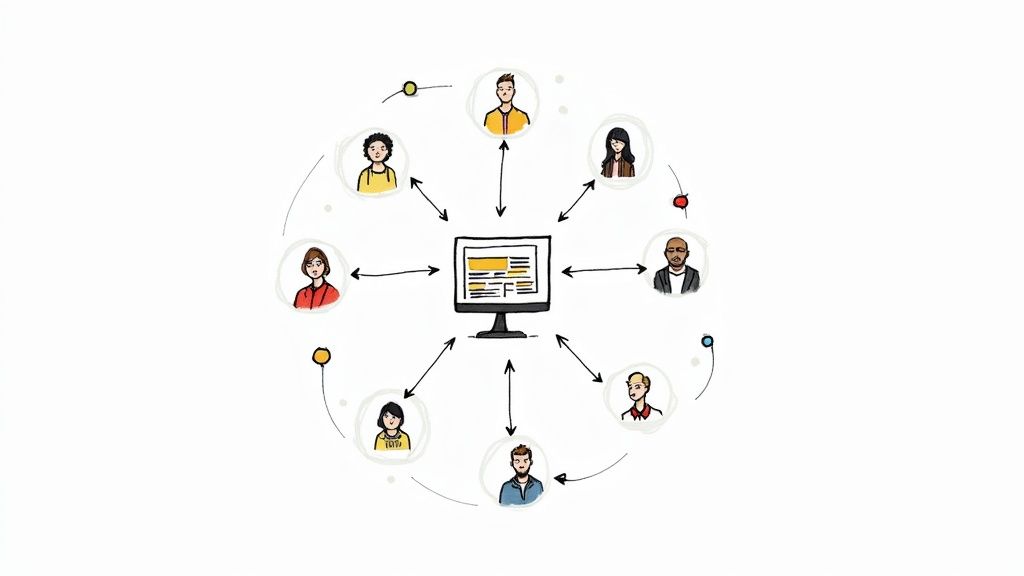
Product-Led Growth (PLG) is a go-to-market strategy that places the product itself at the core of the customer journey. Instead of relying on a traditional sales team to acquire and convert leads, PLG uses the product as the primary driver for customer acquisition, retention, and expansion. This approach typically involves a freemium or free trial model, allowing users to experience the product's value firsthand before committing to a purchase, making it one of the most effective startup marketing strategies for user-centric businesses.
This model reduces friction in the buying process and creates a powerful, scalable growth engine. When a product is intuitive, solves a clear problem, and delivers an exceptional user experience, it begins to sell itself. Users who find value are more likely to upgrade, become advocates, and share the product with their networks, creating a viral loop that fuels organic growth.
Real-World Examples
Many of today's tech giants were built on a PLG foundation. Slack became a billion-dollar company by enabling users to invite their entire team, creating viral expansion within organizations. Dropbox famously achieved 3900% growth in 15 months with its referral program that rewarded users with more storage for inviting friends. Similarly, Calendly grew organically by embedding itself into the user’s workflow; every meeting booked with Calendly exposes a new potential user to the product’s value.
Actionable Tips for Implementation
- Minimize Time-to-Value: Map out the exact steps a new user takes to get their first "win." For an invoicing app, this might be creating and sending their first invoice. Your goal is to get them there in under 5 minutes. Discover how to enhance this with effective strategies for product-led onboarding.
- Build in Viral Loops: Integrate sharing or collaboration features directly into the core product experience. For a design tool, this means adding a "Share with your team" button right next to the export function.
- Use Product Analytics: Install a tool like Mixpanel or Amplitude to track user behavior. Identify the one action that correlates with long-term retention (e.g., for Facebook, it was "adding 7 friends in 10 days") and optimize the onboarding to encourage it.
- Implement Strategic Upgrade Prompts: Place upgrade CTAs where a free user hits a limit. For a video tool, when a user tries to export a video longer than the free 5-minute limit, show a pop-up explaining the benefits of the paid plan.
- Focus on Solving One Problem Well: Your free offering should be exceptionally good at solving a specific, narrow pain point. For a project management tool, the free version could offer unlimited single-user projects but require a paid plan for team collaboration.
3. Growth Hacking & Viral Loops
Growth hacking is less of a channel and more of a mindset, a systematic process of rapid experimentation across marketing, product development, sales, and data analysis to identify the most efficient ways to grow a business. This approach is one of the most dynamic startup marketing strategies, emphasizing creative, low-cost tactics over traditional marketing budgets. A core component is the "viral loop," a mechanism where existing users bring in new users simply by using the product.
This strategy is built on a data-driven, test-and-learn methodology. Instead of relying on gut feelings, growth hackers formulate hypotheses, run structured experiments, and analyze the results to double down on what works and discard what doesn't. For example, they might test if changing an onboarding button from "Sign Up" to "Get Started Free" increases conversions by 10%. This relentless focus on a single "North Star" metric ensures that every action is geared towards tangible, exponential growth.

Real-World Examples
The history of Silicon Valley is filled with legendary growth hacks. Dropbox pioneered the two-sided referral program, offering free storage to both the referrer and the new user, which permanently increased sign-ups by 60%. Hotmail famously grew to 12 million users in 18 months by simply adding the signature "P.S. Get your free email at Hotmail" to the bottom of every user's email. More recently, Airbnb tapped into Craigslist's massive user base by creating a feature that allowed hosts to cross-post their listings with a single click.
Actionable Tips for Implementation
- Define Your North Star Metric: Identify the one key metric that best captures the core value your product delivers. For a music streaming app, it could be "minutes listened per week." Every experiment should aim to move this number.
- Build Virality In, Don't Bolt It On: Integrate referral and sharing mechanisms directly into the core user experience. A document editing tool could add a "Share for feedback" feature that requires the recipient to sign up to comment. You can learn more about integrating these features during product development for startups.
- Run Structured Experiments: Use a simple spreadsheet to track your tests. Columns should include: Hypothesis (e.g., "Changing the CTA to orange will increase clicks"), Metric, Timeline, and Result. This disciplined approach separates growth hacking from just "throwing ideas at the wall."
- Optimize the AARRR Funnel: Systematically analyze and improve every stage of the user journey: Acquisition, Activation, Retention, Referral, and Revenue. Start by running a user test to see where people get stuck in your sign-up process (Activation).
- Ensure Product-Market Fit First: Before trying to scale, send a simple survey to your active users asking, "How would you feel if you could no longer use our product?" If less than 40% answer "very disappointed," you likely need to improve your product before focusing on growth.
4. Social media marketing & community building
Social media marketing for startups has evolved far beyond simply broadcasting promotional messages. It's now a crucial strategy for building an engaged audience and fostering a genuine community around your brand. This approach focuses on creating authentic conversations, providing value, and cultivating strong relationships with potential and current customers, turning passive followers into loyal advocates.
This strategy is about creating spaces where your audience feels heard and can connect with each other, such as in dedicated Facebook groups, Slack channels, or Discord servers. By nurturing these environments, startups can gain invaluable feedback, increase customer loyalty, and build a powerful, self-sustaining marketing engine fueled by user-generated content and word-of-mouth. These community insights can be instrumental in shaping your product roadmap, aligning with the principles of effective UX design for startups.
Real-World Examples
The power of community-led growth is undeniable. Glossier built its billion-dollar beauty empire primarily through its Instagram community, leveraging user-generated content to drive authenticity and sales. Duolingo became a cultural icon with its unhinged, playful TikTok presence, creating a personality that resonated deeply with its target audience. Similarly, productivity tool Notion fostered thriving user communities on Reddit and Discord, where power users create and share templates, effectively marketing the product for them.
Actionable Tips for Implementation
- Focus, Don't Scatter: Choose one or two platforms where your target audience is most active. If you're targeting developers, spend your time on Twitter and Reddit, not Pinterest. It’s better to dominate one channel than have a weak presence on five.
- Engage Authentically: Dedicate 30 minutes daily to responding to every comment and mention. Ask open-ended questions in your captions like, "What's the biggest challenge you're facing with [your problem area] this week?"
- Empower Your Advocates: Create a private Slack or Discord channel for your top 20 most engaged users. Give them early access to features and ask for their feedback, making them feel like valued insiders.
- Use Feedback as a Guide: Create a simple system (like a Trello board) to log all product feedback and suggestions you receive from social media. Review it weekly with your product team.
- Create for Conversation: Design content that encourages sharing and discussion. For a finance app, post a poll asking, "What's your biggest savings goal right now? A) House B) Vacation C) Retirement." This prompts interaction beyond a simple "like."
5. Influencer & Partnership Marketing
Influencer and partnership marketing is a powerful approach centered on collaborating with individuals or complementary brands that have already earned the trust of your target audience. Rather than building a following from scratch, startups can leverage the credibility and reach of established voices to generate awareness and drive conversions. This strategy bypasses traditional advertising's noise by using trusted recommendations as the primary vehicle.
This tactic works by identifying influencers on platforms like Instagram, TikTok, and LinkedIn, or by forging co-marketing alliances with non-competing businesses. For example, a new fitness app could partner with a healthy meal delivery service to run a joint webinar on "Achieving Your Wellness Goals." This provides value to both audiences and is one of the most effective startup marketing strategies for quickly gaining social proof.
Real-World Examples
This strategy has created billion-dollar brands. Gymshark scaled its valuation to over $1 billion by building a community around fitness influencers, turning them into long-term brand ambassadors. Similarly, mattress company Casper partnered with lifestyle influencers to make its product an aspirational home essential. On the B2B side, Stripe's partnerships with platforms like Shopify created a seamless, integrated distribution network that fueled its massive growth.
Actionable Tips for Implementation
- Prioritize Micro-Influencers: Focus on creators with 10K-100K followers. Use a platform like Upfluence or SparkToro to find influencers whose audiences have a high engagement rate (over 3%) and match your customer demographic.
- Ensure Genuine Alignment: Before reaching out, audit a potential partner's last 20 posts. Do their values and content style genuinely match your brand? Do they promote competing products? A bad fit can do more harm than good.
- Grant Creative Freedom: Avoid overly scripted campaigns. Provide a one-page brief with key messaging points, a call-to-action, and "do's and don'ts," but let the creator produce content in their authentic style.
- Track Everything: Create a unique, memorable discount code for each influencer (e.g., "SARAH15"). This makes it easy for them to share and for you to track exactly how many sales each partnership drives.
- Build Long-Term Relationships: Instead of a one-off post, propose a 3-month ambassador program where the influencer creates a series of content. This fosters deeper brand advocacy and produces more authentic content over time.
6. Email Marketing & Automation
Email marketing is the highly strategic process of building a list of engaged prospects and customers and nurturing them through targeted, personalized communication. Far from being outdated, it remains one of the highest ROI startup marketing strategies available. Modern email marketing leverages sophisticated automation, segmentation, and behavior-triggered messages to deliver the right content to the right person at the right time, fostering relationships and driving conversions.
For a startup, an email list is a critical, owned asset. Unlike social media followings, you have direct, unfiltered access to your audience. For example, you can create a welcome email sequence that automatically sends new subscribers a series of five emails over two weeks, introducing your brand, sharing your best content, and presenting a special offer, nurturing them from cold lead to warm prospect.
Real-World Examples
Several major brands were built on the back of a strong email list. TheSkimm grew into a media empire that started as a single daily email newsletter, proving the power of a dedicated subscriber base. SaaS company Grammarly uses sophisticated, behavior-triggered emails to encourage product usage, sending users a personalized weekly report on their writing habits and common mistakes. Similarly, InVision nurtures its designer community with high-value educational content delivered directly to their inboxes.
Actionable Tips for Implementation
- Create Compelling Lead Magnets: Offer a valuable, specific resource like "The 10-Point Checklist for Launching a Successful Podcast" in exchange for an email. Use a tool like Canva to design it professionally in under an hour.
- Segment Your List: When users sign up, ask them one simple question, such as "What's your biggest challenge?" and tag them based on their answer. This allows you to send targeted content. For example, users who choose "finding clients" get different emails than those who choose "managing finances."
- Focus on List Quality: A small, engaged list is far more valuable than a large, unresponsive one. Every three months, use your email tool's features to remove subscribers who haven't opened your last 10 emails.
- Personalize and Humanize: Use the subscriber's first name in the subject line (e.g., "Sarah, a quick question...") and send emails from a real person's name and email address ("sarah@startup.com") to increase open rates.
- Mobile-Optimize Everything: Before sending, use a tool like Litmus or your email provider's preview function to ensure your email looks great on both iPhone and Android devices. Use a single-column layout and large fonts.
7. Paid Advertising & Performance Marketing
Unlike organic strategies that take time to build momentum, paid advertising offers immediate visibility and traffic by placing your message directly in front of a targeted audience. This approach uses platforms like Google Ads, Meta (Facebook/Instagram), and LinkedIn to drive specific actions. Performance marketing is the key discipline here, focusing relentlessly on measurable results like clicks, sign-ups, and sales, making it one of the most direct and scalable startup marketing strategies for rapid growth and market validation.
This strategy allows startups to quickly test messaging, validate target audiences, and drive conversions from day one. For instance, a startup can run two different Facebook ads—one focusing on a product feature and the other on a customer benefit—to see which message generates more sign-ups. This speed is crucial for iterating on your value proposition and understanding what resonates with potential customers.
Real-World Examples
Many of today's largest digital-native brands used paid channels as their primary growth engine. Shopify aggressively used Google Ads to capture high-intent searches like "create online store," dominating a lucrative bottom-of-funnel keyword. The project management tool Monday.com built massive brand awareness through persistent YouTube and display advertising campaigns. Similarly, Revolut leveraged highly targeted Facebook ads to acquire millions of users across Europe, optimizing campaigns for low-cost app installs.
Actionable Tips for Implementation
- Start with Small Test Budgets: Allocate a small, fixed budget, like $20/day, to test one channel (e.g., Facebook) with 2-3 different ad creatives and audience targets. Don't scale until you've found a profitable combination.
- Focus on High-Intent Keywords First: In Google Ads, begin with keywords that signal a clear intent to purchase, like "[your competitor] alternatives" or "best accounting software for small business." These often yield a better initial ROI.
- Use Dedicated Landing Pages: Use a tool like Unbounce or Leadpages to create a specific landing page for each ad campaign. The headline on the landing page should exactly match the headline in your ad to maximize conversions.
- Track Everything from Day One: Before launching, ensure your Meta Pixel or Google conversion tag is installed correctly on your website and thank you page. Test it to confirm that conversions are being recorded.
- Know Your Unit Economics: A campaign is only successful if your Customer Acquisition Cost (CAC) is sustainable relative to your Customer Lifetime Value (LTV). For a $50/month subscription, a CAC of $300 (6 months to payback) might be acceptable. You can learn more about calculating this crucial metric at pixelonelabs.com.
- Leverage Retargeting: Create a custom audience in your ad platform for people who visited your pricing page but didn't sign up. Run a specific ad to this group with a testimonial or a special offer to bring them back.
8. PR & Media Relations
Public Relations (PR) and media outreach are powerful startup marketing strategies focused on generating earned media coverage to build credibility, social proof, and brand awareness. Unlike advertising, where you pay for placement, PR involves convincing journalists, publications, and influencers to feature your startup because it's newsworthy. This earned trust is often far more impactful than a paid ad, as it comes with third-party validation from a reputable source.
The goal is to shape public perception by securing positive mentions in industry publications, podcasts, news sites, and other platforms your target audience trusts. For a startup, a single well-placed article in a major publication like TechCrunch can drive more high-quality sign-ups in one day than a month of paid advertising, providing a level of authority that is difficult to buy.
Real-World Examples
PR has been the launchpad for countless successful startups. Warby Parker built its brand on the compelling "Buy a Pair, Give a Pair" story, which was a natural fit for media outlets looking for positive, human-interest narratives. Airbnb used creative PR stunts and storytelling around its "Belong Anywhere" mission to generate massive media attention and overcome early regulatory hurdles. Similarly, Robinhood leveraged PR to perfection, positioning itself as a revolutionary force democratizing finance, a narrative that captivated both tech and financial press.
Actionable Tips for Implementation
- Build Relationships Early: Use Twitter Lists to follow 20-30 journalists in your industry. Engage with their work by sharing their articles and adding thoughtful comments long before you have anything to pitch.
- Create Newsworthy Angles: Your product launch isn't always news. Instead, pitch a story based on unique data your startup has collected, an interesting founder journey, or a contrarian take on a current industry trend.
- Prepare a Media Kit: Use a simple Dropbox or Google Drive folder. Include high-resolution logos, professional headshots of the founders, product screenshots, and a one-page fact sheet with key company information.
- Leverage HARO: Sign up for Help A Reporter Out (HARO). Spend 15 minutes each morning scanning the daily emails for relevant requests and send a concise, helpful response when you find a good fit.
- Craft a Perfect Pitch Email: Keep your subject line short and descriptive (e.g., "Story idea: New data on remote work trends"). The email body should be three paragraphs max: introduce the story, explain why it's relevant to their audience now, and provide a clear call to action.
9. Referral & Word-of-Mouth Programs
While organic word-of-mouth is powerful, a structured referral program is one of the most effective startup marketing strategies for systematically turning your happy customers into a scalable acquisition channel. This approach involves creating a formal system that incentivizes existing users to refer friends, family, or colleagues. By offering a clear, compelling reward for both the referrer and the new customer, you can engineer virality and drive exponential growth.
This strategy works because it leverages trust and social proof. A recommendation from a friend is infinitely more credible than a traditional advertisement. For example, a meal kit service offering "Give $30, Get $30" motivates both parties—the existing customer gets a discount on their next box, and the new customer gets a low-risk trial. This transforms your user base into an active, motivated sales force.
Real-World Examples
The history of startups is filled with legendary referral-driven growth stories. Dropbox famously achieved a 3900% growth in 15 months by offering free storage space to both the referrer and the new user. Uber and Lyft scaled rapidly by giving ride credits to both parties, creating a powerful incentive to share. Similarly, fintech app Robinhood attracted millions of users by gamifying its referral program, offering a free stock to both the existing and new user.
Actionable Tips for Implementation
- Offer Two-Sided Incentives: Make the value proposition clear and compelling for both sides. The "give $20, get $20" model is a proven success because it feels generous, not just self-serving.
- Reduce Sharing Friction: Place the referral link or code in a highly visible place within your app or user dashboard. Include pre-written message templates for one-click sharing via WhatsApp, Messenger, and email.
- Time Your Prompts: Use an in-app pop-up to ask for a referral immediately after a user completes a key action for the third time (e.g., completes their third project or makes their third purchase). This targets engaged, happy users.
- A/B Test Your Rewards: Use referral marketing software (like ReferralCandy or Rewardful) to test different offers. For a month, offer 50% of users a $10 credit and the other 50% a 20% discount on their next purchase to see which performs better.
- Promote the Program: Don't just build it and hope they come. Mention the referral program in your email newsletter footer, on your order confirmation page, and through occasional dedicated social media posts.
10. Strategic Launch Campaigns (Product Hunt, Hacker News, Beta Communities)
A strategic launch campaign leverages specialized online communities to create a concentrated burst of attention and momentum for your product. Platforms like Product Hunt, Hacker News, and specific Reddit subreddits are filled with tech-savvy early adopters actively looking for new tools. A successful launch on these sites isn't just about traffic; it's a powerful startup marketing strategy for gaining initial users, valuable feedback, and significant social proof in a single day.
This approach works by tapping into existing, highly engaged audiences rather than trying to build one from scratch. A top-ranking launch on Product Hunt can lead to thousands of signups, media coverage, and investor interest, effectively kickstarting your growth engine. It's a high-stakes, high-reward tactic that can put a new startup on the map almost overnight by creating a powerful narrative and a sense of discovery among influential users.
Real-World Examples
Notion cemented its position in the crowded productivity space with multiple #1 Product of the Day wins on Product Hunt, driving massive waves of adoption. Loom used its Product Hunt launch in combination with a generous freemium model to achieve rapid, viral growth. Similarly, Superhuman created immense buzz and a long waitlist with its polished Product Hunt presence, positioning itself as an exclusive, high-demand product from day one.
Actionable Tips for Implementation
- Prepare Meticulously: A month before your launch, start participating in the target community. On Product Hunt, comment on other products. On Reddit, share valuable advice in your target subreddits. This builds credibility.
- Craft an Authentic Story: For your first comment on Product Hunt, don't just list features. Use the "Problem, Agitate, Solution" framework. Explain the pain point you experienced, why existing solutions fell short, and how your product uniquely solves it.
- Engage All Day: Block your entire calendar for launch day. Set up alerts for every new comment and aim to reply within 5-10 minutes. This shows you're engaged and builds momentum.
- Rally Your Network (Ethically): Create a shareable asset for your network (e.g., a pre-written tweet) but instead of asking for upvotes, ask them to "join the conversation" in the comments. This drives engagement, which is a key ranking factor.
- Offer an Exclusive Deal: Create a special offer like "50% off for life for the Product Hunt community" to create urgency and incentivize immediate signups. Mention it clearly in your first comment and on your website. You can learn more about how to bring a product to market on pixelonelabs.com.
Startup Marketing Strategies Comparison Matrix
| Strategy | Implementation Complexity | Resource Requirements | Expected Outcomes | Ideal Use Cases | Key Advantages |
|---|---|---|---|---|---|
| Content Marketing & SEO | Medium - requires content skill | Low to Medium - writers, SEO tools | Long-term organic traffic growth | Building brand authority and trust | Cost-effective, sustainable, trust-building |
| Product-Led Growth (PLG) | High - product and engineering | Medium to High - product development | Faster acquisition, viral growth | SaaS/self-service products | Low CAC, scalable, self-selling product |
| Growth Hacking & Viral Loops | High - requires analytics and tests | Low to Medium - cross-functional teams | Rapid and experimental growth | Startups needing fast growth | Low cost, innovative, measurable |
| Social Media Marketing & Community | Medium - ongoing community effort | Low - mostly time investment | Engaged, loyal audience | Brands building customer relationships | Organic reach, brand loyalty, low cost |
| Influencer & Partnership Marketing | Medium - partner management | Low to High - depends on influencer | Rapid awareness and credibility | Consumer products, lifestyle brands | Access to engaged audiences, third-party trust |
| Email Marketing & Automation | Medium - setup and content creation | Low - inexpensive tools | High ROI, direct conversions | Nurturing leads and customers | Highest ROI, direct communication |
| Paid Advertising & Performance | Medium - ad setup and optimization | Medium to High - ad budget | Immediate traffic and conversions | Rapid market testing and scaling | Fast results, precise targeting |
| PR & Media Relations | Medium - relationship building | Low to Medium - can DIY or agencies | Credibility, brand authority | Startups seeking media exposure | Third-party validation, low cost |
| Referral & Word-of-Mouth Programs | Medium - technical setup and rewards | Low to Medium - incentives and tools | High-quality leads, compounded growth | Products with existing satisfied users | Lower CAC, scalable, high LTV customers |
| Strategic Launch Campaigns | Medium to High - prep and timing | Very Low - mostly time investment | Burst of awareness and early users | New product launches, tech startups | Concentrated attention, social proof |
From Strategy to Execution: Building Your Startup's Growth Engine
Navigating the landscape of startup marketing can feel like assembling a complex engine without a manual. We've explored a comprehensive suite of ten powerful startup marketing strategies, from the foundational pillars of Content Marketing and SEO to the explosive potential of Growth Hacking and the community-centric power of Product-Led Growth. Each strategy offers a unique pathway to acquiring, engaging, and retaining customers. Yet, the true art of startup marketing isn't in mastering a single tactic; it's in the intelligent synthesis of several.
The most successful founders and marketers don't view these strategies as items on a checklist. Instead, they see them as interconnected gears in a larger growth machine. Your goal is not to do everything at once. It's to identify the one or two strategies that provide the most leverage for your specific product, market, and growth stage, and then execute them with relentless focus.
Your Actionable Blueprint for Growth
So, where do you begin? The journey from a list of ideas to a functioning growth engine requires a deliberate, iterative process. Abstract knowledge becomes a competitive advantage only when it is applied, measured, and refined.
Here are your immediate next steps:
Conduct a Strategy-to-Market Fit Audit: Re-evaluate your product and ideal customer profile against the strategies we've discussed. Is your product inherently collaborative and shareable? A viral loop or referral program might be your starting point. Is it a complex B2B solution for a niche audience? Deep-dive content marketing and targeted PR will likely yield the best results. A direct-to-consumer brand might find its initial traction through influencer marketing and building a vibrant social media community.
Select Your "Keystone" Strategies: Based on your audit, choose no more than two primary strategies to focus on for the next 90 days. This focused approach prevents resource dilution and allows you to achieve meaningful momentum. For example, a new SaaS startup could combine a strategic Product Hunt launch with an intensive pre-launch email marketing campaign to build an initial user base and gather critical feedback.
Define Your Minimum Viable Test (MVT): For each chosen strategy, outline the smallest possible experiment you can run to validate its potential. Instead of launching a massive blog, can you write three high-intent articles targeting a specific pain point? Before committing to a large influencer budget, can you partner with five micro-influencers to test messaging and audience response? The goal is learning, not perfection.
The Unifying Principle: Product is King
Ultimately, the most potent lesson from these diverse startup marketing strategies is that your product remains your single greatest marketing asset. A remarkable product simplifies every marketing effort. A product with built-in growth loops, like Dropbox’s referral system, markets itself. A product that delivers an exceptional user experience, like Slack, fuels word-of-mouth organically.
This is why marketing can't be an afterthought bolted on after development is complete. It must be woven into the very fabric of your product from the initial concept. When your user onboarding is seamless, your features are inherently shareable, and your value proposition is crystal clear from the first interaction, you create a powerful, self-sustaining growth engine. The strategies discussed in this article act as the fuel, but a well-designed product is the engine itself. By embracing this holistic view, you move beyond simply promoting a product and begin building a brand that customers not only use but champion.
Ready to build a product with marketing and growth embedded from day one? At Pixel One, we specialize in designing and developing digital products that are engineered for success. We partner with startups to create exceptional user experiences and integrate the very growth mechanisms discussed in this guide. Visit us at Pixel One to see how we can help you build the engine for your market breakthrough.