
A Guide to the Digital Product development Process
Master the digital product development process with this step-by-step guide. Learn proven strategies to turn your idea into a successful product.Bringing a digital product to life is a journey, not just a single event. It starts with a spark of an idea and moves through a structured process that turns that concept into a real solution people can use. Think of it as a cycle of strategy, design, development, testing, and launch—a proven path to make sure what you're building actually solves a problem for a real audience.
Unpacking the Digital Product Development Process
It’s easy to think of product development as a straight line, but it’s much more like building a custom home. You wouldn't just show up with a hammer and some wood. You’d start with blueprints, think carefully about who will live there, and check every single detail before you even think about handing over the keys. A great digital product needs that same level of care and planning.
This entire framework is what keeps a great idea from becoming just another failed project. It’s the bridge between an abstract concept and a concrete, valuable tool. When teams skip these critical stages, they often end up building something nobody wants, burning through time and money in the process.
Why a Structured Process Matters
Having a roadmap matters. It brings order to what can be a pretty chaotic undertaking, making sure everyone—from developers to marketers—is pulling in the same direction. When you stick to a proven process, you start to see some serious advantages.
Here’s what a good process brings to the table:
- Reduced Risk: You get to test your ideas and challenge your assumptions early on. For example, instead of building a full-scale social media app, you can create a simple prototype to see if people will even engage with its core feature. This drastically cuts the chances of building a product that flops.
- Improved Efficiency: With a clear plan, your team isn't wasting time on dead-ends. Everyone knows what to focus on, which means you can get to market faster.
- Enhanced User Satisfaction: By putting the user at the very heart of every decision, you create a product that feels intuitive, adds real value, and is a genuine pleasure to use. Think about how Slack's design simplifies team communication—that's a direct result of focusing on the user.
- Greater Scalability: A product built on a solid foundation is much easier to grow. Adding new features or handling more users down the road becomes a planned evolution, not a frantic scramble.
For new companies, getting this cycle right is everything. It's often the difference between flaming out and finding sustainable growth. We dive deeper into this in our guide on product development for startups.
The whole point of the digital product development process isn’t just to ship a product. It's to create a cycle of learning and improvement that consistently delivers value to users and hits your business goals.
Building Your Strategic Blueprint
Every great digital product starts long before anyone writes a single line of code. It begins with a simple but powerful question: 'What problem are we actually solving, and who are we solving it for?' This first strategic phase is everything. It's the blueprint that keeps your project on track and prevents you from making expensive mistakes later.
Think of it like building a house. You wouldn't just start throwing up walls and hope for the best, right? You'd start with a solid foundation and a detailed architectural plan. Skipping this step in product development is just as risky. The goal here is to anchor every single decision you make—from design choices to feature priorities—in a rock-solid understanding of your market and your users.
Defining Your Target User and Their Problem
Before you can build the right solution, you have to get inside the head of the person who will use it. This goes way beyond basic demographics like age and location. It’s about digging deep to uncover their real motivations, frustrations, and the little daily struggles they face. This is where market research and creating user personas come into play.
A user persona is essentially a detailed, semi-fictional profile of your ideal customer. It’s a tool that brings your target audience to life, making them feel like a real person your team can rally around and build for.
Let's imagine we're building an app called MealPlanPro. The initial idea is pretty straightforward: an app for meal planning. But who is it for? Through surveys, interviews, and even just reading competitor reviews, we start to see a clear user emerge.
- Persona Example 'Busy Brian':
- Who is he? A 32-year-old marketing manager who works long hours and is always on the go.
- What are his goals? He genuinely wants to eat healthier and save some money by cooking at home, but he feels completely overwhelmed by the process.
- What are his pain points? He has zero time to hunt for recipes, make shopping lists, and figure out a whole week of meals. More often than not, he gives up and orders expensive, unhealthy takeout.
Suddenly, with 'Busy Brian' in mind, the MealPlanPro team isn't just building a generic app anymore. They're on a mission to solve a specific problem for a specific person.
Crafting a Compelling Value Proposition
Okay, so you know who you're building for and what their problem is. Now you have to spell out exactly how your product solves that problem better than anything else out there. This is your value proposition. It should be a clear, punchy statement that communicates the unique benefit you're offering.
For MealPlanPro, a weak value proposition would be something like, "An app for meal planning." It's true, but it's boring and doesn't grab anyone. A strong one, however, gets right to the point:
MealPlanPro generates personalized weekly meal plans and shopping lists in under 60 seconds, helping busy professionals eat healthy, save time, and reduce food waste.
See the difference? This statement is powerful because it speaks directly to Brian's pain points (no time, wants to be healthy) and shines a spotlight on the unique benefit (speed and personalization). This kind of clarity is absolutely vital for guiding the entire development process, especially in the early days. If you're curious about how this applies to getting a first version out the door, see what an expert MVP development company focuses on.
Setting Clear Goals and Success Metrics
A strategy without a way to measure it is just a dream. To know if you're actually succeeding, you need to define Key Performance Indicators (KPIs) that tell you whether you're moving in the right direction. These goals can't be vague; they must be specific, measurable, and tied directly to what you want the business to achieve.
For our MealPlanPro app, a huge KPI would be user engagement. So, a concrete goal might sound like this: Achieve 10,000 monthly active users (MAUs) within six months of launch. A single, clear metric like this focuses the entire team's effort on building features that get people to sign up and keep coming back.
The strategic groundwork you lay here has a massive impact on your chances of success. It’s not just a hunch—research shows that top innovators hit a product success rate of 76%, while companies with weaker strategies lag behind at around 51%. That gap proves just how critical this initial planning phase really is. For more on this, check out these product development statistics on StudioRed.com. Your strategic blueprint isn't just a formality; it's the single most important step in building a product people will actually love and use.
Phase 2: Designing an Intuitive User Experience
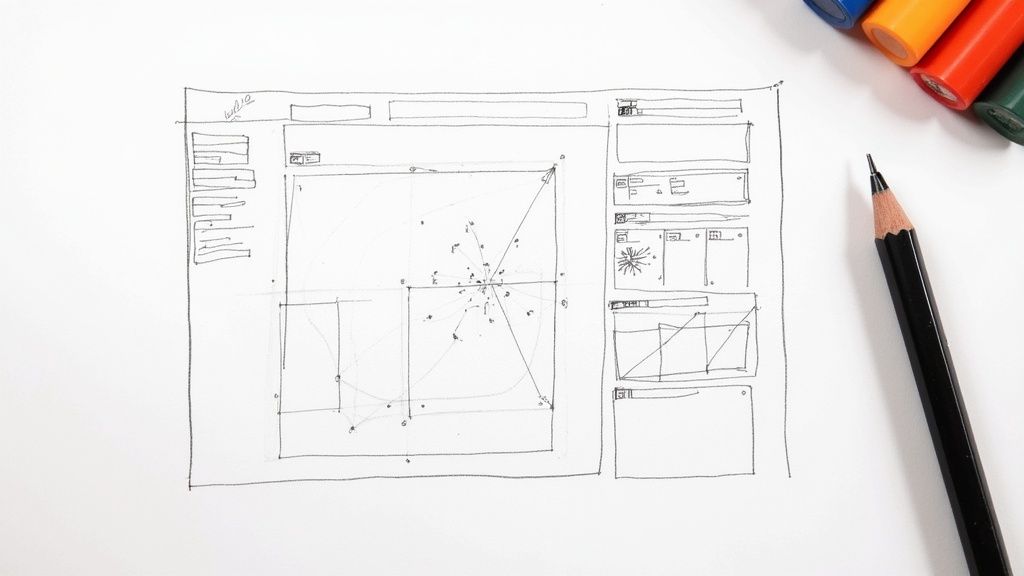
Alright, with a solid strategy in place, it’s time to start giving your idea some real shape and form. This is the part of the digital product development process where we translate all that research and those user personas into something people can actually see and interact with.
This phase is all about design, but it’s really two sides of the same coin: User Experience (UX) and User Interface (UI).
I like to explain it like this: think of building a house. UX is the architectural blueprint. It dictates the flow—where the rooms go, how you move between them, and whether the layout makes practical sense for the people living there. UI, on the other hand, is the interior design. It’s the paint colors, the furniture, the light fixtures—everything that makes the house look and feel good. A house can look stunning (great UI) but be a nightmare to live in (bad UX). To create a product people love, you absolutely need both.
The Core of UX Design
User Experience is the invisible scaffolding that holds up a great product. The main goal here is to make the user’s journey feel effortless, logical, and maybe even a little enjoyable. It's less about pretty pictures and more about empathy—getting inside your user's head to understand what they need to do and then clearing any obstacles from their path.
A solid UX process always comes back to a few fundamental questions:
- Is it useful? Does this product actually solve a real-world problem for our target user, 'Busy Brian'?
- Is it usable? Can Brian figure out how to generate a meal plan on his own, without needing a step-by-step manual?
- Is it accessible? Can someone with different abilities navigate and use the product just as effectively?
Nailing the answers to these questions is what separates a product that’s just technically functional from one that people can't live without.
From Low-Fidelity Wireframes to High-Fidelity Mockups
Design isn’t a one-and-done task; it’s a journey from a rough sketch on a napkin to a polished, pixel-perfect product. This process relies on a few key deliverables, each building on the last.
Wireframes: These are the bare-bones blueprints of your product. Think simple lines and boxes with no color or fancy graphics. Their only job is to map out the structure, the placement of key elements, and how a user will move from one screen to the next. For our MealPlanPro app, a wireframe would simply show where the "Generate Plan" button sits and how the recipe list is laid out. It’s a fast, cheap way to test the core logic before getting bogged down in visual details.
Mockups: Once everyone agrees on the blueprint, the designers create a static, high-fidelity mockup. This is a full-color, but non-interactive, picture of what the final product will look like. It pulls in the typography, color palette, and branding, giving everyone a clear vision of the end goal. This is where the UI really starts to shine.
Prototypes: A prototype is where it all comes together. It’s an interactive mockup that you can click, tap, and swipe through, simulating the real product experience. This is pure gold for usability testing. You can sit down with actual users, watch them interact with the prototype, and spot confusing navigation or clunky layouts before a single line of code gets written.
Good design is not just about making things look good. It's about creating an experience so intuitive that the user doesn't even have to think about it. The interface becomes an extension of their intent.
This step-by-step design process is a massive time and money saver. Fixing a flawed user flow in a wireframe takes a few minutes; changing it after the code is already built can take weeks.
If you’re trying to improve a product that’s already live, running a comprehensive UX design audit can be incredibly revealing, often uncovering hidden usability issues that are hurting your growth. At the end of the day, putting the user at the heart of the design process ensures you build something that isn't just beautiful, but truly effective.
Phase 3: Bringing Your Product to Life with Agile Development
This is where the rubber meets the road—the stage where all the strategy sessions, wireframes, and design mockups finally start turning into a real, working product. In the old days, development was a rigid, step-by-step process. You couldn’t start one phase until the last one was signed, sealed, and delivered. Today, that model is a recipe for falling behind. The best teams build with flexibility and speed.
At the core of this modern approach is Agile development. Instead of trying to build the entire product in one massive, months-long push, Agile breaks the work into small, manageable chunks. This way, teams can build, test, and get feedback in short cycles, ensuring the product they’re building is actually what users want and need.
Why Agile Beats Old-School Methods
The traditional "Waterfall" method is like building a house from a blueprint that’s set in stone. You plan every single detail upfront, and if you decide you want to move a wall halfway through construction, it’s a costly, disruptive nightmare.
Agile, on the other hand, is more like tending to a garden. You plant a few things, see how they grow, get some feedback on the layout, and adjust your plan as you go. Maybe the tomatoes need more sun, or the path would look better over there. You adapt.
This flexibility is non-negotiable in today’s market. Things change fast. A great idea from six months ago might be irrelevant today. That’s why the best product teams operate in a continuous loop: discover, build, measure, and refine. They ship small updates, see how users react, and use that data to decide what to do next. This approach minimizes wasted time and dramatically lowers the risk of building something nobody wants.
To get a clearer picture, let's compare the two approaches side-by-side.
Waterfall vs Agile Development At a Glance
The table below breaks down the fundamental differences between the rigid Waterfall model and the adaptive Agile framework.
| Aspect | Waterfall Model | Agile Model |
|---|---|---|
| Structure | Linear and sequential; one phase must finish before the next begins. | Iterative and incremental; work is done in small, repeatable cycles. |
| Flexibility | Very rigid. Changes are difficult and expensive to implement mid-project. | Highly flexible. Changes are welcomed and can be incorporated between cycles. |
| Testing | Occurs at the very end of the development process, just before release. | Integrated throughout the lifecycle; each small piece is tested as it's built. |
| Feedback Loop | Feedback is gathered only after the final product is delivered. | Continuous feedback from stakeholders and users is collected after each cycle. |
| Pace | Slow and deliberate, with one big launch at the end. | Fast-paced with frequent, small releases that deliver value incrementally. |
As you can see, Agile isn't just a different process—it's a completely different mindset focused on adaptation and continuous improvement.
The diagram below shows the technical flow that happens within each of these Agile cycles.
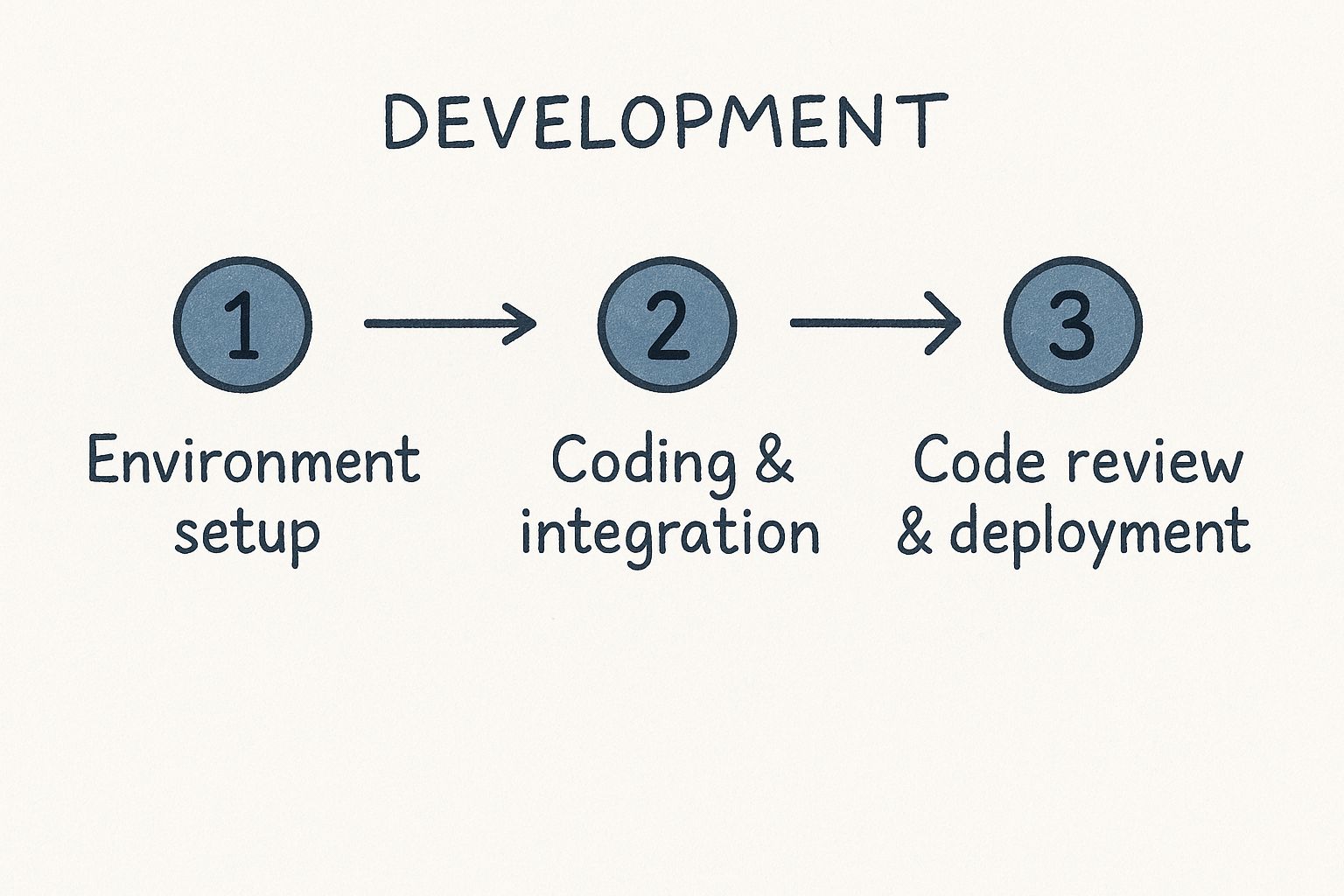
It’s not chaos. Each cycle is a well-oiled machine of coding, testing, and reviewing that repeats for every new feature.
Breaking Down the Agile Workflow
So how does this all work in practice? Agile isn't just a vague concept; it's a framework with specific components that keep everything moving forward smoothly.
Here are the key parts of the machine:
- Sprints: These are short, focused work periods—usually 1 to 4 weeks—where the team commits to completing a specific chunk of work. At the end of each sprint, they have a tangible, working piece of the product to show for it.
- Backlog: This is simply a prioritized to-do list for the entire product. It contains every feature, bug fix, and improvement that needs to be done. The product owner constantly grooms this list to make sure the team is always working on what matters most.
- User Stories: Instead of writing dense, technical requirement documents, Agile teams use user stories. These frame tasks from the customer's point of view, making it clear why something is being built. The format is simple: "As a [type of user], I want [an action] so that [a benefit]."
Let’s go back to our MealPlanPro app. A user story for the development team might sound like this:
"As a busy professional, I want to generate a weekly meal plan in under one minute so I can save time on planning."
This simple sentence is pure gold for a developer. They’re not just building a "plan generator." They’re solving a real user's problem—the need for speed and convenience—which directly influences how they write the code.
Choosing Your Technology Stack
While Agile tells you how you're going to build, the technology stack defines what you'll build with. This stack is the collection of programming languages, frameworks, and tools that will power your product. Making the right choice here is critical, as it impacts everything from performance and scalability to how expensive it is to maintain down the line.
Don't worry, you don’t need to be a top-tier engineer to grasp the basics. The goal is to pick technologies that fit your product's needs. For example, if MealPlanPro is expected to have millions of users, the team needs a database like PostgreSQL that won't buckle under that kind of pressure. If the goal is to launch on both iOS and Android at the same time, a cross-platform framework like React Native is probably the smart move.
Picking a tech stack isn't about chasing the latest shiny new toy. It's a strategic decision that balances your immediate needs with your long-term vision. This is where partnering with a team experienced in a range of digital product development services can be invaluable, helping you make a choice that sets your product up for success right from the start.
Ensuring Quality Through Rigorous Testing
Even the most brilliant product idea can be completely torpedoed by bugs, crashes, and sluggish performance. That’s why the Quality Assurance (QA) phase isn't just a final checkbox to tick off; it's a critical stage that safeguards the user experience and, ultimately, your brand's reputation.
Think of it like the final inspection on a new house. You wouldn't move your family in before an expert has given the all-clear on the plumbing, electrical systems, and foundation. QA is that expert inspection for your digital product.
This isn't about pointing fingers at developers for mistakes. It's a team effort to make the product as strong as possible. The goal is simple: find and squash problems before your customers do. A single, nagging bug can be enough to erode trust and send users straight to your competitors.
The Different Layers of Product Testing
Testing isn't a one-and-done deal. It's a multi-layered process, with each type of test looking at the product from a different angle to make sure everything is rock-solid. Just like a car goes through separate tests for its engine, brakes, and airbags, a digital product needs a whole battery of checks.
Here’s a look at the most common types of testing:
- Unit Testing: This is the most microscopic level. Developers test individual components or "units" of code to make sure each one does its job correctly on its own. It's like checking every single brick before you start building a wall.
- Integration Testing: Once we know the individual bricks are solid, integration testing checks how they work together. Do different features cause conflicts when they interact? For example, does the "Add to Shopping List" feature correctly update inventory when a user checks out? This makes sure all the bricks fit together to form a stable structure.
- Performance Testing: Here, we put the product under stress to see how it holds up. How quickly does the app load when thousands of people are using it at once? This ensures your product stays fast and responsive, even when it's popular.
- Usability Testing: This one is all about the user experience. We watch real people try to use the product to see if they can navigate it easily and accomplish what they need to without getting frustrated. It’s the ultimate reality check for your design.
Catching problems during these early testing stages is way cheaper and easier than trying to fix them after the product is already live.
The Final Walkthrough: User Acceptance Testing
After the internal team has done all its technical checks, it’s time for the moment of truth: User Acceptance Testing (UAT). This is the last quality checkpoint before launch, where the product is put in the hands of actual users from your target audience.
This is the final walkthrough with the homebuyer before they take the keys. It’s not about what the builder thinks anymore; it's about whether the house meets the buyer's expectations.
For our MealPlanPro app, UAT would mean giving a beta version to a group of busy professionals who fit our target customer profile. We wouldn't hand them a script. Instead, we’d just ask them to try and plan their weekly meals.
UAT in Action: A beta tester for
MealPlanProtries to generate a vegan meal plan for the week. They might report that the filter for dietary preferences is confusing, or that the app lags when they add more than five recipes to their shopping list. This is the kind of priceless, real-world feedback that internal testing can easily miss.
This kind of feedback is gold. It shifts the question from "Does it work?" to "Does it work for you?" A product can pass every technical test with flying colors, but if it doesn't meet the real needs and expectations of its users, it's still a failure. UAT is your last line of defense to make sure you’ve truly built the right solution for the right problem.
Launching and Scaling for Long-Term Success
Getting to launch day feels like a massive accomplishment. But here’s the truth: it’s the starting line of a marathon, not the finish. A successful launch isn't just about flipping a switch and hoping for the best. It’s a carefully orchestrated event that pulls together marketing, customer support, and your technical team.
Think of it like opening a new restaurant. You wouldn't just unlock the doors and wait. You'd have your staff trained, the menu perfected, and a marketing blitz to build excitement. The same goes for a digital product. You need polished app store listings, compelling marketing assets, and a support team ready for that first wave of user questions.
The Continuous Feedback Loop
Once your product is out in the wild, the real work begins. The products that truly succeed are the ones that adapt based on how people actually use them, not on how the team assumed they would. This is where the ‘build, measure, learn’ feedback loop becomes your engine for growth.
It’s a simple but incredibly powerful cycle:
- Build: You push a new feature or an improvement live. For example, Netflix notices users are dropping off, so they build and release an "auto-play next episode" feature.
- Measure: You dive into analytics to see how users are interacting with it. Netflix tracks how many people let the next episode play versus those who stop it.
- Learn: You analyze the data and user feedback to figure out what to do next. The data shows a massive increase in binge-watching, so they double down on features that support this behavior.
This isn’t just a process; it's a mindset. It turns guesswork into a data-informed strategy and is the heart of any modern digital product development process.
Leveraging Data for Smart Decisions
To make that feedback loop spin, you have to get comfortable with your data. Tools like Google Analytics, Mixpanel, or Hotjar become your eyes and ears, showing you exactly what people are doing inside your product.
You'll want to keep a close eye on a few key metrics:
- User Engagement: Are people using the features you spent months building? Where do they spend their time?
- Conversion Rates: Are users completing critical actions, like signing up or buying something?
- Retention Rate: This is the big one. Are people coming back after their first visit? High retention is the clearest sign you've built something valuable.
Data is also your secret weapon for creating a stellar onboarding experience. A smooth first-time user journey can make or break your retention numbers. We cover how to nail this in our guide to product-led onboarding.
Scaling Your Product for Growth
As your user base expands, you'll run into a new set of "good problems." The server setup that worked perfectly for 1,000 users might start to creak and groan under the load of 100,000. Scaling is all about getting your product—both technically and operationally—ready to handle that growth without sacrificing performance.
The goal of scaling isn't just to get bigger; it's to grow smarter. It means making strategic improvements that support a larger audience while maintaining the quality and speed your early adopters loved.
This commitment to a robust development process pays off in real numbers. Industrial companies that invest in digital products see an average efficiency boost of 19% over five years. This approach also shortens their time-to-market by around 17% and can slash production costs by up to 13%. This cycle of launching, measuring, and scaling is what separates the good products from the great ones that last.
Got Questions? We've Got Answers
If you're diving into digital product development, you've probably got a few questions swirling around. It's totally normal. Whether you're a first-time founder trying to get your bearings or a seasoned pro, these are some of the most common things we get asked.
How Long Does This Whole Thing Actually Take?
This is the million-dollar question, isn't it? The honest answer is: it depends entirely on what you're building. There's just no one-size-fits-all timeline.
For a lean Minimum Viable Product (MVP) with just the essential features, you could be looking at a 3-6 month timeframe. For instance, the original Dropbox MVP was just a simple video demonstrating the file-syncing concept. But if you're building a complex platform with sophisticated features and custom integrations, that timeline could easily stretch to 9-12 months or even longer.
The best way to think about it isn't as one long marathon. With an Agile approach, development happens in sprints. This means you can get a basic, functional version of your product out the door much faster, then add more features based on what your first users actually want.
What's the Most Important Phase of Product Development?
Every phase has its purpose, but if I had to pick one, it would be the initial strategy and research phase. Hands down.
Why? Because everything else hinges on it. You can have the most beautiful design and the cleanest code in the world, but if you've built a product that doesn't solve a real problem for a real audience, it’s all for nothing.
Spending that extra time upfront to truly understand your users, validate your core idea, and nail down what success looks like will save you from so many expensive headaches later on. It's the ultimate risk-reducer.
What's a Realistic Budget for Developing a Digital Product?
Costs can swing wildly depending on the project's scope, the team you hire, and where they're located. To give you a ballpark idea, here's how it often breaks down:
- Low Complexity (MVP): For a simple app with core functionality and a straightforward user interface, you're likely in the $20,000 to $60,000 range. Think of a basic task management app or a content aggregator.
- Medium Complexity: A more robust product with custom UI, more features, and integrations with other services will typically run between $60,000 and $90,000. This could be a small e-commerce platform or a booking system.
- High Complexity: For a large-scale system with advanced logic, heavy-duty integrations, and the need for serious scalability, costs can easily surpass $100,000. This includes platforms like social networks or custom fintech applications.
It's helpful to see this as an investment in your business. A smart budget accounts for more than just the launch—it gives you the runway to improve and grow.
Do I Really Need a Technical Co-Founder?
Not necessarily, but you absolutely need technical leadership you can trust. If coding isn't your strong suit, you've got a few solid options:
- Find a technical co-founder who is just as passionate about the vision as you are. This is ideal for early-stage startups where equity is the main currency.
- Hire freelance developers to handle specific parts of the project. This is a good option for well-defined, smaller tasks but can be hard to manage for a full product build.
- Partner with a digital product agency that brings a full team of experts—strategists, designers, and engineers—to the table. This often provides the most stability and expertise but requires a larger upfront investment.
The right choice comes down to your budget, your long-term vision, and how hands-on you want to be with the technical side of things.
Ready to turn your idea into a market-ready product? The team at Pixel One specializes in navigating every stage of the digital product development process, from strategy to scale. Let's build something exceptional together. Learn more about our services.