
Top Digital Product Development Services for Your Business
Explore expert digital product development services to turn ideas into market-ready solutions. Get insights on choosing the right partner today.You’ve got a killer idea for a new app. The next step? Finding the crew to build it. That's where digital product development services come in. Think of them as your on-demand team of architects, designers, and engineers who take your concept from a napkin sketch to a real, market-ready product.
What Are Digital Product Development Services
Digital product development services are an all-in-one package for building and launching a digital product, like a mobile app, an e-commerce platform, or a SaaS tool. It’s a complete process covering everything from validating your initial idea and designing the user interface to writing the code and getting it into the hands of your customers.
Instead of the headache of recruiting individual freelancers or the massive expense of building an in-house team from the ground up, you partner with a specialized firm. They bring a full, experienced team to the table, ready to go. For example, instead of hiring a UI designer, a backend developer, and a project manager separately, a development agency provides them as a cohesive unit.
This is about much more than just coding. It’s a strategic partnership that blends business strategy, creative design, and deep technical know-how to solve a real problem for a specific audience.
The Core Mission of Development Partners
At its heart, the goal is simple: turn your idea into a valuable business asset. A good development partner doesn’t just build what you ask for; they act as a guide through the entire messy, complex process of creating something new. They help you avoid common pitfalls, make smart technical choices, and stay laser-focused on what your users actually need.
Their job typically includes:
- Validating the Business Idea: They kick things off by making sure your idea has legs. Actionable insight: Before you invest serious time and money, they conduct market research and user interviews to confirm there's a real demand. This step can save you from building a product nobody wants.
- Creating a Strategic Roadmap: They'll work with you to map out the product's features, set a realistic timeline, and define a budget. This plan becomes your guide for the entire project.
- Designing an Intuitive User Experience: Their designers craft the look and feel of the product, creating wireframes and prototypes to ensure the final version is a joy to use.
- Engineering a Robust Product: This is where the code comes in. Developers build the application's front-end and back-end, making sure it’s secure, scalable, and runs smoothly.
The real magic of a great development partner is their ability to close the gap between a business vision and the technical reality. They bring the process, expertise, and resources you need to build the right thing, for the right people, at the right time.
This isn't a small niche, either. The global product development market is huge, with over 126,000 companies and 8,000 startups operating worldwide. The market is growing at a steady clip of 3.51% annually, fueled by the constant need for new digital solutions. With around 6.7 million people employed in the industry, its economic footprint is massive. You can explore more data on the product development market to get a better sense of its scale.
What Does a Digital Product Development Partner Actually Do?
When you hire a digital product development team, you’re not just paying for code. You're bringing in a team of specialists to guide your idea from a rough sketch to a polished, market-ready product. It’s a lot like building a custom home. You wouldn't just hand a pile of lumber to a builder and say, "Go." You'd work with an architect, an interior designer, and a general contractor—each playing a critical role at every stage.
This partnership is what turns a good idea into a product that people genuinely want to use. Let's walk through the core services that make it all happen.
Strategy and Discovery: Creating the Blueprint
Before a single line of code is written, you have to answer the most important question: "Are we building the right thing?" This is the entire point of the Strategy and Discovery phase. It's where the big-picture thinking happens, and it saves you from wasting a ton of time and money building something nobody needs.
Think of your development partner as a business consultant here. They'll dig deep into your concept by:
- Scoping out the competition: What are others doing right? Where are the gaps we can fill? For example, they might analyze a competitor's app reviews to identify common user complaints, which then become feature opportunities for your product.
- Talking to real users: Does your idea actually solve a problem for your target audience? They conduct interviews and surveys to validate this.
- Running a reality check: Is this idea technically possible to build within a reasonable budget and timeline?
The result of this phase isn't code; it's a strategic roadmap. This is your blueprint, detailing the product's core features, who it's for, and why they'll care.
UX/UI Design: Crafting the Experience
With a solid plan in place, the focus shifts to how the product will look, feel, and function for the end-user. This is where UX (User Experience) and UI (User Interface) designers come in, and their job is about much more than just making things look pretty. They are the architects of the user's journey.
A product can be flawless on a technical level, but if users find it confusing or clunky, it’s a failure. Good design isn't just about how it looks—it's about how it works.
Take a platform like Airbnb. Its wild success is due in large part to an interface that makes the complicated process of finding and booking a place feel incredibly simple and intuitive. Designers get there by creating wireframes, interactive prototypes, and pixel-perfect visual designs that make the experience feel effortless.
Engineering and Development: Bringing It All to Life
Now it’s time to build. The Engineering and Development phase is where the blueprints and visual designs are transformed into a living, breathing digital product. This is where the heavy lifting of coding happens, typically handled by a few specialized teams.
- Front-End Developers build everything you can see and touch—the buttons, menus, and layouts that users interact with.
- Back-End Developers build the powerful engine under the hood. They manage the servers, databases, and application logic that make everything run smoothly.
- Mobile Developers focus on building dedicated apps for iOS and Android if a native mobile experience is part of the plan.
This is where your digital vision becomes a reality. It's a massive and growing field; the global market for digital content creation hit USD 32.28 billion and is expected to grow by 13.9% annually, reaching an estimated USD 69.80 billion by 2030. You can dig into the numbers in this detailed market report.
To give you a clearer picture, here's how these services often break down in a typical partnership.
Key Services in a Digital Product Development Partnership
| Service Component | Purpose & Analogy | Key Deliverables |
|---|---|---|
| Strategy & Discovery | The Architect's Blueprint: Defining what to build and why before laying the foundation. | Market analysis, user personas, technical feasibility report, product roadmap, initial budget estimates. |
| UX/UI Design | The Interior Designer: Crafting the look, feel, and flow of the product to make it intuitive and enjoyable. | User flows, wireframes, interactive prototypes, visual design mockups, style guides. |
| Engineering | The Construction Crew: Writing the code that turns designs into a functional, working product. | Clean and scalable code, working front-end and back-end systems, API integrations, functional software builds. |
| Quality Assurance | The Building Inspector: Stress-testing every corner to find bugs and ensure everything works as intended. | Test cases, bug reports, performance testing results, cross-browser compatibility checks. |
This table sums up the journey, showing how each specialized service contributes to the final, polished product.
Quality Assurance and Testing: The Final Inspection
Finally, before you unveil your product to the world, it has to go through a gauntlet of tests. The Quality Assurance (QA) team's job is to be your product's harshest critic. They are professional bug-hunters, trying everything they can to break the application so your users don't have to.
For example, they'll test if the app crashes when a user uploads a very large image, or if the payment process fails on an older smartphone model. They'll test on different devices, browsers, and operating systems, pushing every feature to its limit. This meticulous process ensures that when your first users sign up, they get a smooth, polished, and error-free experience. Whether you're launching a simple website or need custom web application development, skipping this step is simply not an option.
A Look Inside the Product Development Lifecycle
Creating a digital product isn’t a one-and-done deal. It’s a journey, a step-by-step process that takes a spark of an idea and turns it into a real, market-ready product. Think of this lifecycle as your roadmap—it shows you exactly what to expect when you bring a digital product development partner on board.
The key to modern development is that it’s iterative. Instead of spending a year building something in secret and hoping people like it, the process is a constant loop of building, testing, learning, and refining. This approach is all about reducing risk and making sure the final product is something people actually want and will use.
This image gives you a bird's-eye view of how time and resources are typically spread across the major phases of the project.
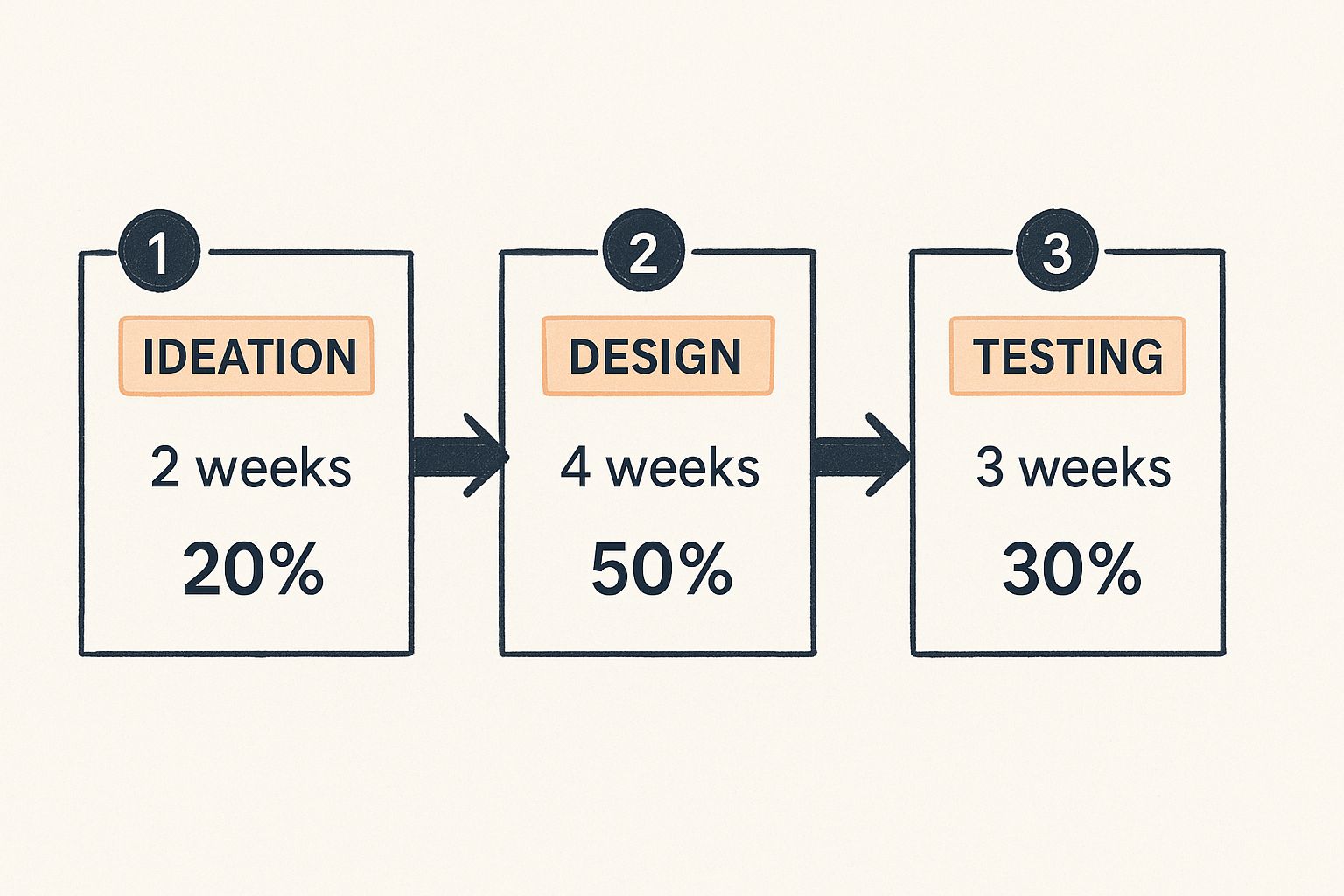
As you can see, a huge chunk of the effort goes into the design phase. It’s a powerful reminder of how critical it is to get the user experience right before a single line of code is written for the final product.
Stage 1: Idea and Validation
Every great product starts with a simple goal: solving a real problem for real people. The Idea and Validation stage is all about making sure that problem actually exists and that your solution is the right one. This is the foundation for everything that follows. Skipping this step is a classic mistake that often leads to building a beautiful product that nobody needs.
In this early phase, a development partner helps you dig deep to:
- Do the market research: Who are your customers? What are your competitors doing right (and wrong)?
- Nail down your value proposition: What makes your product special? Why would someone choose it over another?
- Check for feasibility: Can this actually be built with current tech? Does it make financial sense?
Actionable Insight: A practical way to validate your idea is to create a simple landing page that describes the product and includes a sign-up form for updates. Promoting this page to your target audience can quickly tell you if there's genuine interest before you build anything.
Stage 2: Prototyping and MVP
Once you’ve confirmed the idea has legs, it's time to make it feel real. This usually starts with a prototype, which is basically an interactive mockup of your product. It lets everyone see, click, and get a feel for the user experience long before the heavy coding starts. This is a crucial first step in any good UX design audit.
Next, the team focuses on building a Minimum Viable Product (MVP). Don't mistake an MVP for a buggy or incomplete product. It's the simplest version of your product that solves the core problem for your very first users. It has just enough features to be useful and, most importantly, to start gathering priceless feedback from the real world.
A classic example is Dropbox. Their first MVP wasn't even a working product; it was a simple video explaining what it would do. The explosion of sign-ups from that video alone proved they were onto something huge, giving them the validation they needed to build the whole thing.
This build-measure-learn loop lets you test the waters without betting the entire farm, making it a non-negotiable part of modern product development.
Stage 3: Full-Scale Development
With a validated idea and feedback from your MVP users, it's time to build the real thing. Full-Scale Development is where the magic happens. This is the most resource-intensive phase, where your product is fully engineered and polished. The team typically works in short cycles called "sprints" to consistently build and release new features from the product roadmap.
This is where the heavy lifting occurs, including:
- Writing clean, scalable code for the front-end (what users see) and the back-end (the engine under the hood).
- Connecting to other services and APIs.
- Building in robust security to keep user data safe.
- Running relentless quality assurance (QA) tests to squash bugs.
Keeping the lines of communication wide open between you and the development team here is absolutely essential to making sure the final product aligns perfectly with your business goals.
Stage 4: Launch and Deployment
The big day has arrived! The Launch and Deployment phase is when your product officially goes live. But it's way more than just flipping a switch. A smooth launch is the result of meticulous planning and coordination.
This stage involves everything from setting up servers and databases to pushing the code to the live environment. A practical example is having a launch checklist that includes final QA sign-offs, marketing announcements queued up, and a support team ready to handle user inquiries from the moment the product is available.
Stage 5: Maintenance and Iteration
Getting your product out the door isn't the finish line—it's the starting line for the next race. The Maintenance and Iteration stage is all about keeping your product running smoothly, securely, and effectively over the long haul. This means monitoring performance, fixing any new bugs that pop up, and providing top-notch support to your users.
But the real work here is listening and improving. By watching how people use the product and gathering their feedback, you'll uncover incredible opportunities to make things better. Actionable insight: Use tools like Hotjar or FullStory to see how users are actually interacting with your app. These insights are gold for identifying what to improve in the next development cycle.
Choosing The Right Engagement Model
One of the biggest decisions you'll make when partnering with a development agency is how you'll actually work together. This is called the engagement model, and it's the framework that defines everything from communication and collaboration to budgeting and billing.
Think of it like building a custom home. You could agree on a single, fixed price for a standard blueprint, pay your builder by the hour for a one-of-a-kind design that might change along the way, or even hire their whole crew full-time to build an entire estate over several years. Each approach works, but the right one depends entirely on what you're trying to build.
Getting this choice right means aligning the agency's workflow with your project's goals, budget, and how comfortable you are with the unknown.
Fixed Price: Predictability and a Clearly Defined Scope
The Fixed Price model is as straightforward as it sounds. You and the agency agree on a specific scope of work for a single, locked-in price. This is the perfect fit when your project is buttoned-up, well-documented, and unlikely to change.
A great practical example would be building a standard five-page corporate website with a contact form and a blog. The requirements are clear, leaving very little room for surprises.
This model gives you total budget predictability, which is a huge relief for businesses with strict financial controls. But that rigidity is also its main drawback. If you decide you need a new feature halfway through, it usually means stopping work to draft a new contract and scope, which can slow down momentum.
The real magic of a Fixed Price model is the financial certainty. You know exactly what you're getting and exactly what it will cost, which is ideal for projects where the finish line is crystal clear from day one.
Time and Materials: Flexibility for Evolving Projects
In complete contrast, the Time and Materials (T&M) model is all about flexibility. You pay the agency for the actual hours their team logs on your project, plus any direct costs for things like software or third-party tools. This approach is built for agile development and is a lifesaver for complex projects where you expect the requirements to change.
Imagine you're building a groundbreaking SaaS platform. You have the core idea, but you know that early user feedback and market discoveries will inevitably shape its final features. A T&M model lets you pivot, add functionality, and shift priorities on the fly without the hassle of renegotiating a fixed contract every time.
This adaptability is its superpower, ensuring you build the product your customers actually want. The trade-off, of course, is a less predictable budget. Actionable insight: To maintain control in a T&M model, insist on regular budget check-ins (e.g., weekly or bi-weekly) to ensure spending aligns with progress and to avoid surprises.
Dedicated Team: A True Long-Term Partnership
The Dedicated Team model is the deepest partnership you can form. Here, you're essentially hiring a full-time, exclusive team of designers, developers, and project managers from the agency. They function as a direct extension of your own company, becoming fully immersed in your culture, vision, and long-term goals.
This is the go-to model for large-scale, long-term products that require continuous development, maintenance, and feature updates. Big companies often use this approach for their flagship digital products or for complex initiatives like enterprise app development services. It gives you the consistent talent and deep product knowledge you need, but without the overhead and HR headaches of hiring everyone directly.
Choosing Your Development Engagement Model
So, which model is the right fit for you? It all comes down to your project's complexity, your budget's flexibility, and how clearly you can define the scope from the outset. This table breaks down the core differences to help you make an informed decision.
| Model | Best For | Pros | Cons |
|---|---|---|---|
| Fixed Price | Small, well-defined projects with a clear scope and minimal uncertainty. | Predictable budget and timeline; requires less hands-on client supervision. | Inflexible to changes; risk of lower quality if the scope is underestimated. |
| Time & Materials | Complex, long-term projects where requirements are expected to evolve. | High flexibility; supports an agile process; gives you more control over the product. | Less budget predictability; demands active and ongoing client involvement. |
| Dedicated Team | Large-scale products that need continuous development and deep integration. | Deep product expertise; full control over the team; high engagement and motivation. | Higher overall cost; requires significant management from your side. |
Ultimately, the best engagement model creates a win-win scenario. It gives you the product you need while allowing the development team to do their best work in a structure that makes sense for everyone involved.
Why Partnering With an Agency Makes Sense
Trying to build a digital product with an in-house team is a massive undertaking. It’s slow. It’s expensive. You have to recruit, hire, and onboard a whole crew of specialists—a process that can easily eat up months before anyone writes a single line of code.
Working with an agency that offers digital product development services is a completely different ballgame. It lets you sidestep all those early-stage headaches and plug directly into a well-oiled machine built for innovation. This isn't just a shortcut; it's a strategic move to get a serious edge in a market that doesn't wait around.
Instant Access to Vetted Expertise
When you bring on an agency, you’re not just hiring a coder. You get a complete, cross-functional team on day one. We’re talking UX/UI designers, front-end and back-end engineers, QA testers, and product strategists who already know how to work together like clockwork.
This immediate access to a full squad of specialists means you get to skip the painfully long and expensive recruitment process. You avoid the guesswork of vetting individual candidates and instead get a team that has already perfected its communication, workflows, and collaborative chemistry on countless other projects.
Significant Cost-Effectiveness
Building a team in-house means dealing with a mountain of overhead costs that go way beyond salaries. You have to factor in benefits, payroll taxes, office space, pricey software licenses, and all the necessary hardware. These expenses pile up fast and can bleed your budget dry before your product even has a chance to make a dime.
Outsourcing turns those unpredictable fixed costs into a single, predictable operational expense. You pay for the results you get, not the overhead required to produce them. It's a much smarter, more capital-efficient way to get a digital product off the ground.
This financial model is a huge reason why so many companies choose outsourcing product development. For a closer look, you can learn more about the benefits of outsourcing product development in our detailed guide.
Faster Time-to-Market
In today's economy, speed is everything. A seasoned agency has been through the product development cycle time and time again. They know where the pitfalls are, how to streamline workflows, and how to push the timeline without cutting corners. They already have the frameworks, tools, and project management systems ready to go.
This built-in efficiency gets your product to your users much faster. You can start collecting feedback, making improvements, and grabbing market share while your competitors are still stuck trying to hire their first engineer.
Focus on Your Core Business
Ultimately, partnering with a development agency lets you do what you do best: run your business. When you hand off the complex, time-sucking technical work, your own team is free to focus on strategy, marketing, sales, and building customer relationships.
The digital products industry now generates over USD 2.5 trillion in annual value, and consumers are spending more than USD 560 billion a year on digital media alone. Getting a piece of that massive pie requires focus. An agency partnership gives you exactly that. You can discover more statistics about the booming digital product economy to truly grasp its scale.
How to Select the Right Development Partner
Choosing a partner to build your digital product is one of the most critical decisions you'll make. Get it right, and the agency becomes a genuine extension of your team. Get it wrong, and you’re looking at blown budgets, missed deadlines, and a product that just doesn't hit the mark.
This isn't about generic advice. You need a practical checklist to properly vet potential partners. It requires digging much deeper than a flashy website to find a team whose expertise truly matches your project's DNA.
Analyze Portfolios for Relevant Experience
First things first, dive into their portfolio. But don't just skim the pretty designs. You're on a mission to find proof of industry-relevant experience. If you’re building a complex fintech app that requires Stripe integration and high security, an agency that only shows off simple marketing websites is probably not your match.
Look for case studies that tell a story. What was the business problem? What process did they follow to solve it? And, most importantly, what were the results? A strong portfolio won't just show screenshots; it will show data on how they boosted user engagement by 30% or drove a 15% increase in revenue.
Verify Social Proof and Reputation
Testimonials on a company’s own website are a decent start, but remember, they are hand-picked. For the real, unbiased story, you have to go to third-party review platforms.
Independent review sites like Clutch, G2, and GoodFirms are goldmines for verified, in-depth client feedback. Pay close attention to comments about project management, communication, and whether they stuck to the timeline and budget. Consistent praise across multiple platforms is a huge green flag.
This is how you get past the sales pitch and find out what it’s really like to work with them. Look for patterns in the reviews—both the good and the bad.
Ask the Right Questions
Once you have a shortlist, it's time to talk to them. This is your chance to gauge their technical skills, communication style, and overall cultural fit. Don't just wing it; go into these calls with sharp, specific questions that reveal how they actually operate.
Here are a few essential questions to get you started:
- Communication: "What does your day-to-day communication look like? What tools do you use—Slack, Jira, Asana—to keep clients in the loop?"
- Process: "Walk me through your typical project, from the first discovery call to launch and post-launch support." This is especially crucial if you need a lean initial version; a clear process is the sign of a great MVP development company.
- Technology: "What's your go-to tech stack, and why? How do you make sure the code you write today will be easy to scale and maintain tomorrow?"
- Team: "Who would be my dedicated project manager? Can I meet the core developers and designers who would be working on my project?"
A true partner will give you clear, confident answers. They'll be transparent about their process and excited to share the details. By following this simple framework, you can move forward confidently, knowing you’ve picked a team that can truly bring your vision to life.
Frequently Asked Questions
https://www.youtube.com/embed/SzMiJFOa6w8
When you start looking into digital product development, a lot of practical questions naturally come up. Let's tackle some of the most common ones we hear from businesses about to start this journey.
How Much Do Digital Product Development Services Cost?
The honest answer? It depends. The cost is all over the map, driven by your project's complexity, the team's location, and the sheer scope of work.
A straightforward Minimum Viable Product (MVP) for a mobile app might land somewhere between $25,000 and $75,000. On the other hand, a complex, feature-packed SaaS platform with multiple integrations could easily run $150,000 or more.
Keep in mind that North American agencies often have higher hourly rates, typically $100-$250, compared to teams in other parts of the world. The only way to get a real number is to ask for a detailed proposal that breaks down the costs based on your specific needs.
How Long Does It Take to Build a Digital Product?
Just like cost, the timeline is tied directly to the product’s scope. An MVP can often be designed, built, and launched in a brisk 3-6 months, which is perfect for getting it into users' hands and collecting feedback fast.
For a full-blown product with all the bells and whistles, you're likely looking at a timeline of 6 to 12 months, sometimes longer. This is where agile development really shines, as it breaks the work into smaller sprints. You see real progress every few weeks, which keeps the project moving and allows for adjustments along the way.
It's crucial to distinguish between a project and a product. A project has a clear start and end, like shipping version 1.0. A product, however, is a living thing. It needs ongoing care—updates, new features, and tweaks based on what your users are telling you—long after its initial launch.
Who Owns the Intellectual Property of the Product?
This one is simple: you do. In any professional service agreement, you, the client, should retain 100% ownership of the intellectual property. That includes every line of code, every design file, and everything in between.
This should be a non-negotiable term in your contract. Actionable insight: Before signing, make sure the contract explicitly states that all "work for hire" and resulting intellectual property is transferred to you upon payment. A trustworthy development partner will be completely transparent about this, ensuring there’s no confusion about who owns the final product.
Ready to turn your idea into a market-leading digital product? The expert team at Pixel One specializes in bringing concepts to life with a focus on strategy, design, and flawless engineering. Let's build something amazing together.