
How Do I Bring a Product to Market? A Practical Guide
Wondering how do I bring a product to market? Discover proven strategies for validation, development, and successful launch to turn your idea into reality.Launching a product isn't a single, dramatic event—it's a journey, a series of deliberate phases that take you from a raw idea to a market-ready solution. Think of it as a structured process that starts with proving people actually want what you're building, then creating a basic version, and finally, crafting a smart plan to get it in front of them. For instance, the team behind Slack didn't start by building a chat app for the world; they built an internal tool to solve their own communication problems while developing a video game. Only after realizing its potential did they pivot and bring it to market.
Your Launch Roadmap From Idea to Customer
The path from a spark of an idea to your first paying customer can seem like a winding, uncertain road. But it's not. There's a well-trodden blueprint that successful products follow, and it all starts by answering one crucial question before you invest a single dollar: "Should we actually build this?" This roadmap is your high-level guide, showing you how each step sets the stage for the next.
We're going to skip the abstract theories and get straight to a framework you can actually use. Grasping the full picture from day one is the best way to avoid the classic, costly mistake of building something nobody needs.
The Core Stages of Your Journey
Bringing a product to life is less about a giant leap of faith and more about a series of calculated steps. Each one is designed to systematically chip away at risk and stack the odds in your favor. Globally, more than 30,000 new consumer products launch every year, but the numbers tell a sobering story. Only about 40% of developed products ever make it to market. Of those, a mere 60% generate any revenue at all.
This is precisely why a structured approach isn't just helpful—it's essential.
Here’s a quick look at the core stages we'll be breaking down:
- Idea Validation: This is where you prove, with real evidence, that there's a hungry market for your solution.
- MVP Development: You'll build the simplest, most essential version of your product that solves a core problem for your first users.
- Go-to-Market Strategy: Here, you'll map out exactly how you're going to reach, attract, and win over your target audience.
- Launch Execution: It's time to put your plan into motion, creating that initial buzz and momentum to bring in your first wave of customers.
To help you visualize this journey, here’s a quick overview of the key phases.
The Core Product Launch Stages at a Glance
| Stage | Primary Objective | Key Activities |
|---|---|---|
| Idea Validation | Confirm real-world demand. | Customer interviews, surveys, competitor analysis, landing page tests. |
| Prototyping & MVP | Build a functional, core solution. | Wireframing, user testing, feature prioritization, initial development. |
| Go-to-Market Strategy | Plan your market entry. | Defining target audience, setting pricing, choosing channels, messaging. |
| Launch & Optimization | Generate momentum and learn. | Executing marketing campaigns, gathering feedback, iterating on the product. |
This table shows how each stage logically builds on the last, ensuring you're making informed decisions based on real data, not just assumptions.
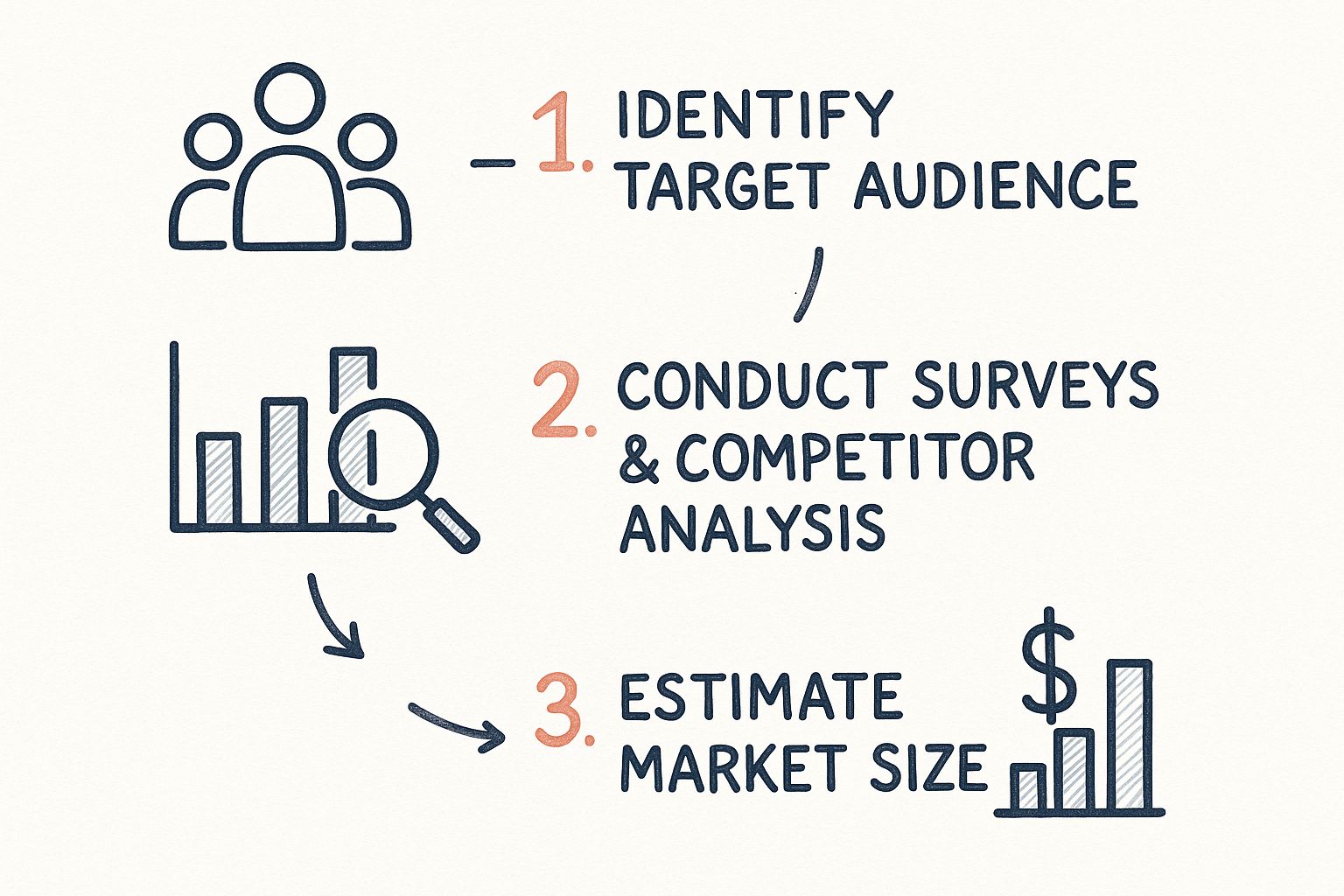
As you can see, the process is designed to be iterative. You gather critical insights at each step before you commit more time and money to the next.
The biggest mistake founders make is falling in love with their solution instead of their customer's problem. A successful launch starts with empathy and evidence, not just a cool idea.
Getting this sequence right is the heart of a powerful product launch. For a more detailed look at the nuts and bolts, our guide on the digital product development process offers a deeper dive. By sticking to this roadmap, you're not just building a product; you're building a foundation for real, sustainable growth.
Confirming Demand Before You Build Anything
Here’s the most expensive mistake I see founders make: they build something nobody actually wants. The question you need to be obsessed with at this stage isn't "Can we build this?" It's "Should we build this?" Answering that question with real data is the single most important thing you'll do on this entire journey.
This is the point where you have to step outside your own head and put your brilliant idea to the test. True validation isn't about collecting compliments; it’s about finding hard evidence of a painful problem people are desperate to solve. Think of it as the firewall between a great idea and a business that goes up in flames.
Start With Smart Competitor Analysis
First things first, you need to get the lay of the land. It's easy to see a crowded market and get spooked, or to find no competitors and think you've struck gold. Both assumptions are usually wrong.
Your real goal here isn't just to make a list of who else is out there. It’s to find their Achilles' heel. And the best place to find those weaknesses is by digging through their customer reviews, support forums, and social media comments. For example, if you're building a new project management tool, spend an afternoon on Capterra and G2, filtering for 3-star reviews of Asana or Trello.
Look for the same complaints popping up over and over again. Those aren't just gripes; they're opportunities.
- "I love what it does, but the interface is a nightmare to navigate."
- "It's perfect for enterprise, but the pricing makes it a non-starter for a small business like ours."
- "The main feature is solid, but I can't believe it doesn't integrate with [X]."
Every one of those comments is a signpost pointing you toward a gap in the market. That's where you can win—by solving a specific, nagging problem that the big players are overlooking.
Build a Simple Landing Page to Test Interest
The quickest way to see if people are genuinely interested is to ask for a tiny commitment. A simple one-page website, what some people call a "smoke test" landing page, is the perfect tool for the job. You don't need a product yet, just a compelling pitch for what your product will do. For example, use a tool like Carrd or Webflow to create a page with a strong headline: "The first project management tool designed for chaotic creative agencies."
Make sure your landing page hits two points hard: the problem you solve and the value you deliver. The most important piece of the puzzle is a clear call-to-action. This could be a sign-up form for an email waitlist, a special early-bird discount, or a spot in the beta program.
This is more than just email harvesting. Your conversion rate—the percentage of visitors who actually sign up—is a direct pulse check on your value proposition. A 5% conversion rate is a decent signal. Anything north of 10% means you've likely hit on a serious pain point.
Use Small Ad Campaigns for Message Testing
Once your landing page is up, you need to get eyeballs on it. Running small, targeted ad campaigns on platforms like Facebook, Instagram, or LinkedIn is a fantastic way to test your assumptions about who your audience is and what message resonates with them.
Don't think of this as a sales push. It's a science experiment.
- Craft a few different ad variations: For your project management tool, create one ad with the headline "Tired of messy spreadsheets?" and another with "Deliver client projects on time, every time." Use different images for each—one showing a stressed-out person, another showing a happy, organized team.
- Target distinct audience segments: Show your ads to different groups based on their job titles, interests, or demographics. Pay close attention to who bites.
The game here is to find the magic combination of message and audience that delivers the highest click-through and sign-up rates. For just a few hundred bucks, you can gather priceless data about who your real customers are and what they truly care about.
Validation is the art of failing cheap. An ad campaign that flops is a win because you've learned what doesn't work without spending a fortune on development.
Conduct Revealing Customer Discovery Interviews
While quantitative data from ads tells you what is happening, talking to people tells you why. Customer discovery interviews are simply structured conversations with potential users where your only goal is to understand their world, their problems, and their workflows. Reach out to 10-15 people in your target audience on LinkedIn and offer them a $25 gift card for 20 minutes of their time.
The secret is to ask open-ended questions about things they've already done, not what they might do in the future.
- Bad Question: "Would you use a product that did X?"
- Good Question: "Tell me about the last time you tried to do X. What was that process like for you?"
People are terrible at predicting their own behavior but are brutally honest when describing past frustrations. Listen for emotional cues—words like "annoying," "frustrating," or "time-consuming." Those feelings are gold because they signal genuine pain.
These insights will directly shape your product's features and marketing. For startups, getting this phase right is everything. Expert guidance can make a massive difference, and you can learn more about the specifics of product development for startups to better navigate these crucial early stages.
From Prototype to a Minimum Viable Product

Alright, so you've confirmed there's a real problem people need solved. Now it's time to stop talking and start building. This is where your solution begins to take a tangible shape, moving from abstract ideas to something a user can actually see and touch. The goal here isn't perfection; it’s all about speed and learning.
Think of a prototype as a movie prop. It looks real enough to get a genuine reaction, but it doesn't need all the complex machinery working inside. The whole point is to get your idea out of your head and into the hands of potential users as quickly and cheaply as possible.
Start with Low-Fidelity Prototyping
Your first attempts should be simple, maybe even a little ugly. You’re testing the core concept and flow, not arguing over which shade of blue to use for a button. Honestly, you can start with just a pen and paper or a whiteboard to map out the user's journey. A practical example: draw each screen of your mobile app on a separate index card, then have a potential user "tap" through them to see if the flow makes sense.
Once you've got the basic flow down, you can jump into some accessible digital tools that don't require a lick of code.
- Figma & Sketch: These are the industry go-to's for creating interactive, clickable mockups. You can stitch screens together to simulate how someone would actually navigate your app or website.
- Balsamiq: This tool is brilliant for creating wireframes that look intentionally rough. That hand-drawn feel encourages people to give raw, honest feedback on functionality instead of getting sidetracked by the visuals.
The feedback you get at this stage is pure gold. Putting a simple, clickable prototype in front of just five to ten people from your target audience can expose confusing navigation, unclear instructions, and broken workflows before you’ve written a single line of code.
Defining Your Minimum Viable Product
After your prototype has validated the core user flow, it's time to build a Minimum Viable Product (MVP). An MVP isn't a half-baked product; it's the most stripped-down version of your idea that still delivers on its core promise. It’s not about building less—it’s about building just enough to solve a key problem for your earliest fans and start learning from real-world use.
The trick is to be absolutely ruthless with prioritization. Ask yourself one question over and over: "What is the single most important problem we are solving?" Your MVP should be lasered-in on the features that directly address that problem. Everything else is just noise.
An MVP is a process, not just a product. Its primary purpose is to maximize learning while minimizing development effort. You're building a tool to test a hypothesis about your market.
A battle-tested framework for this is the MoSCoW method. It helps you sort potential features into four distinct buckets.
- Must-Have: These are the non-negotiables. The product simply doesn't work without them. For a ride-sharing app, this would be GPS tracking, driver/rider matching, and payment processing.
- Should-Have: Important features that add real value, but aren't deal-breakers for the first launch. For the ride-sharing app, this might be fare estimates or saved destinations.
- Could-Have: "Nice to have" features you can add down the road if time and resources allow. Examples: splitting fares with friends or a loyalty program.
- Won't-Have (This Time): Features that are explicitly kicked out of scope for this version. This could be a complex "schedule a ride in advance" feature.
Your MVP should only contain your "Must-Have" features. This intense focus crushes scope creep and gets your product into the wild that much faster.
The Power of a Non-Traditional MVP
Here's a secret: sometimes, an MVP doesn't even have to be software. Remember, the goal is simply to validate your core idea with the least possible effort. Dropbox famously pulled this off with a simple explainer video.
Before they ever built their complex file-syncing tech, the founders created a short video showing how the product would work. They posted it on a tech forum, and their sign-up list exploded from 5,000 to 75,000 people literally overnight. That video was their MVP, proving there was massive demand before a fully functional product even existed.
This approach de-risks the entire launch process. Whether it’s a video, a spreadsheet, or a "concierge" service where you manually do the work for your first few customers, the objective is the same: prove people will use and pay for what you're offering. Nailing a focused MVP is a critical skill, and partnering with an experienced MVP development company can bring the structure and expertise you need to define those core features and build an effective first version.
Designing Your Go-to-Market and Launch Plan
You can build a brilliant product, but without a smart launch plan, it's like throwing a fantastic party and forgetting to send out the invitations. This is where you create your playbook for a powerful market entrance. Your go-to-market (GTM) strategy is so much more than a marketing checklist; it's the unified plan that connects your product to the right people through the right channels at the right price.
Honestly, this plan is the bridge between having a great MVP and actually getting it into the hands of paying customers. It ensures every team—from sales to marketing to product—is aligned and pushing in the same direction.
Crafting Your Ideal Customer Persona
Before you can sell anything, you need to know exactly who you're selling to. A vague idea like "small business owners" just won't cut it. You have to get granular and create a detailed Ideal Customer Persona (ICP), which is essentially a fictional character representing your perfect customer.
Give this person a name, a job title, daily challenges, and goals. What keeps them up at night? Where do they hang out online? What frustrates them about the current solutions on the market? The more specific you are here, the easier it becomes to craft messaging that genuinely connects.
For instance, instead of targeting "project managers," you might define your ICP as "Maria, a 34-year-old remote project manager at a mid-sized tech company, who struggles to keep her cross-functional teams aligned on deadlines using a messy combination of spreadsheets and email." Suddenly, you can speak directly to Maria's pain.
Setting Your Pricing and Positioning
How you price your product sends a powerful signal about its value. This decision can't be based on a gut feeling or simply what your competitors are charging. It needs to be directly tied to the value you provide and the customer you're serving.
A few common models to think about:
- Cost-Plus Pricing: You just calculate your costs and add a standard markup. It’s simple, sure, but it completely ignores the value your customer gets.
- Competitor-Based Pricing: You set your price based on what others in the market charge. This can be a decent starting point but often leads to a race to the bottom on price.
- Value-Based Pricing: You price your product based on the perceived value it delivers. For example, if your software saves a business 10 hours of manual work per month, and that employee costs $50/hour, your product is creating $500 in value. Pricing it at $49/month suddenly seems like a bargain. This is often the most profitable approach, but it demands a deep understanding of your customer's pain points and the ROI you provide.
Your positioning is the story you tell—it’s how you want people to think and feel about your product compared to the alternatives. Are you the budget-friendly option? The premium choice? Or the go-to specialist tool for a tiny niche? Your pricing and messaging have to reinforce this position consistently. A clear user experience is also critical to conveying value, which is why working with the best UX design agencies can ensure your product's perceived value matches its price tag.
Choosing Your Launch Channels and Tactics
The days of just issuing a press release and hoping for the best are long gone. A modern product launch demands a multi-channel approach that meets customers where they already are. We're seeing launches rely heavily on things like video-first content (used in 67% of launches), AI-powered personalization (with a 34% adoption rate), and micro-influencer partnerships, which have grown by a staggering 78% year-over-year.
Your launch isn't just about making noise; it's about starting conversations in the right communities. Authenticity and engagement will always outperform a massive ad spend with a generic message.
The channels you choose should be a direct reflection of your ICP. If Maria, our remote PM, is active in LinkedIn groups and follows specific project management blogs, then those are your primary battlegrounds. Forget about wasting money elsewhere. You can find more insights on these trends over at Openhunts.com.
Let's look at how today's tactics really differ from the old-school playbook.
Modern vs. Traditional Launch Tactics
The game has changed. What worked five or ten years ago often falls flat today. This table breaks down the core differences in mindset and results.
| Tactic | Modern Approach (e.g., TikTok Campaign) | Traditional Approach (e.g., Press Release) | Primary Benefit |
|---|---|---|---|
| Reach | Targeted, authentic engagement with a specific niche audience. | Broad, one-way broadcast to general media outlets. | Higher-quality leads. |
| Credibility | Builds social proof through user-generated content and influencer reviews. | Relies on the authority of the media publication. | Trust and authenticity. |
| Feedback | Provides instant, real-time feedback and direct community interaction. | Offers delayed, indirect feedback, if any. | Rapid learning and iteration. |
| Cost | Can generate significant organic reach with a low initial investment. | Often requires expensive PR agency retainers for visibility. | Better ROI. |
As you can see, the modern approach is all about targeted, two-way conversations that build genuine community and trust, leading to a much stronger return on your effort.
Building a Pre-Launch Community
One of the most powerful things you can do is build an audience before you launch. This creates a built-in group of eager early adopters ready to buy and evangelize your product from day one.
Start with something simple: a "coming soon" landing page that captures emails. Offer a compelling reason for people to sign up, like a lifetime discount, exclusive beta access, or a "founding member" status. Then, drive traffic to this page through content, social media engagement in relevant communities, and maybe even a few strategic partnerships. For example, share your progress and ask for feedback in a niche Subreddit or a relevant Facebook group to drive targeted sign-ups.
But don't just let that email list sit there. Nurture it. Send regular updates on your progress, share behind-the-scenes content, and ask for their input on features or designs. When you make them part of the journey, you're not just building a list of leads—you're cultivating a loyal community that is genuinely invested in your success.
Keeping the Momentum Going After Launch
It’s easy to think of launch day as the finish line, but it’s really just the starting gun for the marathon ahead. That initial buzz from your launch campaign will eventually quiet down, and that’s when the real work of building a sustainable business truly begins. Sustaining growth isn't about one-off, flashy events; it's a disciplined cycle of listening, measuring, and constantly improving.
The hard truth? Most new products don't survive. In the fast-moving consumer goods space, for instance, the failure rate hovers between a staggering 80% and 90% within just 18 months. It's a brutal reminder of just how tough it is to maintain momentum. Platforms like TikTok have shown how vital continuous engagement is for discovery and growth. You can get a deeper sense of these trends by exploring how new products find their audience on Accio.com.
Become a Feedback Magnet
Post-launch, your single most valuable asset is your user base. These are real people using your product, and they hold the keys to understanding what's working, what's broken, and what you absolutely need to build next. Your job is to make it incredibly easy for them to share their thoughts and to observe their actual behavior.
Don't just sit back and wait for support emails to roll in. Go get the feedback.
- In-App Surveys: Use simple tools to trigger short, contextual surveys. After a user finishes a key task for the first time, why not ask, "On a scale of 1-5, how easy was that?"
- Session Recordings: Tools like Hotjar or FullStory are a game-changer. They let you watch anonymized recordings of user sessions, giving you an over-the-shoulder view of where people get stuck, confused, or frustrated.
This kind of qualitative data gives you the "why" behind your analytics. You might see a huge drop-off on a specific page, but watching a session recording could reveal it's because a critical button is nearly impossible to find.
Turn That Feedback into a Roadmap
Collecting feedback is one thing; making sense of it is another. Before you know it, you'll have a mountain of suggestions, bug reports, and feature requests. The trick is to develop a system for prioritizing all this input so you can build a roadmap driven by your customers' actual needs.
A practical method is to create a simple spreadsheet or use a tool like Canny.io. For every piece of feedback, log what it is, who requested it, and how many other users have asked for the same thing. This creates a data-backed system for prioritization. If ten different customers ask for the same integration in a single week, that’s a signal you can't afford to ignore. This method ensures you're building features that deliver the most value to the most people, not just catering to the loudest voice in the room.
Your product roadmap should be a living document, not a stone tablet. It needs to be flexible enough to adapt to what your users are telling you, directly and indirectly, every single day.
Understand the Metrics That Actually Drive Growth
To know if your business is truly healthy, you have to track the right metrics. Vanity numbers like total sign-ups might feel good, but they don't tell the full story. For sustainable growth, two numbers matter more than almost any others: Customer Acquisition Cost (CAC) and Lifetime Value (LTV).
- Customer Acquisition Cost (CAC): This is your total sales and marketing spend divided by the number of new customers you brought in over that period. For example, if you spend $1,000 on ads in a month and get 10 new paying customers, your CAC is $100. It tells you exactly how much you're paying to land one new customer.
- Lifetime Value (LTV): This is the total revenue you can reasonably expect from a single customer over the entire time they use your product. If your subscription is $20/month and the average customer stays for 18 months, your LTV is $360.
The relationship between these two is what makes or breaks a business. A healthy model requires your LTV to be significantly higher than your CAC. A common benchmark to aim for is an LTV:CAC ratio of 3:1 or better. If it costs you more to acquire a customer than they will ever be worth to you, your business is on a timer.
Master the Art of Customer Retention
Getting a new customer is expensive. Keeping an existing one is where the real profit is. Your post-launch efforts should be laser-focused on retention. This means guiding new users to that "aha!" moment—the point where they truly understand your product's core value—as quickly as humanly possible.
An automated email onboarding sequence is a fantastic tool for this. Instead of one generic "welcome" email, create a series of messages that drip out over the first week.
- Day 1: A warm welcome that guides them to take the single most important first action. For an invoicing app, this would be "Create and send your first invoice."
- Day 3: A quick email sharing a pro-tip or a powerful secondary feature they might have missed, like setting up recurring invoices.
- Day 5: A short case study showing how another customer just like them found success, e.g., "See how this freelance designer cut their admin time in half."
This kind of structured guidance dramatically increases the chance that a new user will stick around. Our guide on product-led onboarding dives much deeper into creating these crucial early experiences. Another powerful tactic is building a community around your product. A dedicated Slack channel or forum gives users a place to connect, share ideas, and help each other out, building a sense of loyalty that goes far beyond just features and price.
Common Questions About Product Launches
Launching a product can feel like navigating a minefield. You can have the best map in the world, but you'll still run into specific questions and unexpected challenges. Let's tackle some of the most common hurdles I've seen founders face time and time again.
How Much Does It Cost to Launch a Product
This is the classic "how long is a piece of string?" question. Honestly, the cost to bring a product to market can be anything from a few thousand dollars for a simple digital tool to millions for a piece of complex hardware. The real key isn't the final number, but how you spend it along the way.
For example, a lean software startup might get a solid MVP built for $15,000 to $50,000. Then, they might earmark another $5,000 to $10,000 for a highly targeted ad campaign and some initial content marketing. On the other hand, if you're building a new consumer gadget, you could easily burn through $200,000+ just on prototyping, tooling, and your first inventory run.
To get a handle on your own numbers, break down your budget into three core areas:
- Development: This is everything from wireframing and design to prototyping and the actual engineering work.
- Marketing & Sales: Think website, ad spend, PR, content creation—anything that gets the word out.
- Operations: Don't forget the less glamorous stuff like legal fees, software subscriptions, and other overhead.
The goal is to spend just enough to prove you're on the right track. Don't go all-in before the market has given you a clear thumbs-up.
How Long Does the Process Take
Just like the cost, the timeline is all over the map. That said, a typical software MVP often takes somewhere between 3 to 6 months to get from that initial spark of an idea to launch day. This can change dramatically based on how complex your product is and how many people you have working on it.
A simple mobile app might be ready to go in just a few months. But a more involved B2B SaaS platform could easily take closer to a year to get its core feature set ready for customers. The trick is to avoid the dreaded "never-ending development cycle."
A launch timeline is a forcing function. Set an aggressive but realistic date, and then ruthlessly cut scope to meet it. The market will teach you more in one week than you'll learn in three months of internal debates.
Setting a hard deadline creates a healthy sense of urgency. It forces you to make tough decisions about what's truly essential for version one.
What If Someone Steals My Idea
This fear paralyzes so many first-time founders. But in my experience, it's almost never the thing that kills a startup. Your biggest threat isn't a competitor swiping your idea; it's building something that nobody wants.
Ideas are cheap. Execution is your real moat. Your unique ability to build, market, listen to customers, and adapt is what will set you apart. Pour your energy into talking to users and building a product they can't live without, not operating in stealth mode. A classic example is the rivalry between Facebook and MySpace. Social networking wasn't a new idea, but Facebook's superior execution, focus on a specific user base (college students), and cleaner interface allowed them to win.
Of course, if you're working with genuinely sensitive intellectual property, you should look into provisional patents or have contractors sign NDAs. But for most new ventures, speed and customer feedback are infinitely more valuable than secrecy.
Bringing a new product into the world is a tough, demanding journey, but it's also incredibly rewarding. At Pixel One, we partner with startups and established companies to navigate every stage of this process, from the first sketch to a successful launch and beyond. Let us help you turn your idea into a successful product.