
MVP Development for Startups Done Right
A practical guide to MVP development for startups. Learn to build, test, and launch a successful product by focusing on core features and user feedback.When people hear "Minimum Viable Product," they often picture something half-baked or incomplete. That's a huge misconception. MVP development for startups isn't about shipping a buggy, unfinished product; it’s a strategic decision to launch with just enough features to solve a core problem for your first users.
The real goal? To learn as fast as possible while minimizing risk.
Why an MVP Is Your Startup's Smartest First Move
I've seen so many founders fall into the same trap: they get obsessed with building the "perfect" product right out of the gate. They spend months, sometimes years, burning through cash and coding in a vacuum. The tragic part is that when they finally launch, they often find out nobody actually wants what they've built.
That’s a startup-killer.
The MVP philosophy flips that entire process on its head. Instead of trying to build a product for everyone, you laser-focus on solving one critical problem for a very specific group of early adopters. It’s not about being minimal on quality; it's about being minimal on scope to maximize learning.
A Tale of Two Startups
Let’s play this out with a real-world scenario. Imagine a new SaaS startup building a project management tool. The old-school approach would be to build everything: task management, team chat, file storage, time tracking, invoicing... you name it. A year and $500,000 later, they launch a bloated, generic tool that doesn't stand out. The launch is a flop.
Now, let's look at the MVP way. The founders do their homework and realize their target audience's biggest headache is simply visualizing project progress. So, their MVP is just one thing: a clean, beautiful Kanban board. It costs them $50,000 and they get it into users' hands in three months.
The early users love its simplicity for that one job. Better yet, they start giving priceless feedback: "This is great, but I really need due dates," or "Could you add assignee tags?" Suddenly, the roadmap isn't based on guesswork—it's driven by real user demand.
This focused strategy delivers huge wins:
- Reduced Financial Risk: You’re not betting the entire company on a hunch. You're testing your core idea with the smallest possible investment.
- Faster Time-to-Market: Getting a product into the wild quickly means you stop guessing and start learning from actual user behavior.
- User-Centric Development: Your product evolves based on what people actually need, not what you think they need. This feedback loop is essential for building a scalable business model that can actually grow.
MVP Philosophy vs Traditional Development
To really understand the difference, it helps to see the two mindsets side-by-side. One is about learning fast, the other is about building big.
| Aspect | MVP Approach (Learn Fast) | Traditional Approach (Build Big) |
|---|---|---|
| Primary Goal | Validate core assumptions and learn from users. | Launch a complete, feature-rich product. |
| Scope | Minimal and focused on one key problem. | Comprehensive, aiming for a "full" solution. |
| Target Audience | Early adopters willing to give feedback. | Broad mass market from day one. |
| Development Cycle | Short, iterative sprints (weeks or months). | Long, linear waterfall process (months or years). |
| Risk | Low financial and market risk. | High risk of building the wrong product. |
Ultimately, the MVP approach isn't a shortcut; it's a smarter, more capital-efficient way to build a company.
The core purpose of an MVP is not to end the development process, but to start the learning process. It’s a tool to test your most critical assumptions with real users.
This isn't just a niche strategy anymore; it's becoming the standard. The global market for MVP development services, valued at USD 288 million in 2024, is expected to hit USD 541 million by 2031, according to a comprehensive report on market dynamics. By starting small, you lay the groundwork for a product that people will actually use and love.
Laying the Groundwork for a Winning MVP
A successful MVP development journey for startups doesn't kick off with the first line of code. It starts much earlier, in a crucial foundational stage that separates a brilliant idea from a costly misstep. This is where you move from a fuzzy concept to a razor-sharp plan backed by real-world evidence, not just wishful thinking.
First things first: you need to do market research that actually uncovers a genuine, painful problem for a specific group of people. I’m not talking about surface-level competitor snooping. Get out there and talk to potential users. Don't ask, "Would you use an app for this?" That's a leading question. Instead, dig deeper with questions like, "What’s the most frustrating part of your day?" Their answers will shine a light on the real pain points.
This initial digging is non-negotiable. If you can't find a problem people are already trying to solve—even with clumsy spreadsheets or a patchwork of different tools—you might be building a solution without a problem.
From Market Gaps to User Personas
Once you’ve locked onto a core problem, you need to get crystal clear on who you're solving it for. Forget generic demographics like "millennials in urban areas"—that’s far too broad to be useful. What you need is a user persona, a detailed sketch of your ideal first customer. This profile should focus on their daily frustrations, their professional goals, and what they’d actually pay to fix.
Let's say you're building an invoicing tool. Instead of targeting "small business owners," you create a persona for "Sarah, the freelance graphic designer."
- Her Frustration: Sarah burns 5-10 hours every month manually creating invoices and chasing down late payments. Her current system is a messy spreadsheet that's prone to errors.
- Her Goal: She needs a simple, automated way to bill clients. This would free her up to spend more time on creative work and less on admin.
- Her Motivation: She would gladly pay for a tool that saves her time and helps her get paid faster. Every hour she saves on invoicing is another hour she can bill a client.
See the difference? This level of detail makes your target user a real person, which makes every decision from here on out much easier.
Think of your user persona as your north star. Whenever you're debating a feature, just ask: "Does this directly help Sarah solve her invoicing nightmare?" If the answer is no, it has no place in the MVP.
This laser-focused approach is why roughly 72% of startups lean on the MVP method for product development. By zeroing in on a specific user's most critical needs, they slash the risk of building features nobody wants and dramatically improve their odds of success.
The process flows from one step to the next, creating a solid foundation for what comes next.
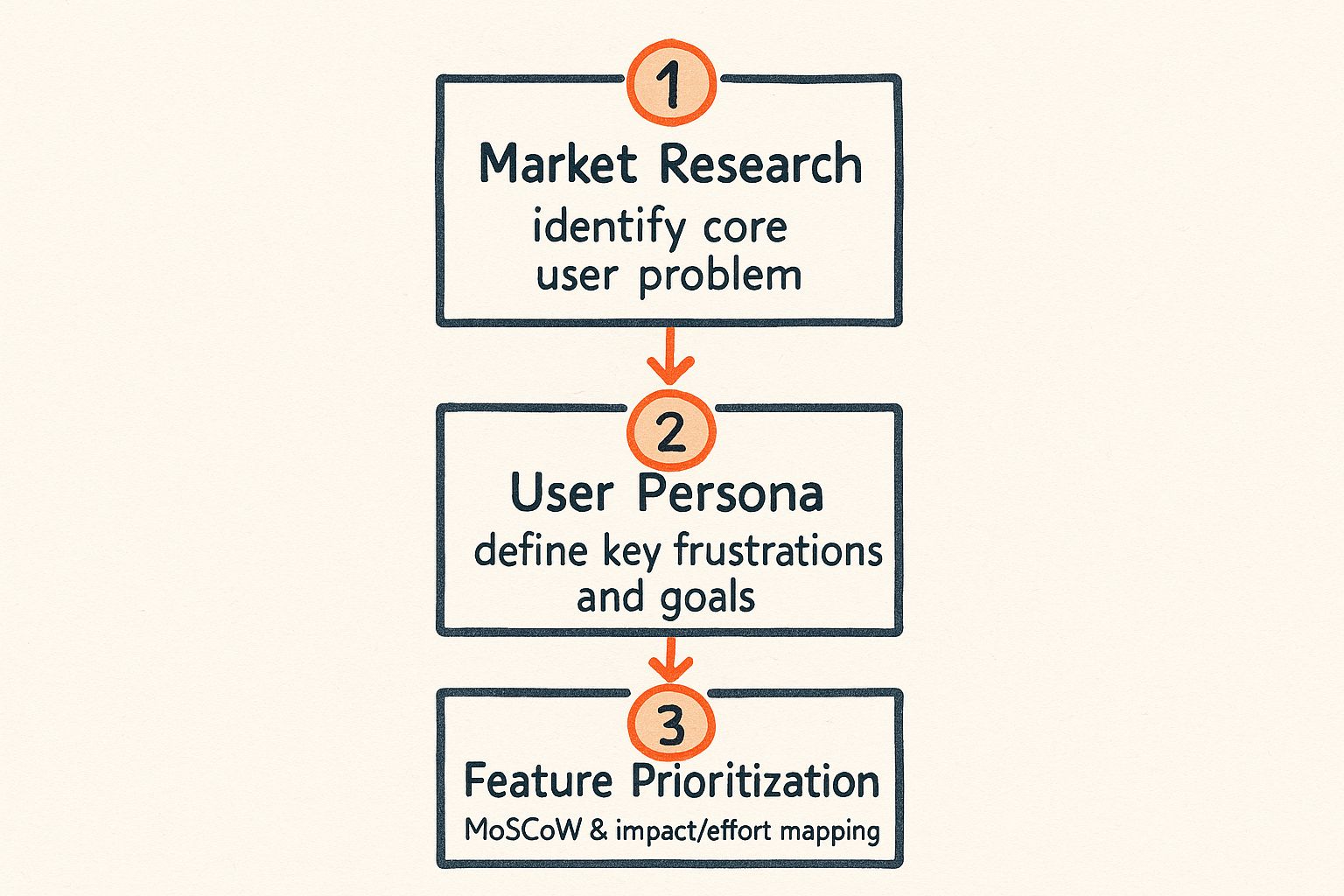
As you can see, each stage builds on the one before it. This ensures your final feature list is firmly rooted in validated user needs, not just what sounded cool in a brainstorming session.
How to Ruthlessly Prioritize Your Features
With a clear problem and a well-defined user persona, you’ve arrived at the toughest part of this pre-development phase: prioritizing features. This is where so many startups get it wrong, falling victim to the dreaded "feature creep." Your job is to be absolutely ruthless.
Two of the best frameworks I've used to make these hard calls are the MoSCoW method and the Impact/Effort Matrix.
The MoSCoW method is a simple way to bucket your feature ideas:
- Must-Have: These are non-negotiable. The product simply won't work without them. For Sarah, this would be the ability to create and send a basic invoice.
- Should-Have: Important, but not critical for the very first launch. Think of features like automated payment reminders.
- Could-Have: These are "nice-to-have" features you can add down the line, like customizable invoice templates.
- Won't-Have (This Time): Features you explicitly decide to exclude for now. A full accounting integration would fall into this category.
Your MVP must only contain the Must-Haves. That's it.
The Impact/Effort Matrix is another fantastic tool for getting clarity. You plot each feature on a simple 2x2 grid based on its potential user impact and the development effort required.
| Low Effort | High Effort | |
|---|---|---|
| High Impact | Quick Wins (Do these first!) | Major Projects (Plan carefully) |
| Low Impact | Fill-ins (Consider if time) | Money Pits (Avoid for the MVP!) |
This grid makes it painfully obvious where to focus. Your "Quick Wins" are the perfect candidates for your MVP. By using these frameworks, you ensure your MVP is a targeted solution designed to deliver maximum value with minimum effort. Getting this planning stage right is a fundamental part of the entire digital product development process.
Building Your First Viable Product
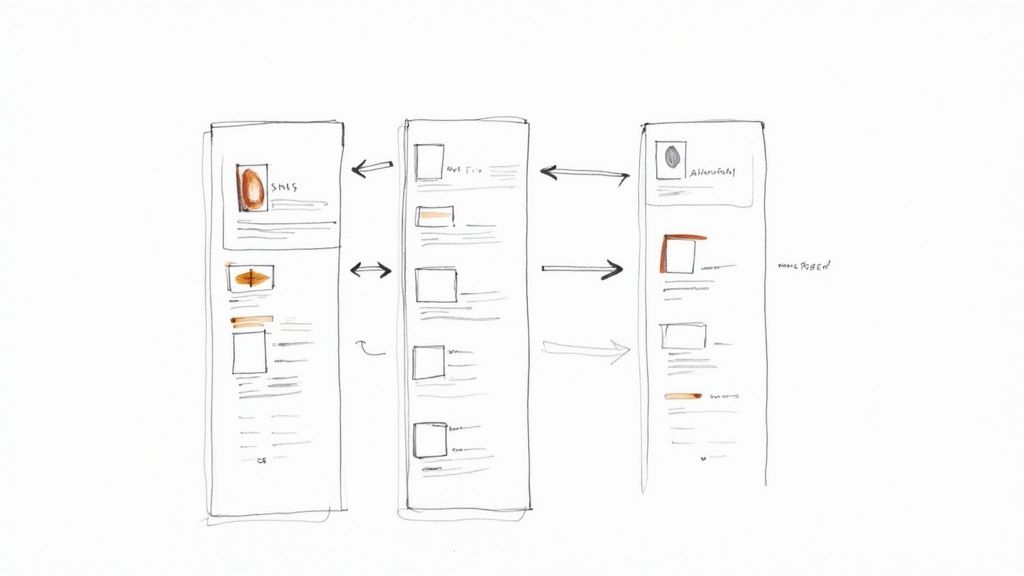
Alright, you've nailed down the problem and know exactly who you're building for. Now for the exciting part: turning those ideas into something real. This is where the rubber meets the road in MVP development for startups, moving from strategy docs and sticky notes to actual blueprints and code.
The goal here is deliberate speed. You're not building your forever product; you're building a functional core that proves your concept works. It’s all about getting a testable version into users' hands as efficiently as possible.
Charting The User's Path With Flow Mapping
Before you even think about design, you need to map out the user flow. This is basically the simplest path a user takes to get their main job done with your product. Forget all the bells and whistles for a moment and just focus on the critical A-to-B journey.
Let's go back to our invoicing app for Sarah. Her core goal is to send an invoice.
The user flow would look something like this:
- Login: Sarah enters her credentials.
- Dashboard: She sees a list of existing invoices and a "Create New Invoice" button.
- Create Invoice Screen: She fills in client details, line items, and the total amount due.
- Review & Send: She previews the invoice and clicks "Send."
- Confirmation: She gets a "Success!" message and is returned to her dashboard, where the new invoice is listed as "Sent."
This simple exercise is a game-changer because it forces you to think through every necessary screen and action. It becomes the north star for both your design and development teams, making sure everyone is on the same page about what actually needs to be built first.
From Sketches To Clickable Prototypes
With your user flow locked down, you can start giving it some shape. The trick is to start low-fidelity. Don't fall into the trap of spending weeks on polished, pixel-perfect designs for a product that hasn't even been validated yet.
Start with low-fidelity wireframes—basic, black-and-white layouts that feel more like architectural sketches than finished designs. They’re all about structure and function, not looks. This lets you iron out usability kinks without getting derailed by a debate over button colors.
Next, you bring those sketches to life with a clickable prototype. Using a tool like Figma, you link your wireframes together to create a simulation of the app. It's not a working product, but it lets you get your concept in front of potential users to see if the flow even makes sense to them.
A prototype isn’t your MVP. It's a cheap, fast way to test your design assumptions before you write a single line of code. It answers, "Is this easy to use?" The MVP answers, "Is this worth using at all?"
This wireframe-to-prototype workflow is a cornerstone of the modern process to develop an app because it lets you find and fix design flaws when they're cheap, rather than after you've invested in expensive development time.
Embracing Agile Sprints For Focused Building
Once your design is validated, it's go-time. For MVPs, there's no better way to build than using an agile methodology. This approach breaks the entire build into small, focused work cycles called sprints, which typically last one or two weeks.
Instead of staring at a massive, intimidating list of features, your team focuses on one small, achievable goal at a time. Let's go back to our invoicing app to see what this looks like.
- Sprint 1: The only goal is user registration/login and a dashboard view. At the end of two weeks, users can sign in and see an empty screen, but it's a start.
- Sprint 2: Build on that foundation. The goal is the "Create Invoice" form. By the end, a user can fill out and save an invoice as a draft.
- Sprint 3: Add the final core function: sending the invoice. The focus here is on generating a simple PDF and emailing it.
This incremental build keeps momentum high and ensures you're constantly delivering real value. It prevents scope creep and keeps the team laser-focused. By the end of a few sprints, you have a lean, functional product built with purpose and precision.
Launching Your MVP to Learn and Iterate
https://www.youtube.com/embed/1hHMwLxN6EM
Getting your Minimum Viable Product built is a huge milestone. But let’s be clear: the launch isn’t the finish line. It’s the starting pistol.
This is the exact moment your carefully crafted hypotheses collide with reality. The real learning starts now. The goal of an MVP launch isn't a splashy press event; it's a strategic, controlled rollout designed to get the most valuable feedback with the least amount of noise.
Too many founders get this part wrong. They hype the launch like a Hollywood premiere, only to be met with deafening silence or, worse, a flood of shallow feedback from the wrong crowd. The smarter play is to treat the launch like a controlled experiment.
Testing Before You Take Flight
Before your MVP even sees the light of day, it needs to go through some serious internal workouts. This isn't just about squashing bugs; it's about making sure the core journey you mapped out actually flows the way you imagined.
First up is internal Quality Assurance (QA). Your own team should be the first line of defense, trying to break the product in every way they can think of. This phase is all about technical stability. Does it crash? Do the buttons actually do what they’re supposed to? Is the core function solid?
Once it’s stable, you move on to User Acceptance Testing (UAT). This is where you bring in a small, trusted circle of people who perfectly match your ideal customer persona. These aren't random beta testers. They are potential early adopters who truly understand the problem you're solving.
Their feedback is gold. It moves beyond technical glitches and gets into pure usability. Can they figure out how to get the main thing done without a manual? Is the whole experience intuitive?
Your early testers aren't just bug hunters; they're your first co-creators. Treat their feedback with the reverence it deserves. It’s the raw material you'll use to build something people will actually pay for.
The Power of a Soft Launch
Okay, your MVP is stable and has the thumbs-up from your UAT group. Now, you have to fight the urge to shout it from the rooftops. A "big bang" launch is a massive gamble.
Instead, go with a soft launch to a hand-picked, limited audience.
This approach gives you some critical advantages:
- Controlled Feedback: You get high-quality, focused insights from users who are genuinely invested in your solution.
- Manageable Scale: Your servers (and your sanity) can handle the initial load without getting overwhelmed.
- A Safe Space to Fail: If a major issue pops up, it only affects a small group. This gives you a chance to fix it before it torpedoes your reputation.
So, who makes it into this exclusive group? Think about that waitlist you’ve been building, a niche online community where your target users live, or a small handful of industry contacts. If you built a project management tool for designers, maybe you launch it exclusively to a specific Slack community for freelancers.
The key is to find a small pond where you can make a big splash.
Creating a Direct Line for Feedback
The whole point of launching an MVP is to learn. That means you have to make it ridiculously easy for users to tell you what they think. Don't hide behind a generic "contact us" form.
You need to open up direct, low-friction channels for them to talk to you.
Here are a few practical ways to do it:
- A Dedicated Slack or Discord Channel: Invite your first 50 users to a private channel where they can chat directly with you and the dev team. This creates a powerful sense of community.
- In-App Feedback Widgets: Use tools like Hotjar or UserVoice to add a simple "Got feedback?" button. This lets users report issues or ideas the moment they have them, without leaving the app.
- One-on-One User Interviews: Proactively email your most active users with a simple message: "Hey, I see you've created 10+ invoices. Could I borrow 15 minutes of your time to hear about your experience? I'll send you a $25 gift card for your time."
These channels turn feedback from a one-way street into a real conversation. For startups just figuring out how to bring a product to market, building these initial feedback loops is far more important than a "perfect" launch day.
Synthesizing Feedback Into Action
Collecting feedback is only half the battle. The other half is turning that firehose of information into a clear, data-driven roadmap. You’ll be dealing with two kinds of data, and you need both.
Qualitative data is the "why." It comes from your user interviews and direct feedback channels—their frustrations, their "aha!" moments, and what made them smile.
Quantitative data is the "what." It comes from tools like Google Analytics or Mixpanel. This is your user sign-ups, feature usage rates, and churn numbers.
The magic happens when you layer them on top of each other.
For instance, your analytics might show that 70% of users bail during onboarding (the "what"). Then, a few user interviews reveal it's because one specific instruction is totally confusing (the "why"). Boom. Now you have a clear, actionable problem to solve.
This combined insight is what fuels the "Build-Measure-Learn" loop, turning your MVP from a static first draft into a living, breathing solution that gets better every single week.
Common MVP Mistakes and How to Avoid Them
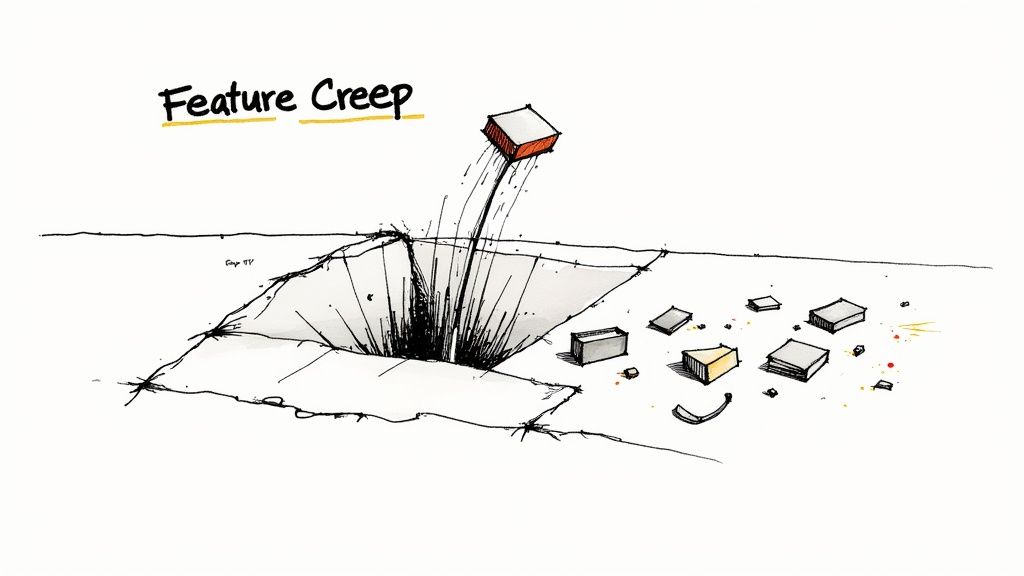
Embarking on the MVP journey is exciting, but it's a path littered with traps that can sink even the most brilliant ideas. Honestly, knowing what not to do is just as crucial as following a perfect roadmap. Avoiding these common mistakes can be the difference between a successful launch and a quiet, costly failure.
Right off the bat, one of the biggest misconceptions is that "minimum" means "cheap" or "low-quality." Nothing could be further from the truth. Your MVP should absolutely be lean, but its core function must be solid. A buggy, confusing product doesn’t just fail to get you feedback—it actively pushes early adopters away and can poison your reputation from day one.
The Siren Song of Feature Creep
I’ve seen this happen more times than I can count. Feature creep is the most seductive mistake in product development. It never starts with a big, obvious error. It’s always a series of small, seemingly harmless additions. "Let's just add this one little thing," or "This would be so much cooler if..."
Before you know it, your focused, elegant MVP has ballooned into a complex mess that's over budget, behind schedule, and tries to be everything to everyone. And as a result, it ends up being good at nothing.
Imagine a team building a simple meal-planning app. The core idea is to generate a shopping list from a few chosen recipes. But then someone suggests adding a calorie tracker. Then a pantry inventory system. Then social sharing. What started as a three-month project is now pushing nine, and the original, simple value is buried under a pile of half-baked features.
So, how do you fight it? You have to be ruthless.
- Create a "Not Now" List: Forget a backlog for a minute. Make a list of every feature you are explicitly not building for the MVP. This creates a powerful boundary for your team.
- The "One Thing" Test: For every single feature someone suggests, ask: "Does this directly help our very first user solve their most critical problem?" If you have to hesitate, it goes on the "Not Now" list.
- Use Sprints as a Shield: Your agile sprint structure is your best defense. New ideas don't get shoehorned into the current sprint. They're captured, put aside, and evaluated later, protecting the team's focus.
An MVP is not a miniature version of your final product. It is the single fastest way to start learning from real users. Any feature that doesn't directly serve that purpose is just noise.
Ignoring Uncomfortable User Feedback
You built the MVP to learn, right? But what happens when that learning feels like a punch to the gut? It's human nature to look for validation, but many founders fall prey to "confirmation bias"—they latch onto the positive comments and quietly dismiss any feedback that challenges their core assumptions. This is a fatal mistake.
I once saw a team build a B2B SaaS tool with an incredibly complex dashboard because they were convinced users wanted deep, granular analytics. But the early feedback was brutal. Turns out, 80% of users were completely overwhelmed and just wanted one simple, exportable report. Ignoring that feedback because you've fallen in love with your own creation is the fastest way to build something nobody will actually use.
This is where a good partner comes in. An experienced MVP development company builds its entire process around listening to and acting on that feedback, no matter how uncomfortable it is.
Misinterpreting Your Success Metrics
The final pitfall is launching without knowing what a "win" actually looks like. If you don't define your Key Performance Indicators (KPIs) upfront, you’re just flying blind. It's easy to get excited about vanity metrics. You might celebrate hitting 1,000 sign-ups, but if your user retention after the first week is only 5%, that’s not a success—it's a warning sign. You've built a leaky bucket.
Before a single line of code is written, you need to decide which metrics truly matter for your specific learning goals.
| Goal | Primary Metric | What It's Really Telling You |
|---|---|---|
| Validate the Problem | Engagement Rate | Are people actually using the core feature? |
| Test Your Solution | Retention Rate | Do they find it valuable enough to come back? |
| Gauge Market Fit | Net Promoter Score (NPS) | Are your first users so happy they’d tell a friend? |
When you set these targets beforehand, you take emotion out of the equation. The data becomes your guide, telling you whether to keep going, make a change, or even scrap the idea and move on. This data-driven discipline is what transforms a simple MVP into the foundation of a real, scalable business.
Got Questions About Building an MVP? We’ve Got Answers.
When you're diving into the world of building an MVP, a few questions always seem to pop up. Founders want to get this crucial first step right, and a bit of clarity can go a long way in turning hesitation into action. Let's dig into some of the most common questions we hear.
We'll break them down with simple, no-fluff answers to help you get moving.
How Much Does It Really Cost to Build an MVP?
Ah, the million-dollar question—though hopefully, the answer is a lot less. The honest truth? There's no single price tag. The cost of an MVP can swing wildly from a few thousand dollars to well over $100,000.
What drives that number up or down? It all comes down to a few key things:
- Complexity: A simple landing page with an email signup is worlds away from an app with real-time data processing and third-party integrations. The more complex the problem, the higher the cost.
- Technology Stack: The specific programming languages, databases, and cloud services you choose will all have an impact on the budget. Some are just more expensive to work with than others.
- Who Builds It: A freelance developer from a region with a lower cost of living will naturally charge less than a top-tier development agency in San Francisco.
The real trick to managing cost is keeping the scope incredibly tight. Pinpoint the absolute core problem you're solving for your first users and build only what's needed to solve that. That discipline is what keeps the initial investment from spiraling out of control.
How Do I Know Which Features to Include?
Deciding what makes the cut is probably the hardest part of the entire process. It’s easy to get attached to cool ideas, but you have to be ruthless.
The best way to do this is to focus on the single most critical action your user needs to take. What is the one thing they must be able to do to get value from your product? Everything else is just noise for now.
A great MVP isn’t about a long list of features. It’s about nailing one essential user journey, from start to finish, without any friction.
To bring some structure to this, try using a simple prioritization framework like the MoSCoW method. It forces you to make tough calls.
- Must-have: The product is broken without these. They are non-negotiable.
- Should-have: Important, but not critical for the first version.
- Could-have: Nice-to-have features that can definitely wait.
- Won't-have: Things you are intentionally leaving out for this release.
Your MVP should only contain your Must-haves. Seriously. This is how you launch lean, get feedback fast, and start the learning process right away.
What Is the Difference Between an MVP and a Prototype?
This is a huge point of confusion, but the distinction is incredibly important because they serve totally different purposes.
A prototype is basically a non-functional mockup. Think of it like an interactive wireframe or a visual blueprint. Its job is to test design concepts and user flow. You use it to answer the question, "Is this intuitive? Do people understand how to use it?" You gather this feedback before a single line of code is written.
An MVP, on the other hand, is a real, working product. It’s stripped down, for sure, but it functions. It has just enough features for your first users to get genuine value from it. An MVP's purpose is to test your core business idea and answer the question, "Will people actually use this to solve their problem?"
Ready to turn your idea into something real? The team at Pixel One lives and breathes MVP development. We help startups get the insights they need to build products that win.