
Startup MVP Development Services: Ultimate Founder’s Guide
Learn how startup MVP development services can accelerate your product launch. Discover expert tips and strategies to succeed fast.So, you have a killer idea for a startup. Before you sink years and a mountain of cash into building the perfect, feature-packed product, let's talk about a smarter way to start. It’s all about building a Minimum Viable Product, or MVP.
Startup MVP development services are designed to do one thing exceptionally well: get a core, working version of your product into the hands of real users, fast. This isn't about cutting corners; it's about being strategic. You focus only on the minimum viable features necessary to solve a crucial problem for your target audience. This lets you test the waters and see if your idea has legs before going all-in.
What Are MVP Development Services Anyway

Think of it like this: you need to get across a river. You could spend the next year and a fortune building a magnificent, eight-lane bridge. Or, you could build a simple, solid raft in a couple of weeks to get to the other side right now. MVP development services help you build that raft.
This isn't about shipping something that's broken or poorly made. It’s a deliberate choice to build only the absolute essential features—the one thing your product must do to make a user's life better. For example, Dropbox's famous MVP wasn't even a product; it was a simple video demonstrating how file syncing would work. This video validated user demand before they wrote a single line of complex code.
The whole point is to launch quickly. This creates an invaluable feedback loop where you learn what people truly want, not just what you think they want based on your own assumptions.
The Core Philosophy of an MVP
The MVP approach is built on a foundation of "validated learning." Instead of betting the farm on a massive, feature-rich product built in a vacuum, you launch a lean version to test your assumptions in the real world. It’s all about being efficient and cutting down your risk.
Here’s what that looks like in practice with actionable steps:
- Focus on a Single Problem: Your MVP should solve one primary pain point, and solve it beautifully. Actionable Insight: Write down the top five problems your product could solve. Now, cross out four of them. The one that's left is your MVP's entire reason for being.
- Speed to Market: Getting your product out there quickly is the top priority. The sooner you launch, the sooner you can start collecting data and user feedback to guide what comes next.
- Data-Driven Decisions: After the initial launch, every update and new feature is guided by real user behavior, not just internal brainstorming sessions. Actionable Insight: Set up a basic analytics tool like Mixpanel or Google Analytics before you launch. Your goal is to track one key metric, like "user invites a friend" or "user completes first project."
This method helps startups avoid the biggest pitfall of all: building something nobody needs. You confirm that there's real demand for your solution before you start scaling up. If you're looking for a deeper dive, our guide on digital product development services has you covered.
Why the 'Minimum' is a Strategic Advantage
Don't let the word "minimum" fool you. It doesn't mean minimal effort or shoddy quality. It means a minimal scope designed for maximum learning. And it’s an approach that’s catching on everywhere.
An MVP is the smallest experiment you can run to test a specific hypothesis. It’s not a smaller version of a big product; it’s a tool for learning.
The numbers back this up. The global market for Minimum Viable Product development was valued at US$316 million in 2024 and is expected to hit US$569 million by 2031. This surge is driven by smart founders and established companies who want to validate their ideas without breaking the bank. You can read more about the expanding MVP market and its trends to see just how big this is getting.
Ultimately, using startup MVP development services is the fastest way to prove your concept and build the product your customers actually want—one validated feature at a time.
The Strategic Edge of Building an MVP
Jumping into building a Minimum Viable Product isn't about cutting corners or launching a half-baked idea. It's a calculated, strategic move that gives startups a massive advantage. When every dollar and every day counts, partnering with a startup MVP development services provider is about getting the most impact from the least amount of risk. The entire philosophy rests on three pillars that directly solve the biggest headaches founders face.
This simple flow shows how an MVP kickstarts a powerful feedback loop, turning your launch into a cycle of constant improvement.
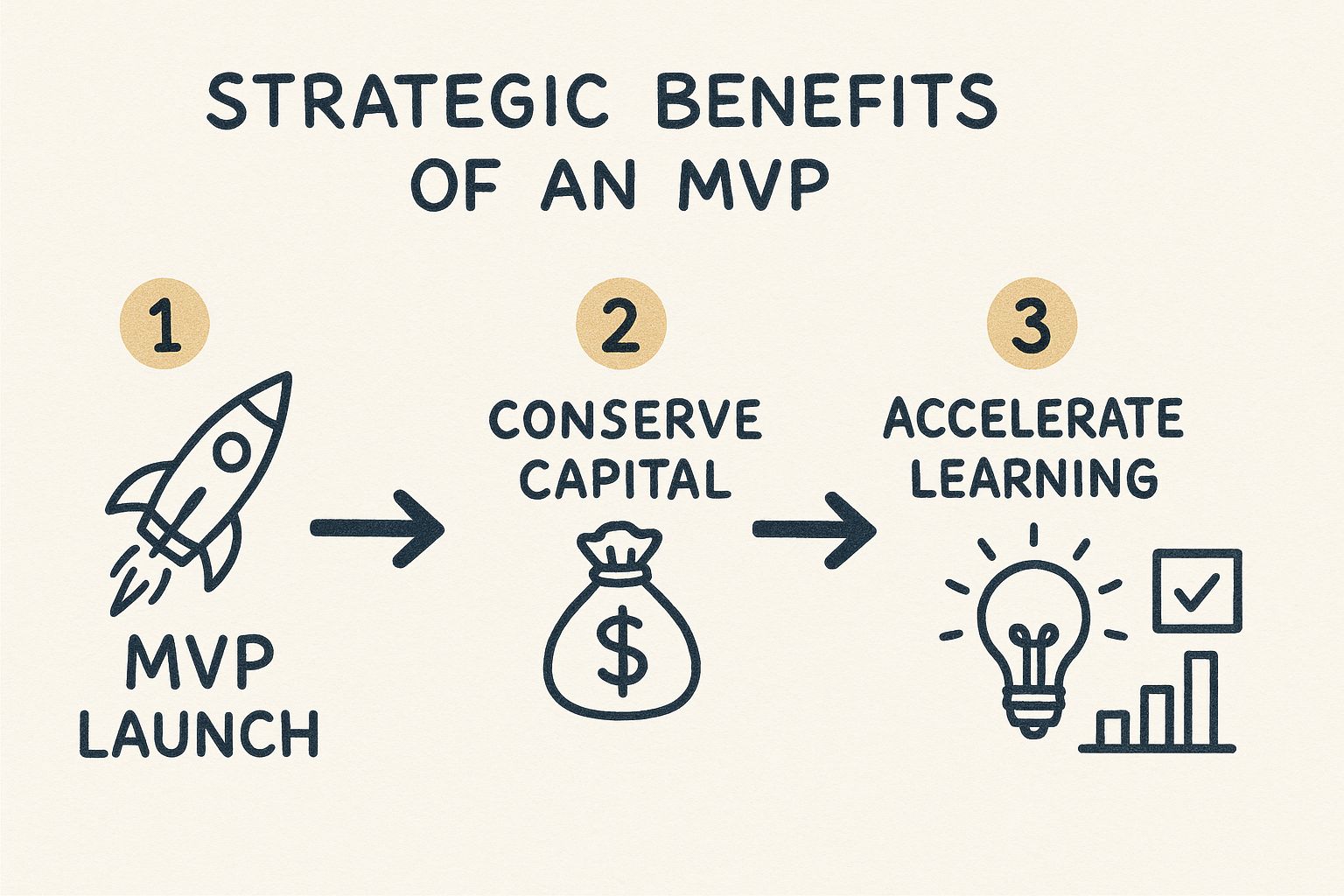
Think of it as a flywheel. Each step builds momentum for the next, making your venture stronger, smarter, and more likely to succeed.
Conserve Your Most Precious Resource: Capital
Cash is king for a startup. The fastest way to kill a great idea is to pour all your funding into a complex, feature-loaded product that’s built on pure guesswork. An MVP is your shield against this common mistake. It forces you to focus your limited resources on solving one core problem exceptionally well.
Practical Example: Instead of building a full-fledged social media scheduling platform for $150k, a startup could build a "concierge MVP" for $15k. This could be a simple web form where users submit their content, and the founder manually schedules it for them. This validates demand for the service before a single line of automation code is written.
Speed Up Your Learning
In the early days, what you learn about your customers is far more valuable than the code you write. An MVP is the ultimate learning machine. By getting a real product into the hands of real users quickly, you shrink the gap between your assumptions and market reality.
An MVP is what turns your guesses into facts. It stops you from saying, "I think users want this," and lets you say, "The data shows users are doing this."
Practical Example: Imagine you’re building a new project management app and you believe a "Gantt chart view" is a killer feature. Your MVP—a simple to-do list—reveals that 90% of your first 100 users are only creating tasks for themselves, not complex team projects. That single data point just saved you three months of development on a feature your core audience didn't need yet.
Validate Your Idea and Get Investors Talking
Investors don't bet on ideas; they bet on traction. An MVP delivers the hard evidence you need to prove a market exists for your solution. It shows you're gaining users, that people are actually engaging with your product, and maybe even generating early revenue. This is the kind of proof that gets you a serious meeting with a VC.
Actionable Insight: When you pitch to investors, don't just show them your MVP. Show them a graph of your user sign-ups for the last 30 days and share a direct quote from a user who loves the product. This real-world proof is infinitely more powerful than any projection on a slide deck.
MVP Approach vs Traditional Development
| Factor | MVP Development | Traditional Full-Product Development |
|---|---|---|
| Initial Cost | Low. Focuses on a single core feature. | Very High. Attempts to build all features at once. |
| Time to Market | Fast. Can launch in a few months. | Slow. Often takes over a year. |
| Risk Level | Low. Validates the idea before major investment. | High. Bets the entire budget on unproven assumptions. |
| Flexibility | High. Easy to pivot based on user feedback. | Low. Changes are costly and difficult to implement. |
| Learning Speed | Rapid. Gathers real-world data from day one. | Delayed. No user feedback until the final launch. |
| Investor Appeal | Strong. Provides traction and market validation. | Weak. Relies on a business plan and projections alone. |
As you can see, the MVP path is designed to give you the feedback, traction, and efficiency needed to survive and thrive.
Ultimately, a well-planned MVP isn't just about saving money—it’s about being smart. It conserves resources, delivers priceless market insights, and builds a solid foundation for growth. To see how this fits into the bigger picture, check out our guide on product development for startups.
Your Step-By-Step MVP Development Roadmap
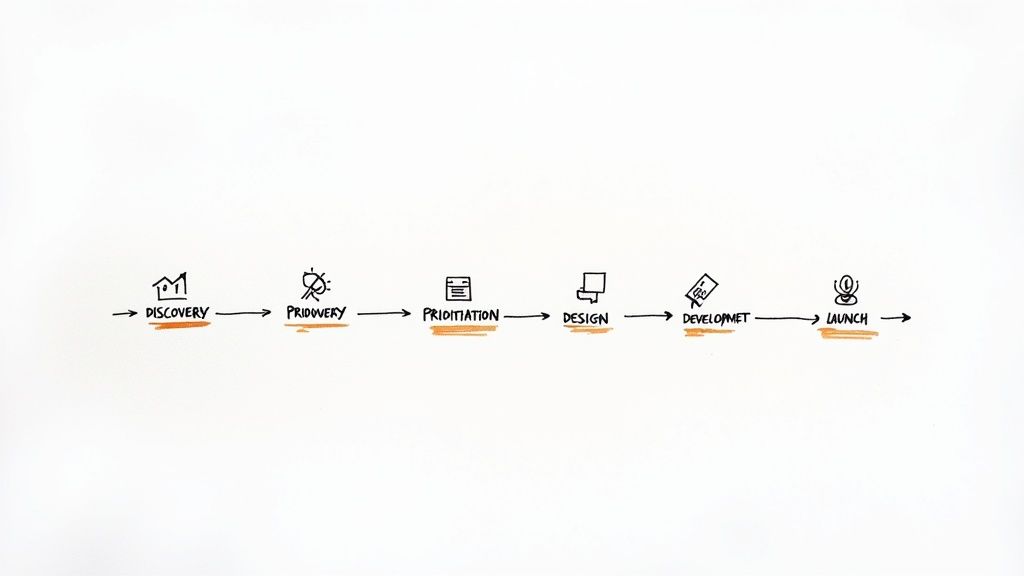
Turning a great idea into a real, working product can feel like a huge mountain to climb. But with a structured MVP development process, that climb becomes a clear, step-by-step path. Think of it less like a rigid instruction manual and more like a trusted map that guides you from a back-of-the-napkin sketch to a live product that’s actually making contact with your first users.
This roadmap is about more than just writing code. It’s a strategy for learning, fast. Every single step is designed to answer a crucial business question and chip away at the uncertainty that plagues every new venture. Following this path helps ensure that what you ultimately build isn't just a collection of features, but a focused solution to a real problem people have.
Let's walk through the key stages of getting your MVP off the ground, exactly how an experienced development partner would guide you.
Stage 1: Discovery and Market Research
Before a single line of code gets written, we have to nail down the most important question of all: what problem are you solving, and for whom? The discovery phase is all about digging deep into this, making sure your entire project is built on a bedrock of evidence, not just wishful thinking.
This means rolling up your sleeves and getting into some serious market research. You’ll be sizing up competitors, looking for gaps they've missed, and figuring out what makes your solution special. Even more critically, this is when you create detailed user personas—profiles of your ideal customers—to get inside their heads and truly understand their frustrations and goals.
Actionable Insight: Don't just research online. Your goal is to conduct at least 10-15 interviews with potential customers. Use a simple script with questions like, "Tell me about the last time you dealt with [the problem]," and "What's the hardest part about that?" Listen more than you talk.
Practical Example: Imagine you want to build an app for local pet sitters. During discovery, you interview 10 pet owners. Eight of them mention their biggest fear is their pet sitter being a no-show. This insight tells you your MVP must have a reliable booking and confirmation system. It's no longer a guess; it's a data-driven priority.
Stage 2: Feature Prioritization
Okay, you know the problem. Now comes the hard part: deciding what to build first. This is where so many projects go off the rails, falling victim to "feature creep"—that constant temptation to add just one more cool thing. Smart feature prioritization is really the art of saying "not right now."
To keep things focused, development teams rely on some simple but incredibly effective frameworks. These tools help you sort and rank potential features, making sure your MVP stays lean and targeted.
Here are a few popular methods with practical application:
- The MoSCoW Method: Group features into: Must-have, Should-have, Could-have, and Won't-have. Actionable Insight: Your MVP is built only from the "Must-haves." If your list has more than 3-5 "Must-haves," you're not being ruthless enough.
- Feature Priority Matrix: This is a simple 2x2 grid. You map features based on their value to the user versus the effort it takes to build them. Actionable Insight: Use a whiteboard. Draw the grid. Spend one hour with your team placing features as sticky notes. The top-right quadrant (High Value, Low Effort) is your MVP's feature list.
- The Kano Model: This method sorts features based on how they impact customer satisfaction. For an MVP, you stick to the "basic expectations" and core "performance" features that solve the main problem.
Choosing the right features is a central part of the digital product development process because it has a direct line to your budget and timeline. Getting this right is absolutely critical.
Stage 3: UI/UX Design and Prototyping
Now we get to bring your idea to life visually. The UI/UX (User Interface/User Experience) design phase is about creating a product that’s not just functional, but also intuitive and maybe even a little delightful to use. For an MVP, the name of the game is simplicity and clarity.
The process usually starts with wireframes—simple, black-and-white blueprints that map out the user's journey and screen layouts. Once those are locked in, designers create high-fidelity mockups with colors, fonts, and branding. Finally, these polished mockups are stitched together into an interactive prototype.
Actionable Insight: Use a tool like Figma or InVision to create your prototype. Then, get it in front of at least five potential users. Watch them try to complete a core task without giving them any instructions. Their points of confusion are a roadmap for what you need to fix before writing any code.
Stage 4: Agile Development Sprints
With a validated design ready to go, the dev team can finally start building. Modern startup MVP development services almost always use an agile approach, which means working in "sprints." A sprint is a short, focused burst of work—usually two weeks—where the team’s goal is to build and complete a small, usable piece of the product.
This iterative rhythm is incredibly powerful. At the end of every sprint, you have a working piece of software to look at and test. This means you’re seeing real progress constantly, giving feedback, and making course corrections along the way.
Practical Example: For our pet-sitter app, the development plan might look like this:
- Sprint 1: Build user login and basic pet-sitter profiles.
- Sprint 2: Develop the search and booking functionality.
- Sprint 3: Implement the core messaging system between owner and sitter.
- Sprint 4: Focus on payment integration and confirmations.
Each sprint delivers a testable piece of the core value proposition.
Stage 5: Launch and The Feedback Loop
Launching your MVP isn't the finish line—it’s the starting line. The whole point of this entire journey was to get to this moment, where your product is finally in the hands of real users, generating real data.
Once you’re live, the real work begins. You'll be using analytics tools to see how people are behaving, sending out surveys, and jumping on calls with your first users. Are they using that one feature you thought was a killer idea? Where are they getting confused? What do they absolutely love?
This information is pure gold. It feeds directly back into your product plan, kicking off a continuous cycle of "Build-Measure-Learn." Each time you go through this loop, you get smarter, and your product gets better. Practical Example: Zappos famously started by posting photos of shoes from local stores on their site. When someone bought a pair, they physically went to the store, bought the shoes, and shipped them. This simple, manual MVP validated their core hypothesis—that people would buy shoes online—without a dollar spent on inventory.
Choosing the Right Tech for Your MVP
Picking the right technology for your MVP is a lot like choosing the right tool for a job. You wouldn't use a sledgehammer to hang a picture frame, and you definitely don't need a massive, enterprise-level tech stack just to see if your core idea has legs. The whole point is to find tools that get you to market fast, don’t break the bank, and are just powerful enough to do the job right.
This decision shouldn't be about chasing the shiniest new technology. It’s a purely strategic choice that needs to line up perfectly with your business goals. Especially for non-technical founders, getting a handle on the "why" behind these tech choices is key.
Custom Code vs. No-Code Platforms
One of the first big forks in the road is deciding whether to build with custom code or lean on a no-code platform. Each path has its own set of trade-offs, and the right choice really depends on what you’re trying to achieve with your MVP.
No-Code Platforms (like Bubble or Webflow): These tools are built for speed. Practical Example: A founder could use Bubble to build a functional directory of local businesses in a weekend, test the idea for a month, and only then decide if it's worth investing in a custom-coded solution. They're perfect for simple concepts that don't require complex logic.
Custom-Coded Solutions: When your idea hinges on unique features, complex logic, or needs to handle sensitive data with care, custom code is the only way to go. This approach gives you total freedom and is designed to scale. Working with startup mvp development services on a custom build means you’re getting a solid foundation that can grow as your business does. To get a better feel for what this involves, our guide on custom web application development offers more detail.
The right tech stack isn't the most powerful one; it's the one that gets you to validated learning the fastest. Your first version is a tool for answering questions, not a forever platform.
This strategic choice is at the heart of a rapidly growing market. The MVP building tools market was valued at around USD 1.2 billion in 2023 and is projected to skyrocket to USD 3.8 billion by 2032. This explosive growth is all about the demand for tools that can slash development time—in some cases by as much as 70%. You can learn more about the rise of MVP building tools and market trends to see where the industry is heading.
Common Tech Stacks Explained Simply
If you decide to go the custom-code route, you’ll start hearing your developers talk about the "tech stack." Don't let the jargon intimidate you; it's just the collection of technologies they're using to build your product. Here’s a quick, no-nonsense look at some common choices for MVPs.
- For the Engine (The Backend):Node.js is a popular choice because it's fast and efficient for building the core logic of your app. For a social app MVP, it can handle real-time notifications and messages without breaking a sweat.
- For the User Experience (The Frontend):React is a crowd favorite because its component-based structure is like digital Lego, letting developers build user interfaces quickly. This means less time building buttons and more time perfecting your app's core workflow.
- For Mobile Apps on Any Device: Tools like React Native or Flutter are game-changers. Actionable Insight: If your audience is split between iPhone and Android users, choosing one of these can effectively cut your mobile development budget in half compared to building two separate native apps.
Making the Right Choice for Your Startup
So, how do you make the final call? A good development partner will walk you through the options, but it all boils down to a few key questions.
| Factor | Best Suited for No-Code | Best Suited for Custom Code |
|---|---|---|
| Speed to Launch | You need to test an idea in weeks. | You have a defined feature set and a 3-6 month timeline. |
| Complexity | Simple workflows, standard features, basic data. | Unique algorithms, third-party integrations, complex logic. |
| Budget | Tightly limited, focused entirely on validation. | Enough runway to build a scalable foundation. |
| Scalability | Good for your first few hundred users, but may hit a wall. | Built from the ground up to handle thousands or millions of users. |
At the end of the day, the technology behind your MVP is a business decision, not just a technical one. The right set of tools will help you learn faster, iterate smarter, and set you up for growth.
How to Choose the Right Development Partner
Picking a partner for your startup mvp development services is one of the biggest calls you’ll make as a founder. Think of it less like hiring a contractor and more like bringing on a technical co-founder for a make-or-break stage of your company. The right team won’t just sling code; they’ll push back on your bad ideas, offer up brilliant ones, and genuinely care about your success.
Your mission is to find a group that feels like a natural extension of your own team. This means you have to look past the shiny portfolios and really get into the nitty-gritty of their process, how they communicate, and whether they actually get what you're trying to build. A great portfolio shows you what they’ve made, but a great process shows you how they’ll build with you.
Look Beyond the Portfolio
A slick portfolio is table stakes. It’s a good starting point, but it only shows you the polished end result, not the messy, complicated journey to get there. To really understand if a partner is the right fit, you need to see how they operate when things don't go according to plan—because they never do. A team's ability to roll with the punches is way more valuable than a perfect paper record.
When you're on that first call, get them talking about problem-solving. Don't just ask about their home runs; ask about the projects that almost went off the rails. A team that's confident and transparent will be open about past struggles and what they learned. That kind of honesty is a huge green light for a healthy partnership.
Actionable Insights: Questions to Ask Potential Partners
- Process and Adaptability: "Tell me about a time a client's core assumption was totally wrong. How did you figure it out, and what did you do to pivot the project?"
- Feature Prioritization: "Let's say our initial feature list is way too big for our budget. Walk me through exactly how you'd help us slash it down to an MVP that still makes a real impact."
- Technical Philosophy: "How do you decide which technologies to use for a new product? Was there ever a time you chose a simpler, 'boring' tech stack over something new and shiny? Why?"
These kinds of questions shift the conversation from a sales pitch to a real working session, giving you a sneak peek of what it’s actually like to build with them.
Evaluate Their Communication and Collaboration Style
The way information flows between you and your development partner can literally make or break your MVP. Almost every delay and misunderstanding can be traced back to bad communication, not bad code. You need a team that’s proactive, open, and has a system for keeping you in the loop without drowning you in technical jargon.
Pay close attention to how they communicate from the very first email. Are their responses clear and to the point? Do they listen more than they talk on your first call? These little things are a massive preview of your future working relationship.
A true development partner doesn't just build what you ask for; they build what you need. They have the expertise and the courage to push back on an idea if they see a better way forward.
Actionable Insights: More Key Questions
- "What's your typical communication rhythm for a project our size? Do you use Slack, have daily stand-ups, or weekly demos?"
- "How do you handle scope changes? If we need to swap a feature mid-sprint, what does that process look like?"
- "Who would be my single point of contact, and how available will they be?"
You're looking for a partner who can clearly explain their process and is obsessed with transparency. A team that values clear, consistent communication is a team that respects your role as the founder. Finding an MVP development agency that clicks with your style is absolutely essential for a smooth ride.
Assess Their Business Acumen
The absolute best development partners are more than just amazing coders—they’re sharp business people. They get that every line of code has to connect back to a business goal, whether it’s getting more users, proving an idea, or making those first few dollars. They should be just as curious about your business model as they are about your tech stack.
A team with real business sense will grill you with tough questions about your customers, your revenue plans, and your key metrics (KPIs). They're not being nosy; they're making sure the thing they build for you has a fighting chance in the real world.
Actionable Insight: A Quick Checklist to Assess Business Savvy
- Do they ask about your users first? A great partner will be obsessed with understanding the person they're building for.
- Do they talk about metrics? They should ask "How will we measure success?" and suggest ways to track those metrics from day one.
- Do they challenge your assumptions? A partner who pushes back and asks "Why?" is trying to de-risk your project and save you money. This is a great sign.
Choosing the right partner is a massive investment in your startup’s future. If you focus on their process, communication, and business smarts, you’ll find a team that won't just build your MVP—they’ll help you lay the foundation for everything that comes next.
Common Questions About MVP Development
Stepping into the world of startup MVP development services always brings up a handful of critical questions for founders. It's a strategic dance, and getting the steps right can mean the difference between a product that takes off and one that never leaves the ground. Let's tackle some of the most common questions we hear every day.
How Much Does an MVP Typically Cost?
This is usually the first thing on everyone's mind, and the honest answer is: it depends. The price tag for an MVP is tied directly to what you're trying to build, the tech stack involved, and the development team's location. A simple prototype built with no-code tools might only be a few thousand dollars, but a custom-coded app with complex features will likely fall in the $25,000 to $75,000 range, or even higher.
Actionable Insight: Instead of asking agencies for a flat quote, ask them what kind of MVP they could build for a fixed budget (e.g., $30,000). This forces a conversation about scope and prioritization, which is far more valuable than just comparing price tags.
How Long Does It Take to Build an MVP?
Speed is one of the biggest draws of the MVP approach, but "fast" is a relative term. The timeline is almost entirely dictated by the scope you and your development partner decide on.
On average, a well-defined MVP project usually takes somewhere between 3 and 6 months. This window covers everything from the initial discovery and design phases, through the development sprints, and all the way to launch.
Here’s a practical breakdown:
- Discovery & Design: 2-4 weeks
- Development Sprints (2-week cycles): 4-8 sprints (8-16 weeks)
- Testing & Launch Prep: 1-2 weeks
If a timeline seems much shorter, the product might be too simple to be "viable." If it's much longer, you're probably drifting away from the "minimum" part of the equation.
What Happens After the MVP Is Launched?
Launching your MVP isn't the finish line—it's the starting gun. The whole point of building an MVP is to get your hands on real-world data and feedback from actual users. Once you're live, your focus needs to pivot immediately to the "Build-Measure-Learn" feedback loop.
Actionable Insight: Your First 30 Days Post-Launch
- Measure Everything: Use analytics to track your one key metric. Don't get lost in vanity metrics like page views; focus on user engagement.
- Learn from Users: Personally email your first 50 users and ask for 15 minutes of their time to chat about their experience. Offer them a gift card for their time.
- Build the Next Iteration: Use that direct feedback to plan your next two development sprints. Focus on the biggest pain points users mentioned.
A great launch isn't about having a perfect product on day one. It’s about shipping something that's good enough to start a dialogue with your market, and then listening carefully to what they tell you.
The goal of an MVP is to maximize learning while minimizing risk. The launch is not the end of development, but the beginning of data-driven product evolution.
Isn't an MVP Just a Cheaper, Lower-Quality Product?
This is a huge misconception we have to clear up all the time. An MVP is not a buggy or poorly made product. It's a high-quality, focused product that does just one or two things incredibly well.
The "minimum" in MVP refers to the scope of features, not the quality of the work. If your MVP's core function is to process a payment, that single feature needs to be rock-solid, secure, and completely reliable. Think of it like building one perfect, polished gear from a complex machine, rather than slapping together the whole machine with cheap parts.
Ready to turn your idea into a market-validated product? At Pixel One, we specialize in helping startups build strategic MVPs that deliver real insights and lay the foundation for scalable growth. Let's build your raft and get you across the river.