
What Is Growth Hacking? Your Guide to Rapid Growth
What is growth hacking? Discover the data-driven mindset, actionable strategies, and real-world examples that fuel rapid, sustainable business growth.So, what exactly is growth hacking? At its core, it's a discipline built on rapid, data-driven experimentation across the entire business—from marketing and sales right through to product development. It’s all about finding the most clever, efficient, and actionable ways to grow.
Think of it as a mindset obsessed with scalable growth. Instead of pouring money into traditional marketing campaigns, a growth hacker looks for creative, often low-cost, strategies to move the needle. For example, instead of a big ad spend, they might create a free, valuable tool that attracts their ideal customer, like HubSpot's Website Grader.
Decoding the Growth Hacking Mindset
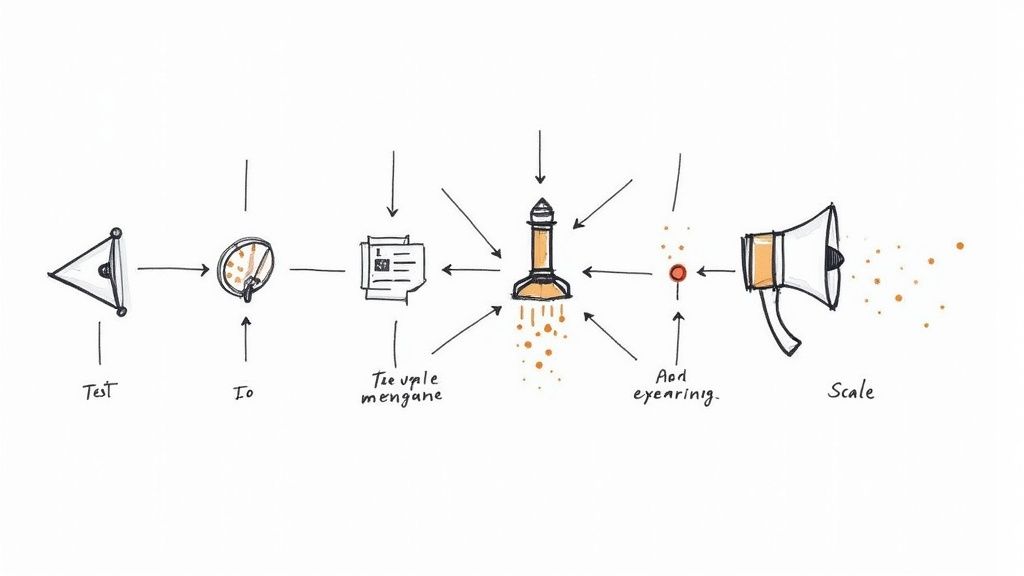
To really get it, let's compare. A traditional marketing team might spend months planning a big-budget ad campaign to build brand awareness. A growth team, on the other hand, might run a dozen small, targeted experiments in a single week to see which one actually gets people to sign up. A practical example would be testing five different headlines on a landing page with a small budget to see which one converts best, before scaling the winner.
This approach is a mash-up of creative marketing, product engineering, and data analysis. The "hacking" part isn't about anything malicious. It’s about finding those ingenious shortcuts to growth that traditional marketers often miss.
A growth hacker's true north is growth. Every decision, every strategy, and every tactic is evaluated based on its potential impact on scalable growth. This relentless focus is what separates it from broader marketing efforts.
The entire process is built on a simple loop: test a hypothesis quickly, analyze the results, and then double down on what works while killing what doesn't. This high-tempo cycle helps businesses find what moves the needle much faster than those stuck in long, drawn-out campaigns.
Growth Hacking vs Traditional Marketing
To make the distinction crystal clear, it helps to see growth hacking and traditional marketing side-by-side. While both want the business to succeed, they take fundamentally different paths to get there. One is all about speed and learning, while the other relies on established channels and building a brand over time.
This table highlights the core differences.
| Aspect | Growth Hacking | Traditional Marketing |
|---|---|---|
| Primary Goal | Rapid, scalable, and sustainable user growth | Brand awareness, lead generation, and market share |
| Process | Fast-paced experimentation and iteration (Agile) | Long-term planning and campaign execution (Waterfall) |
| Focus | The entire customer funnel (Acquisition to Referral) | Top of the funnel (Awareness and Acquisition) |
| Metrics | User activation, retention rates, virality, LTV | Website traffic, impressions, reach, leads |
| Budget | Typically low-cost, creative, and data-driven | Often requires significant investment in paid channels |
| Team Structure | Cross-functional (marketing, product, engineering) | Departmental (siloed marketing and sales teams) |
As you can see, the philosophies are worlds apart. Growth hacking is less about big budgets and more about big ideas tested on a small scale, while traditional marketing plays the long game with established, often costly, methods.
The Story Behind the Growth Hacking Movement
Growth hacking wasn't born in a boardroom. It was forged in the fire of the early 2010s tech scene, where startups were long on ideas but short on cash. Back then, you couldn't just throw money at a big ad campaign and hope for the best. Survival depended on finding a smarter way to grow.
This pressure cooker environment called for a new type of professional. Traditional marketers were great at building brands over the long haul, but startups needed to show explosive growth now to secure their next round of funding. They needed someone laser-focused on one thing and one thing only: growth, by any ethical means necessary.
The Birth of a New Discipline
In 2010, an entrepreneur named Sean Ellis finally gave this new role a name. In a now-famous essay, "Find a Growth Hacker for Your Startup," he defined a growth hacker as someone whose "true north is growth." This person wasn't just a marketer; they were a hybrid of a marketer, developer, and data analyst, all rolled into one. You can read more about the origin story and its impact on modern business at Built In.
The idea caught on like wildfire, championed by figures like Andrew Chen and Gagan Biyani. By 2013, the movement was big enough to warrant its first-ever Growth Hacker Conference. This wasn't about replacing marketing, but rather about evolving it for a new, fast-paced digital era. The pioneers of this movement are now some of the biggest names in tech.
- Airbnb: Famously reverse-engineered a way to post its listings on Craigslist, instantly tapping into a massive, ready-made audience looking for places to stay.
- Dropbox: Built one of the most brilliant referral programs ever. It offered free storage to both the person referring and the new user they signed up, effectively turning its entire user base into a volunteer sales force.
- Facebook: Obsessed over a single metric. They discovered that if a new user added 7 friends in 10 days, they were almost guaranteed to stick around. So, the entire onboarding experience was engineered to make that happen.
These weren't just clever marketing stunts. They were growth engines baked directly into the product itself. This blend of product, data, and marketing is the very soul of growth hacking.
By running these kinds of high-impact experiments, these startups grew at an incredible pace without the traditional marketing budgets of their established competitors. They proved that if you truly understand your customer and aren't afraid to test new ideas quickly, you can create a powerful formula for success. Applying these lessons starts with a solid foundation, which is why we put together a guide on how to successfully bring a product to market.
The Three Pillars of the Growth Hacking Mindset
While specific tactics are always changing, growth hacking itself is really a mindset. It’s not about finding a magic playbook of tricks; it’s about a fundamental way of thinking that powers every successful strategy. This entire approach stands on three core pillars that work together to build a real, sustainable engine for growth.
Once you get these principles, you can stop throwing random tactics at the wall and start building a repeatable process for discovering what actually moves the needle for your business.
Pillar 1: Radical Data-Driven Experimentation
The first and most important pillar is a deep, unwavering commitment to data-driven experimentation. Growth hackers just don't run on gut feelings or what everyone else is doing. Instead, every single action is treated as a test, and every test begins with a clear, measurable hypothesis.
Think of it this way: a traditional marketer might launch a big, new ad campaign because the creative feels right. A growth hacker, on the other hand, would form a hypothesis like, "I believe changing our ad headline from 'Powerful Software' to 'Save 10 Hours Per Week' will boost click-through rates by 20%, because it focuses on a tangible benefit."
They’d then run a small, cheap A/B test to see if they're right. This scientific approach turns the guesswork of growth into a series of calculated experiments.
By digging into charts like this, a growth team can see exactly where users are getting stuck and come up with smart hypotheses for experiments to fix the problem.
Pillar 2: A Full-Funnel Focus
The second pillar is an obsession with the entire customer journey, not just grabbing attention at the top of the funnel. Traditional marketing often pours its energy into awareness and getting new leads, but growth hacking looks at every single stage.
Growth hackers are just as worried about:
- Activation: How fast can we get a new user to that "aha!" moment where they get the value of our product? For a project management tool, this might be when a user creates their first task and invites a team member.
- Retention: Are people actually coming back? If not, why? An actionable insight here could be sending a targeted email to users who haven't logged in for 7 days, offering a tip or a new feature.
- Revenue: How do we turn our user base into a profitable business?
- Referral: Can we turn our happiest customers into a marketing channel of their own?
By optimizing each stage of this journey, you're essentially plugging the holes in a leaky bucket. Imagine you analyze your data and discover that 70% of new sign-ups bail after their first login. A growth team would immediately start running experiments to improve the onboarding flow, which directly boosts both activation and long-term retention. Many of these tests fall under the umbrella of effective conversion rate optimization strategies.
Pillar 3: Cross-Functional Collaboration
Finally, the best growth ideas almost never come from a single department. The third pillar is cross-functional collaboration—breaking down the walls that usually separate marketing, product, and engineering.
The most powerful growth strategies happen at the intersection of marketing insight, product functionality, and engineering capability. When these teams work in unison, they can execute complex ideas that a siloed team could never achieve.
This reliance on data is what sets growth hacking apart. Growth teams live in their analytics tools to understand user behavior, spot opportunities, and tweak their strategies on the fly. For instance, a growth hacker might be digging into data from social media, landing pages, and digital ads all at once to find a weak link and improve performance. This is a world away from traditional methods that often rely on huge budgets and slow, long-term campaigns.
By using data to drive small, rapid changes, growth teams can find scalable strategies that get results fast—which is exactly why the approach is a perfect fit for startups. You can find more great insights about data-driven growth on GoPractice.
Executing a Growth Hacking Cycle
Knowing the theory is one thing, but actually putting it into practice is where growth hacking gets exciting. This isn't about throwing random marketing tactics at the wall to see what sticks. It's a disciplined, repeatable process for turning ideas into real, measurable growth.
The whole cycle kicks off with generating ideas, which is part art, part science. You might dig into your analytics to find where users are dropping off, send out a customer survey to pinpoint their biggest frustrations, or just get your team in a room for a good old-fashioned brainstorm. The aim here is to build a backlog of potential experiments, each one tied to a specific metric you want to nudge upwards.
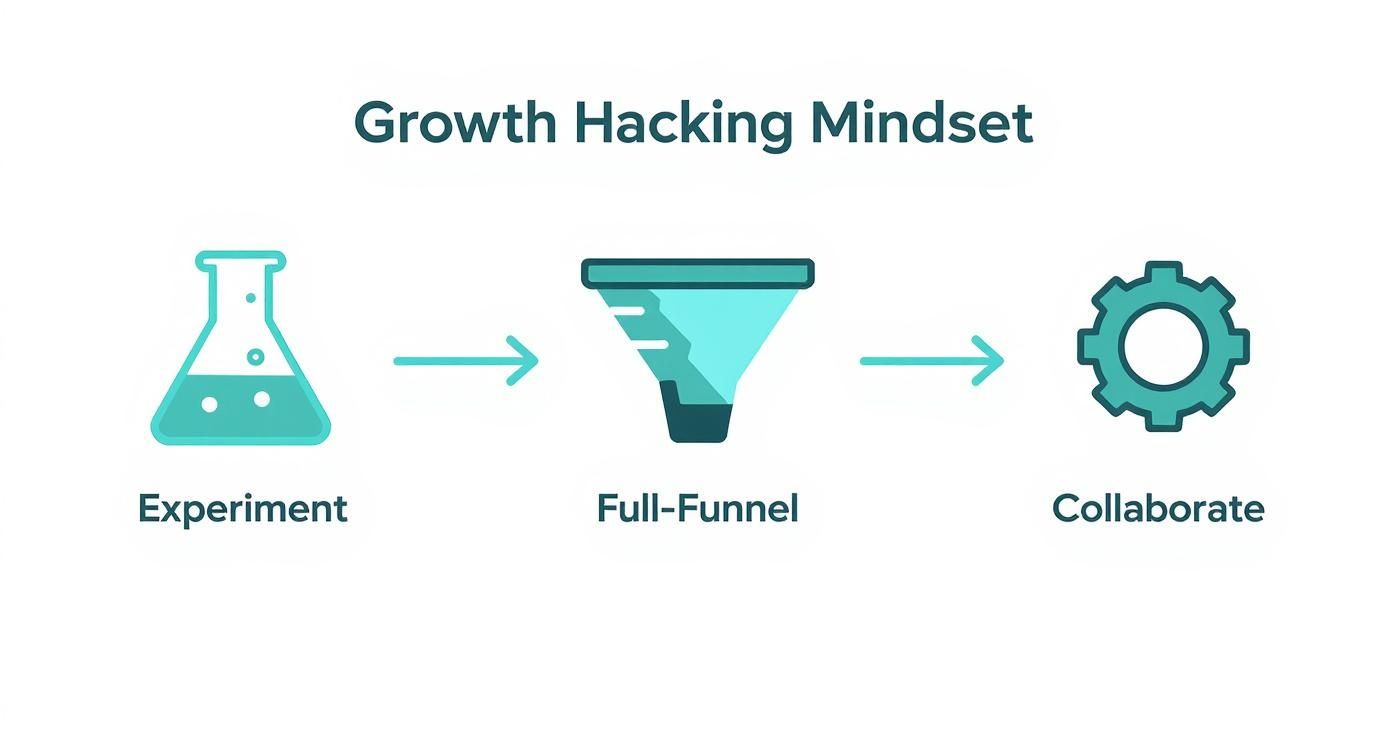
Prioritizing Your Growth Experiments
Okay, so you have a long list of ideas. Now what? You can't possibly test everything at once, so you have to prioritize. A simple but incredibly effective way to do this is with the ICE score, which stands for Impact, Confidence, and Ease.
- Impact: If this experiment is a home run, how much will it actually move the needle on our goals? (e.g., A homepage headline change has a higher potential impact than changing a footer link).
- Confidence: Based on data or past results, how sure are we that this will even work? (e.g., An idea based on customer feedback has higher confidence than a random guess).
- Ease: Realistically, how much time and effort will this take to get live? (e.g., Changing button text is easier than building a new feature).
You score each factor from 1 to 10. Multiply them together, and you get your ICE score. The ideas with the highest scores jump to the top of the list, making sure you’re always focusing your energy where it counts the most. This discipline is what separates frantic activity from productive experimentation and helps you manage your spending effectively. For a closer look at your spending, our customer acquisition cost calculator is a great tool for tracking these metrics.
From Hypothesis to Analysis
Once you’ve picked a winner, it’s time to run the experiment. Let's say a SaaS company is struggling to get free-trial users to upgrade. Their experiment might be to change the call-to-action button in their onboarding emails. A solid hypothesis would sound something like this: "Changing the email CTA from 'Upgrade Now' to 'Unlock Premium Features' will increase our trial-to-paid conversion rate by 15% within two weeks."
You run the test, collect the data, and then—the most important part—you analyze the results. Did it work? Did it flop? And most importantly, why? This is where the real learning happens.
If the test was a success, that change gets baked into the product. If it failed, you’ve still won, because you learned something valuable that will inform your next round of ideas. And just like that, the cycle begins again. It’s this continuous loop of ideating, testing, and learning that truly powers growth.
Iconic Growth Hacking Success Stories
Theory is one thing, but seeing growth hacking in the wild is where its true power clicks. The most legendary success stories often didn't come from massive budgets. They came from a single, brilliant insight into what makes users tick.
These examples show how simple, clever experiments can create unstoppable momentum.

These weren't just one-off tricks; they were masterclasses in understanding the customer journey and weaving marketing right into the product itself.
Dropbox: Turning Users Into Marketers
Dropbox had a big problem: how do you get noticed in a crowded cloud storage market? Instead of blowing millions on ads, they built a simple referral program that has since become one of the most famous growth hacks ever.
The idea was simple but incredibly effective. When a user referred a friend, both of them got extra storage space for free. This two-sided incentive turned their entire user base into a passionate, volunteer marketing army. It was a true win-win that kicked off explosive, viral growth.
Airbnb: Piggybacking on an Existing Audience
In the early days, Airbnb had the classic startup dilemma—plenty of great listings, but not nearly enough eyeballs on them. Their solution? Go where the users already were: Craigslist.
The team built a lightweight integration that let hosts cross-post their Airbnb listings to Craigslist with a single click. This genius move instantly put their properties in front of a huge, highly relevant audience. They solved their visibility problem overnight without spending a dime on ads. This strategy is a textbook example of creating one of the most scalable business model examples by tapping into existing platforms.
Hotmail: The Viral Email Signature
One of the earliest and most powerful growth hacks came from Hotmail. Before it was a household name, the team added a simple, clickable line at the bottom of every single email sent from their platform: "P.S. Get your free email at Hotmail."
This wasn't just a marketing message; it was a growth engine built directly into the core function of the product. Every email sent became a tiny, personal advertisement for Hotmail, leading to millions of new sign-ups.
These strategies prove that growth hacking works everywhere. The consultancy Simon-Kucher reported helping a retail client boost monthly revenue by 450% and a banking client increase deposits by 40 million within a year by applying these same principles. Each of these stories gets to the heart of what is growth hacking: finding smart, scalable ways to grow your business.
Putting Growth Hacking to Work in Your Business
So, how do you actually start applying these growth hacking principles? You don't need a massive budget or a Silicon Valley zip code. It really boils down to having a structured approach to experimentation, and it all starts with a single, unifying goal.
The first thing you absolutely must do is define your North Star Metric (NSM). Think of this as the one number that best reflects the core value your customers get from your product. For Facebook, it was all about "monthly active users." For Airbnb, it was "nights booked." Your NSM gets everyone—from the product developers to the marketing team—rowing in the same direction. An actionable first step is to hold a meeting with key stakeholders and ask: "If we could only track one metric to measure our success, what would it be?"
Assembling Your Growth Team
Once that goal is crystal clear, you need a crew to go after it. A great growth team isn't huge; it's small, quick on its feet, and brings together different skill sets. You'll typically want a mix of people from marketing, product, and engineering. This cross-functional setup is key because it allows the team to come up with ideas, build the tests, and analyze the results without getting bogged down in red tape.
To get the job done, your team will need a few essential tools. A basic growth stack usually includes:
- Analytics: Something like Google Analytics is non-negotiable for understanding what users are doing and tracking conversions.
- A/B Testing: Tools like Optimizely or VWO let you test changes to your website or app to see what actually works.
- User Insights: With Hotjar or Crazy Egg, you can use heatmaps and watch session recordings to literally see where users click and scroll.
Fostering a Culture of Experimentation
More important than any tool, though, is building a company culture that truly embraces experimentation. This means getting comfortable with testing and learning, and it means celebrating the insights from a "failed" experiment just as much as a big win. A practical way to do this is to hold weekly "growth meetings" where the team shares results from all experiments—wins and losses—and discusses what was learned from each.
When your team knows it's okay to fail, they're free to take the kind of smart risks that often lead to the biggest breakthroughs.
In a growth-oriented culture, a failed test is not a waste of resources. It's valuable data that tells you what not to do, bringing you one step closer to discovering what truly works.
By locking in your NSM, putting together a dedicated team, and nurturing a culture of experimentation, you're building a powerful, repeatable engine for growth. This is the foundation for so many effective startup marketing strategies and can be scaled to fit a business of any size.
Answering Your Top Growth Hacking Questions
Even with a solid framework, a few questions always seem to come up. Let's dig into some of the most common ones to clear the air about what growth hacking looks like on the ground.
Is Growth Hacking Just a Startup Thing?
Not at all. While the term was definitely born in the fast-and-furious startup scene, the principles are incredibly versatile. Big players like Amazon and Netflix are constantly running growth experiments to fine-tune the user experience and uncover new ways to make money. For instance, Amazon's "Customers who bought this item also bought" feature is a classic growth experiment designed to increase the average order value.
At its core, growth hacking is about rapid, data-driven experimentation. That’s a powerful tool for any business that wants to grow smarter, whether you’re a two-person team or a multinational corporation.
How Is a Growth Hacker Different From a Digital Marketer?
The biggest distinction is the scope of their focus. A traditional digital marketer typically lives at the top of the funnel, concentrating on things like brand awareness and bringing in new leads. For example, they might focus on running a successful Google Ads campaign.
A growth hacker, on the other hand, is responsible for the entire customer journey. They're obsessed with optimizing every single step, from the moment a person first discovers the brand (acquisition) all the way through to turning loyal users into vocal advocates (referral). It’s a role that blends marketing creativity with product development and data analysis.
One of the biggest mistakes I see businesses make is getting caught up in vanity metrics—think social media likes or a spike in website traffic. Real growth hacking ignores the fluff and zeroes in on actions that produce sustainable results, like boosting user retention or increasing customer lifetime value.
Another common misstep is running tests without a solid hypothesis. A true growth experiment isn't just about throwing spaghetti at the wall to see what sticks. It's a calculated test designed to prove or disprove a specific, measurable idea. This disciplined mindset is what separates random tactics from a genuine growth strategy and ensures you learn something valuable from every experiment, win or lose.
Ready to build a product that’s engineered for growth from day one? Pixel One is a digital product studio that helps startups and enterprises launch and scale with data-driven strategies. Let's build something remarkable together at https://www.pixelonelabs.com.