
Guide to Digital Transformation Consulting Services
Discover how digital transformation consulting services can drive growth. Learn to choose the right partner, understand the process, and measure real ROI.Think of digital transformation consulting as bringing in a master architect to help you redesign your entire business for the modern world. It’s not just about installing the latest software or moving to the cloud. It's a fundamental partnership focused on rethinking how you operate, how you connect with customers, and how you create value.
Simply put, these services are about rewiring your business from the inside out, using technology as the catalyst for real growth and efficiency. An actionable first step is to ask your team: "What's the one manual, repetitive task that wastes the most time each week?" The answer often points to the first, and most impactful, area to transform.
What Are Digital Transformation Consulting Services

Let's use an analogy. Imagine your business is a classic, well-built ship. It's sturdy and has served you well for years, but it relies on sails and a compass. A digital transformation consultant is the naval engineer who helps you install a modern engine, a GPS navigation system, and real-time weather tracking. They don't just patch a few holes; they re-engineer the vessel to make it faster, safer, and more efficient for today's journeys.
This kind of partnership is designed to push your company past small, incremental changes. The real goal is to build a more agile, resilient, and customer-focused organization that can adapt and thrive no matter how the market changes.
It's More Than a Tech Upgrade
At its heart, true digital transformation is a deep cultural and operational shift. Consultants are there to guide you through this journey by concentrating on a few key areas that drive real business results.
A good consulting partner will always start with your core business pillars. The table below breaks down the main areas where they apply their expertise, with actionable examples.
Key Pillars of Digital Transformation Consulting
| Pillar | Focus Area | Actionable Example |
|---|---|---|
| Strategy & Vision | Aligning technology investments with long-term business objectives. | A retailer's goal is to increase customer loyalty. The actionable strategy is to create a digital roadmap that prioritizes an integrated mobile app for personalized offers and a seamless checkout experience. |
| Process Modernization | Re-engineering outdated workflows to boost efficiency and cut costs. | The finance team spends 40 hours a month on manual invoice processing. An actionable solution is to implement an automated accounts payable system that scans invoices, matches them to purchase orders, and schedules payments, cutting processing time by 90%. |
| Customer Experience | Creating seamless, personalized, and engaging customer journeys. | A hotel chain wants to improve the guest experience. An actionable step is to develop an app that handles mobile check-in, keyless room entry, and in-room service requests, eliminating friction points for travelers. |
| Data & Analytics | Turning raw data into actionable insights for smarter decision-making. | A marketing team struggles to prove campaign ROI. An actionable solution is to build a unified analytics dashboard that tracks customer acquisition cost (CAC) and lifetime value (LTV) in real-time for each channel. |
| Technology Enablement | Selecting and implementing the right tools (Cloud, AI, IoT) to power new processes. | A growing company faces server crashes during peak traffic. An actionable step is migrating its e-commerce platform to a scalable cloud provider like AWS to ensure 99.99% uptime. |
| Change Management | Ensuring employees understand, adopt, and champion new ways of working. | A sales team resists using a new CRM. An actionable plan includes appointing peer "champions" to lead training, creating short video tutorials for key features, and running a contest for the team with the best adoption rate. |
This holistic approach is what makes the difference. It connects the dots between technology, people, and processes, making sure that new tools aren't just installed, but actually embraced by the team. This is a crucial element that's often central to successful digital product development services.
Digital transformation is less about technology and more about strategy. It's about how you can use digital capabilities to create fundamentally new business models and customer experiences.
The need for this kind of strategic guidance is exploding. The global market for digital transformation consulting was valued at around USD 344.72 billion in 2024 and is expected to rocket to USD 896.21 billion by 2033.
This incredible growth underscores just how essential these partnerships have become for any company that wants to stay in the game. You can dig into the numbers yourself in the full report on digital transformation consulting from Straits Research. Ultimately, these services provide the seasoned expertise and outside perspective needed to navigate complex but necessary changes.
Building Your Digital Transformation Framework

A genuine transformation is never about buying a single piece of software and hoping for the best. It's about building a solid framework that aligns your technology, people, and processes toward a common goal.
Think of it like building a modern, resilient house. You wouldn't just buy a pile of expensive materials without a blueprint, right? A digital transformation framework is that blueprint. It ensures every component fits together perfectly and supports the entire structure.
This framework stands on four critical pillars. Each one tackles a different part of your business, and real success only happens when all four are developed in harmony. Let's break them down with some practical, real-world examples.
Technology Integration
This is all about choosing and deploying the right tools to solve actual business problems—not just chasing the latest shiny object. An actionable first step is to audit your current tech stack and ask your teams, "Where do our systems fail to talk to each other?" This often reveals critical gaps that new technologies like AI, IoT, or cloud services can fill. The goal isn't just to add more tech, but to create a connected ecosystem where data flows freely.
A practical example comes from logistics. Imagine a mid-sized shipping company bringing in digital transformation consulting services to install an IoT sensor network across its fleet.
- Before: Drivers manually reported their locations, giving dispatchers spotty visibility. This often led to delays and inefficient routing.
- After: Real-time data from IoT sensors now tracks everything—vehicle location, fuel levels, even cargo temperature. This information feeds into an AI system that optimizes routes on the fly, predicts maintenance needs, and gives customers dead-accurate ETAs.
This isn't just a new feature; it's a fundamentally smarter, more transparent supply chain. Making this work requires a powerful backend, which is where expert enterprise web app development becomes critical for connecting these new data streams with your core operational platforms.
Process Optimization
Once you have the right technology, the next step is to rethink the workflows it supports. Process optimization is about hunting down bottlenecks, automating mind-numbing repetitive tasks, and making your entire operation leaner. A great actionable insight here is to apply the "Five Whys" technique to a broken process. Ask "why" it's done a certain way five times to uncover the root cause, which is often an outdated assumption that technology can now solve.
Take a manufacturing firm that was struggling with quality control. Manual inspections were slow and riddled with human error, leading to a 5% defect rate that was eating into profits.
By focusing on process optimization, the firm integrated automated visual inspection systems powered by machine learning. High-resolution cameras now scan products on the assembly line, spotting microscopic defects with 99.9% accuracy and flagging them instantly. This not only dropped the defect rate to nearly zero but also freed up skilled inspectors to focus on more complex challenges.
This is a perfect illustration of using technology to fundamentally overhaul a core business process, resulting in real cost savings and a superior product.
Cultural Adoption
Here’s the pillar that is often the most challenging, yet arguably the most important. The world's greatest technology and processes are useless if your team refuses to use them. Cultural adoption is the human side of the equation. An actionable tactic is to create a "What's in it for me?" document for each department, clearly outlining how the new tools will make their specific jobs easier, not harder.
A financial services firm rolling out a new CRM system is a classic case study.
- Initial Resistance: Employees were comfortable with their old spreadsheets and saw the new platform as an unnecessary complication.
- Strategic Intervention: Consultants helped launch a change management program. This involved training influential "champions" on each team, clearly communicating the benefits (like less admin work and more time selling), and running hands-on workshops.
- Successful Adoption: By directly addressing fears and showing people what was in it for them, the firm hit a 95% adoption rate in six months. The result? A 20% jump in sales productivity.
Customer Experience Reinvention
Finally, every part of the framework must point outward, toward your customer. This pillar leverages digital tools to create seamless, personalized, and memorable experiences. A practical step is to map your customer journey from first contact to post-purchase support, identifying every point of friction. Digital tools can then be applied to smooth out those specific pain points.
A traditional retailer, for instance, can completely reinvent its customer experience with an omnichannel strategy. By integrating its physical stores with its e-commerce platform, it can offer practical services like "buy online, pick up in-store." It can also send personalized recommendations based on a customer's entire purchase history, both online and off. This creates a unified journey that builds lasting loyalty and keeps customers coming back.
Navigating the Consulting Engagement Process
So, what does it actually look like to work with a digital transformation consultant? It’s easy to imagine it as some mysterious process. The reality is far more structured and collaborative.
Think of it like building a custom home. You wouldn't just tell an architect to "build a nice house." You'd start with a deep dive into your family's needs, draft detailed blueprints, and then build and inspect the home in phases. A consulting engagement follows a similar, logical path designed to deliver real value at every turn.
This process generally moves from initial analysis all the way through to final execution, ensuring every step is built on the one before it.
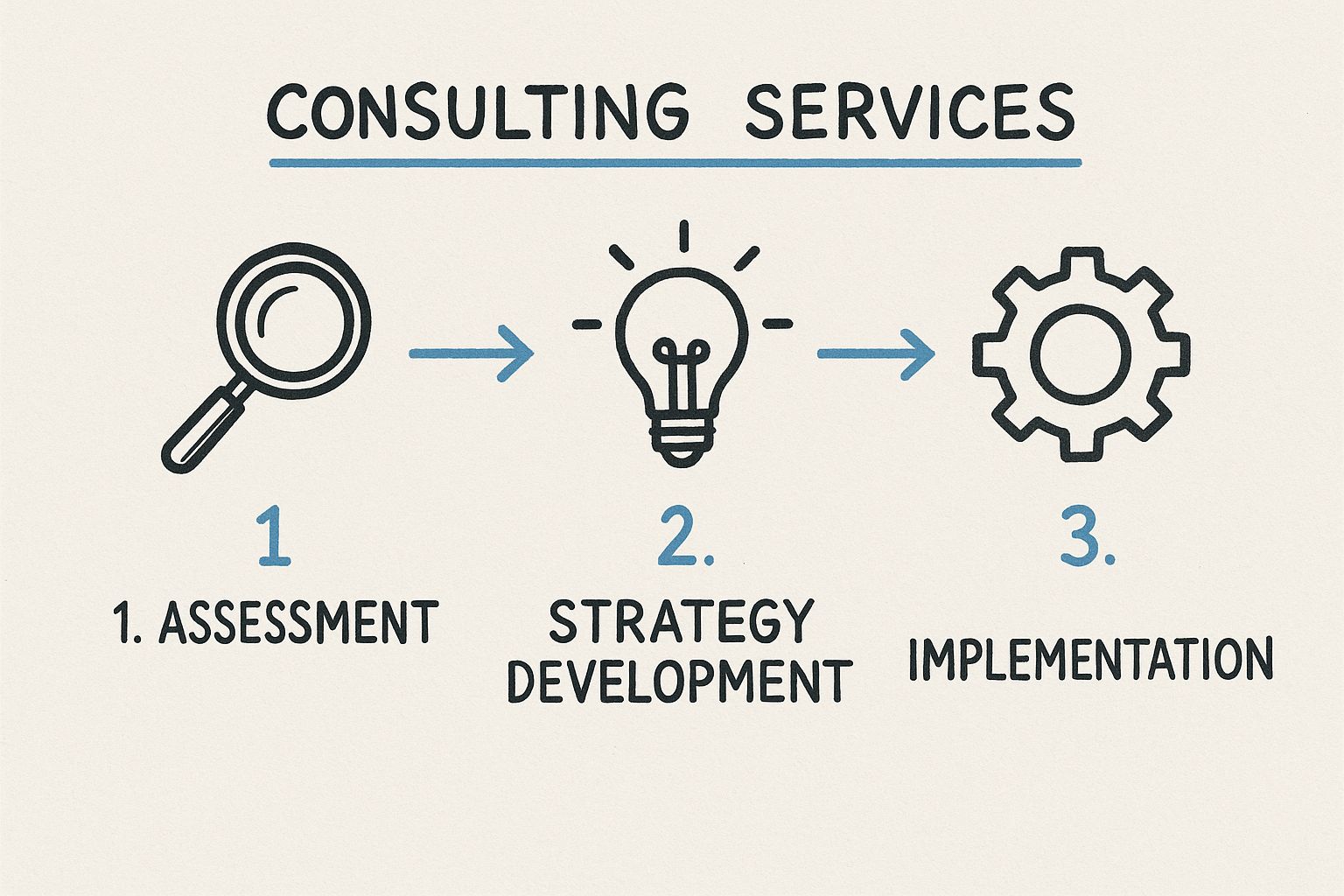
The flow from assessment to implementation makes one thing clear: a successful strategy is built on deep understanding and careful planning, not just a rush to deploy new tech.
Discovery and Assessment
This first phase is all about diagnosis. A good consultant’s first job is to become an expert on your business. They’ll act like organizational detectives, interviewing key stakeholders, mapping out your current workflows, and auditing your entire technology stack.
The goal here isn't just to spot the obvious problems. It’s to uncover hidden opportunities. Your role in this is crucial—the more open and honest you are, the better the final strategy will be.
To get the most out of this stage, an actionable step is to prepare a "pain point" document beforehand. List the top three operational bottlenecks, the most common customer complaints, and where you feel competitors are pulling ahead. This gives the consultant a running start. Be ready to tackle questions like:
- What manual process, if automated, would save the most time?
- Which customer-facing processes generate the most support tickets?
- Where do you feel like competitors are providing a better digital experience?
This deep dive ensures the entire plan is built on a solid foundation of reality, not just assumptions.
Strategy and Roadmap Development
Once there’s a clear picture of your starting point, the focus shifts to creating a tangible plan. This is where the consultant translates all those findings into a strategic roadmap—a step-by-step guide showing you how to get from where you are today to where you want to be tomorrow.
This isn’t some vague mission statement. A proper roadmap is a concrete document that outlines specific initiatives, sets clear priorities, and establishes measurable Key Performance Indicators (KPIs). An actionable example: instead of a goal to "improve customer service," the roadmap would detail an initiative like, "Implement a new CRM system to reduce average ticket response time by 30% within nine months, tracked weekly."
A great digital transformation roadmap provides clarity and focus. It breaks down a massive, intimidating goal into a series of manageable, sequential steps, making the entire journey feel achievable.
This document becomes your north star, getting everyone from the C-suite to the front lines aligned on what needs to be done, why it's important, and what success looks like.
Agile Implementation and Execution
With the roadmap in hand, it’s time to start building. Most modern digital transformation consulting services use an agile approach instead of a massive, "big bang" launch. Solutions are rolled out in smaller, manageable chunks or "sprints."
This iterative method allows for constant feedback and delivers quick wins that build momentum. For instance, a project to overhaul an e-commerce platform might begin by improving just the checkout process—a practical, small change with a potentially huge impact. The team implements the update, measures the effect on conversion rates, gathers user feedback, and then refines the solution before tackling the next feature.
This agile style of execution minimizes risk and proves the project's value early on, which is essential for keeping stakeholders bought in. This phase often requires tight collaboration with technical teams that specialize in building robust back-end systems. To get a better feel for what that involves, you can explore the best practices for enterprise app development services that are often needed to support these rollouts.
Continuous Optimization and Support
The work doesn’t just stop once a new system goes live. The final stage is really a continuous loop: measure, learn, and refine. Consultants help you track the KPIs laid out in the roadmap, analyze the performance data, and identify new ways to improve.
A practical insight here is to schedule quarterly "optimization workshops" where teams review performance data against the initial goals. This creates a dedicated forum to ask: "What worked, what didn't, and what's our next small improvement?" This ongoing optimization is what keeps your digital tools and processes from becoming obsolete.
How Do You Know If Your Transformation Is Actually Working?
https://www.youtube.com/embed/PAINpl-x3Vk
When you're investing serious time and capital into a major business overhaul, one question trumps all others: how do we prove it's paying off? It's not enough to talk about vague benefits. You need to see a clear, data-driven return on investment (ROI) that shows the real-world impact of your hard work.
Tracking success isn't just for a pat on the back. It’s about making smarter decisions. When you know what’s working, you can double down on it, adjust what isn't, and build an undeniable case for your next big move. The impact of digital transformation consulting services typically shows up in three key areas.
Sharpening Your Operational Edge
One of the first places you’ll see ROI is in your day-to-day operations. This is all about getting more done with less—automating tedious tasks, smoothing out clunky workflows, and cutting the costs that come from manual work and human error. Think of it as fine-tuning your company’s engine.
The actionable trick is to directly link new technology to specific, measurable improvements.
- Slash Costs: A manufacturing plant installs predictive maintenance sensors on its machinery. The actionable KPI is "unplanned downtime hours." This move cuts that metric by 40%, which in turn leads to a direct 20% reduction in production costs within the first year.
- Boost Productivity: A financial firm automates its client onboarding. The actionable KPI is "time-to-onboard." What once took five days now takes just one, freeing up staff to handle 50% more clients without needing to hire more people.
These are the foundational wins. They free up cash and talent, allowing you to aim for bigger, more ambitious goals.
Building Deeper Customer Connections
Digital tools don't just help you work better; they completely change how you connect with your customers, turning one-time buyers into loyal advocates. When customers feel understood and valued, they stick around longer and spend more. The proof is in the health and growth of your customer base.
Take a retailer who adds an AI-powered recommendation engine to their website. By tailoring the shopping experience, they might see a 30% jump in the average order value and a 15% increase in customer lifetime value. Why? Because shoppers feel the brand gets them. An actionable insight is to A/B test different recommendation algorithms to continuously refine personalization and maximize these metrics. A huge part of this is getting the user experience right. To dig into that, check out our guide on how to conduct a UX design audit for some practical steps.
A great digital customer experience isn't a perk anymore; it's the price of entry. Keeping an eye on metrics like customer satisfaction (CSAT) scores, churn rates, and repeat purchases gives you a direct window into how well your transformation is hitting the mark.
Unlocking New Digital Revenue Streams
This is where things get really exciting. True transformation isn't just about optimizing what you already do—it's about finding entirely new ways to make money. This could mean launching a digital-first product, creating a subscription service, or even monetizing your data.
Imagine a B2B company that has only ever sold physical equipment. By embedding IoT sensors into their machines, they can suddenly offer a premium subscription for real-time performance data and analytics. Just like that, they've created a brand-new, recurring revenue stream from their existing product line, completely reshaping their business model.
The growth here is explosive. The global digital transformation consulting market was valued at USD 250.0 billion in 2024 and is expected to hit roughly USD 2129.6 billion by 2035, growing at a blistering 21.5% CAGR according to a report on Market Research Future. This incredible pace is driven by companies fiercely competing for the advantages that digital innovation provides.
Digital Transformation ROI by Industry
The potential return on investment from digital transformation varies significantly across industries, as different sectors prioritize unique initiatives. The table below provides a snapshot of what these efforts can look like and the tangible outcomes they can produce.
| Industry Sector | Key Transformation Initiative | Actionable KPI to Track | Example Outcome |
|---|---|---|---|
| Retail & E-commerce | AI-Powered Personalization | Customer Lifetime Value (CLV) | 15% increase in CLV through targeted product recommendations and reduced cart abandonment. |
| Manufacturing | IoT & Predictive Maintenance | Operational Equipment Effectiveness (OEE) | 25% reduction in unplanned downtime and maintenance costs by moving from reactive to predictive schedules. |
| Healthcare | Telehealth & Digital Records | Patient Wait Times & Admin Costs | 30% increase in patient consultation capacity by automating scheduling and reducing manual data entry. |
| Financial Services | Process Automation (RPA) | Cost-to-Income Ratio | 40% reduction in manual processing time for loan applications, improving both speed and accuracy. |
From manufacturing floors to patient care, the data is clear: targeted digital initiatives deliver measurable returns. The key is to identify the right strategy for your specific business context and track the metrics that truly matter.
How to Choose the Right Consulting Partner

Picking the right consulting partner is probably the most critical decision you’ll make on this entire journey. It's a choice that can make or break your initiative. The wrong firm can burn through your budget and leave you with a stalled project, while the right one becomes a genuine catalyst for success.
This isn't just about hiring another vendor. It's about finding a team that truly gets your vision and has the experience to bring it to life. A practical tip: before you even start looking, define your top three "must-have" outcomes for the project. This simple list will be your filter for evaluating every potential partner.
Look for Deep Industry Specialization
Generalists are fine for general problems, but digital transformation is anything but. You need a specialist. A consultant who has already guided a retail company through an e-commerce overhaul will understand your world in a way a firm with only manufacturing experience never could.
When a consultant has deep industry specialization, they already speak your language. They know your market’s unique pain points and the regulatory hoops you have to jump through. For example, a healthcare consultant will already understand HIPAA compliance, while a finance consultant will know PCI DSS standards. That built-in knowledge means they can skip the steep learning curve and start adding real value from day one.
A firm with a solid background in your sector can also provide relevant case studies and benchmarks, giving you a much more realistic picture of what you can actually achieve.
Verify Their Technical and Agile Expertise
Your partner absolutely must have a proven track record with the specific technologies on your roadmap, whether that's AI, cloud migration, or data analytics. But tech skills alone are not enough. You also need a partner who lives and breathes an agile methodology.
An agile approach is non-negotiable for getting value quickly. Instead of a massive, years-long project with a single "big bang" launch, agile focuses on delivering smaller, functional pieces in short cycles. A practical way to test this is to ask them how they would deliver a "minimum viable product" (MVP) for your main goal in the first 90 days. Their answer will reveal their commitment to agile principles. This is a core concept for any modern MVP development company that aims to deliver value quickly.
A true technology partner doesn't just install software. They build solutions that are scalable, secure, and integrate seamlessly into how your teams actually work. They’re focused on creating a flexible foundation that can grow with your business, not just solve today's problem.
It also helps to understand where the expertise is concentrated. The market for digital transformation consulting services is booming, with North America expected to hold a 37% share of the global market by 2025. The U.S. alone makes up a staggering 77.2% of that slice. Europe isn't far behind with a 26.7% share, showing these regions are hubs for mature, experienced consultants.
Ask the Tough Questions During Vetting
The vetting process is your chance to really dig in and see who can walk the walk. Come prepared with a list of questions that go beyond the sales pitch and force them to show you their real-world capabilities.
Here are a few actionable questions to get you started:
- “Tell me about your approach to managing resistance to change within a client's organization. What specific tactics have you used?” This tests if they understand that transformation is about people, not just technology. Look for answers that mention communication plans, stakeholder mapping, and training programs.
- “Walk me through a project where things went wrong. How did you adapt the strategy when the initial plan didn’t work out?” This reveals a lot about their problem-solving skills and their transparency. A good partner will have a story about pivoting based on new data or user feedback.
- “How do you make sure our team is fully equipped to run with this after you’re gone? What does your knowledge transfer process look like?” Their answer will tell you if they're building your independence or just creating a dependency. Look for specifics like documentation, "train-the-trainer" programs, and post-launch support.
The way they answer these questions will tell you everything you need to know about their methodology, their honesty, and whether they see you as a true partner.
Real-World Digital Transformation Success Stories
It's one thing to talk about theory, but it's the results that really tell the story. Let's look at a couple of real-world examples of how companies, working hand-in-hand with consultants, achieved some pretty incredible outcomes. These stories show you what’s truly possible.
Each case study here paints a clear picture: the problem a business was up against, the smart solution their consulting partner brought to the table, and the real numbers that prove it worked. You'll see how these principles apply across completely different industries, which shows just how adaptable a good digital strategy can be.
How a Manufacturer Ditched Downtime with Predictive Tech
Imagine a factory stuck in a constant state of reaction. That was the reality for one traditional manufacturing company. Their production lines would grind to a halt because of surprise equipment failures, causing a domino effect of expensive downtime and blown deadlines. Their old-school approach was to service machines on a rigid schedule, regardless of whether they actually needed it—a huge waste of time and money.
- The Challenge: They were losing nearly 43% of their revenue to unplanned downtime. The mission was to break this expensive, reactive cycle and get ahead of the problems.
- The Strategic Solution: Guided by their digital transformation consulting services partner, they fitted their most important machines with a network of IoT sensors. These devices started collecting real-time data on everything from temperature and vibration to energy use. All that information was then fed into a machine learning model designed to spot the subtle warning signs of an impending failure.
- The Measurable Outcome: The new system was a game-changer. It could predict equipment failures with 95% accuracy. This meant the maintenance crew could schedule repairs before a breakdown ever happened. The result? They slashed unplanned downtime by a staggering 70% and boosted overall production efficiency by 25% in the first year alone.
Reinventing the Customer Welcome Mat in Banking
A regional bank was losing customers before they even signed up. Their onboarding process was a relic from another era—slow, paper-heavy, and just plain frustrating. Opening an account meant multiple trips to a branch and endless manual paperwork, causing far too many people to just give up.
Digital transformation isn't just about internal processes; its most powerful impact is often what the customer feels directly. A smooth experience isn't a bonus anymore—it's the bare minimum.
To stay relevant against nimble fintech startups, the bank knew it had to offer a modern, digital-first experience.
- The Challenge: They needed to cut the new account opening process down from an average of seven days to less than an hour. On top of that, they had to stop the bleeding from a 30% application drop-off rate.
- The Strategic Solution: Consultants worked with them to build a fully digital onboarding platform. The new system let customers scan their ID with a mobile app for identity verification, automatically pulled in data through APIs, and used e-signatures to eliminate paperwork for good.
- The Measurable Outcome: The impact was immediate. The average time to open an account dropped to just 15 minutes. Even better, the application abandonment rate fell to below 5%, and satisfaction scores among new clients shot up by 40%. The bank didn't just fix an internal headache; it created a real competitive edge.
These stories drive home one crucial point: when guided by real expertise, digital transformation delivers tangible, measurable value. It doesn’t matter if you're fine-tuning a factory floor or creating a seamless experience for a new banking customer—the right strategy is what turns technology's promise into proven results.
Frequently Asked Questions About Transformation Consulting
Even with a solid strategy, diving into a major business overhaul always brings up questions. We've compiled answers to some of the most common things business leaders ask when they're thinking about digital transformation consulting services, so you can move forward with a clearer picture.
How Long Does a Typical Project Take?
There's no one-size-fits-all answer here. The timeline is shaped entirely by how deep and wide you want to go. A focused project, like automating a single, specific business process, could be wrapped up in as little as 3 to 6 months. For example, implementing an automated invoicing system is a common project with this timeline.
On the other hand, a full, company-wide transformation that fundamentally changes how you do business can easily be a multi-year effort. Good consultants break these massive projects into manageable phases. They'll aim to deliver noticeable wins within the first 6 to 9 months—like launching a new customer-facing mobile app—to show progress and build momentum.
Is This Only for Large Enterprises?
Not at all. While the big corporate projects get all the press, small and medium-sized businesses (SMBs) often have the most to gain because they can be more agile. The secret is to be strategic and focused.
An SMB doesn't need a massive, budget-breaking overhaul. Instead, a consultant can help pinpoint where a small change will make the biggest impact.
- Practical Example 1: A local retailer could implement an affordable cloud-based inventory system like Shopify POS. This simple move can slash stockouts, improve sales forecasting, and free up cash flow almost immediately.
- Practical Example 2: A small service company could implement a CRM like HubSpot's free tier to automate lead follow-ups. This frees the owner from hours of tedious admin work to focus on business development.
By surgically targeting these kinds of pain points, SMBs can see a huge return without the massive risk or budget of an enterprise-level project.
What's the Most Common Reason for Failure?
You might be surprised to hear it's rarely about the technology. The number one reason transformation efforts fall flat is a failure to manage the human side of the equation. Companies get so excited about the new software that they forget about change management.
An actionable insight: from day one, create a communication plan that answers three questions for employees: "Why are we changing?", "What's in it for me?", and "What support will I get?". If you don't have leaders communicating this clearly and consistently, you won't get buy-in from your team. Without proper training and support to help people adapt, even the best technology will just sit there unused.
How Much Should I Budget for Consulting?
Consulting fees are all over the map, depending on the firm's reputation, project scope, and engagement model (fixed fee vs. retainer). But focusing only on the upfront cost is looking at it the wrong way.
The real question to ask is about the potential return on your investment (ROI). A good consultant won't just hand you a quote; they'll work with you to build a detailed business case. This document should spell out exactly how the investment will pay for itself. For example: "By investing $50,000 in automating our order fulfillment process, we project we will save $80,000 annually in labor costs and reduce shipping errors by 75%." This reframes the cost from an expense into a strategic investment.
Ready to turn your vision into a scalable, market-ready digital product? Pixel One is a digital product studio that helps startups and enterprises launch and scale with confidence. Explore our services and see how we can help you build what's next.