
How to Build a Marketplace Website: A Proven Path to Success
Learn how to build a marketplace website with a practical, step-by-step roadmap for launch, growth, and sustainable success.Before you even think about code, the success of your marketplace is being decided. A good idea is just the starting point; what truly separates a thriving digital ecosystem from an empty digital storefront is a rock-solid strategy. This initial blueprint is your single most important asset.
Your Marketplace Blueprint for Success
The digital marketplace is a crowded space. Projections show the global e-commerce landscape rocketing past $6.8 trillion by 2025, with over 28 million websites all vying for a piece of the pie. That breaks down to an estimated 2,162 new e-commerce sites launching every single day. Standing out isn't just a goal—it's a survival requirement.
Find Your Profitable Niche
The marketplaces that truly succeed aren't the ones trying to be everything to everyone. They dominate a specific, often overlooked, vertical.
Take StockX, for example. They didn't just sell clothes. They built a trusted, authenticated market for rare sneakers, tapping into a deeply passionate community. Similarly, Rover didn't create a generic gig website; it focused laser-tight on connecting pet owners with trusted sitters. That’s the power of a niche.
To find yours, start looking for cracks in the system with actionable research:
- Actionable Insight: Go to forums like Reddit (e.g., r/smallbusiness) or Facebook Groups and search for phrases like "Where can I find..." or "I wish there was a service for..." These are direct requests for a marketplace solution.
- Practical Example: If you see multiple people asking for a reliable place to rent high-end camera equipment for a weekend, you've found a potential niche.
- Key Questions: Can you serve a specific audience like "vegan chefs in Austin" better than the giants like Amazon or eBay? Is there a high-value service like "certified drone pilots for real estate photography" that lacks a dedicated platform?
Once an idea starts to form, you have to validate it. Don't sink your life savings into an assumption. A practical first step is to create a simple landing page describing your marketplace and see if people sign up for a waitlist. This is a low-cost way to gauge real interest. To go deeper, learn how to validate a business idea to make sure you're building on solid ground.
This visual guide breaks down these core pillars of your strategy.
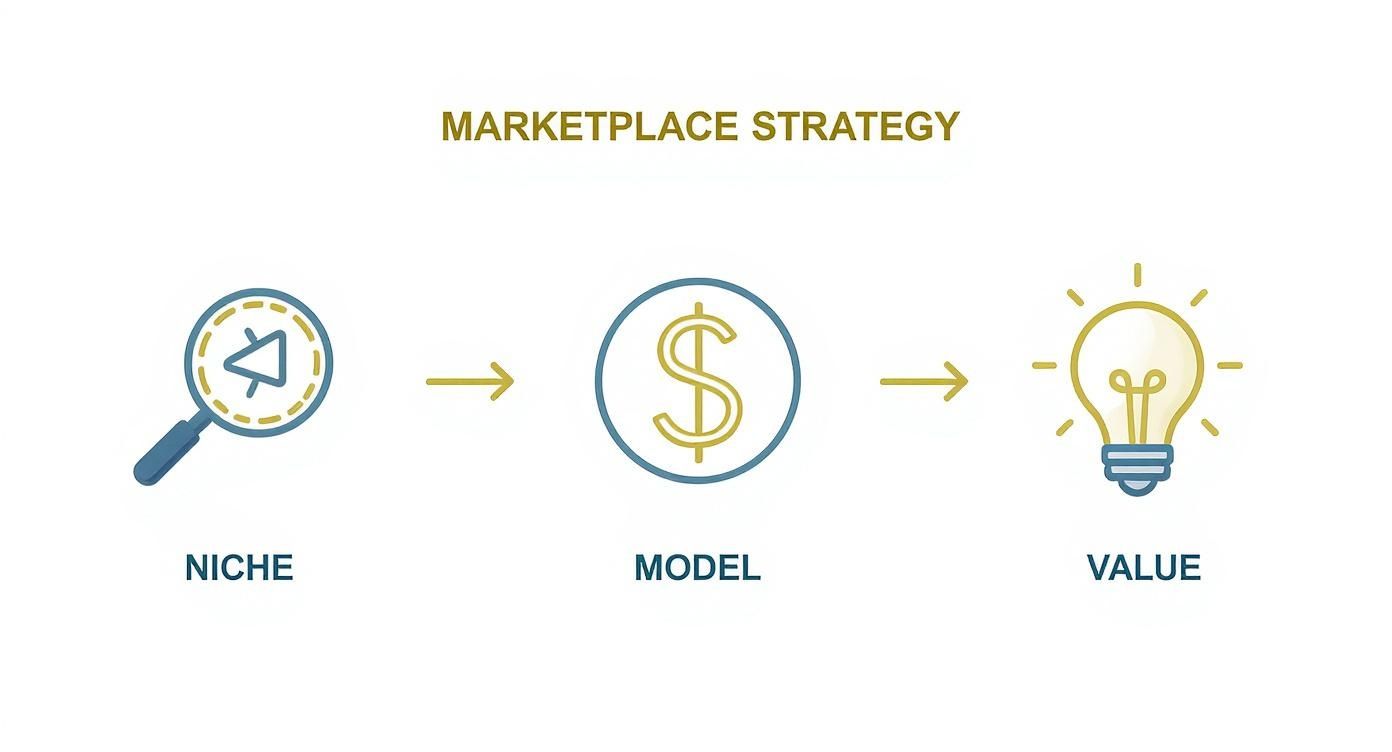
As you can see, a winning strategy starts with a sharp focus and then moves toward execution, with each step building on the last.
Choose the Right Business Model
How you make money directly shapes user behavior, your growth trajectory, and even the type of community you build. There are a few tried-and-true models, and picking the right one for your niche is a game-changer.
Deciding between models like commission, subscription, or listing fees can feel overwhelming. This table breaks down the essentials to help you see which one aligns best with your vision.
Choosing Your Marketplace Business Model
| Model Type | How It Works | Best For | Example |
|---|---|---|---|
| Commission | The platform takes a percentage or flat fee from each successful transaction. | High-value transactions, service-based platforms, and getting initial seller buy-in. | Airbnb, Uber, Etsy |
| Subscription | Users (buyers or sellers) pay a recurring fee (monthly/annually) for access to the platform or premium features. | B2B marketplaces, platforms with high-frequency usage, or where a steady revenue stream is critical. | LinkedIn Premium |
| Listing Fee | Sellers pay a small, flat fee to post their product or service, regardless of whether it sells. | High-volume, low-value items where a commission model wouldn't be profitable or is hard to track. | Craigslist, Zillow |
Actionable Insight: Start with the model that has the lowest barrier to entry for sellers. A commission structure is often the easiest way to attract your first vendors because they only pay when they succeed. You can always introduce premium subscription features later once you have an established community.
Craft Your Value Proposition
You're now face-to-face with the classic "chicken-and-egg" problem: you can't get buyers without sellers, and you can't get sellers without buyers. Your value proposition is what breaks this stalemate. It has to be so compelling that one side will join before the other side is fully there.
A powerful value proposition isn’t about the features you offer; it's about the specific problem you solve for both buyers and sellers better than anyone else. It’s the core reason your marketplace deserves to exist.
Practical Example: To attract the first 100 sellers to a new craft marketplace, you could offer a "Founding Member" package: zero commission for the first year and a featured spot on the homepage for a month. For buyers, you could offer a money-back guarantee on the first purchase to build initial trust. This strategic groundwork is the real secret to building a marketplace that doesn't just launch, but lasts.
Designing an Experience That Builds Trust
A great marketplace does more than just move products from A to B; it creates a community. The design and user experience (UX) are the foundation of that community, and they're what ultimately determine if people feel safe, understood, and want to stick around. If you’re figuring out how to build a marketplace website, remember this: trust is your most valuable currency, and you earn it with thoughtful, human-centric design.
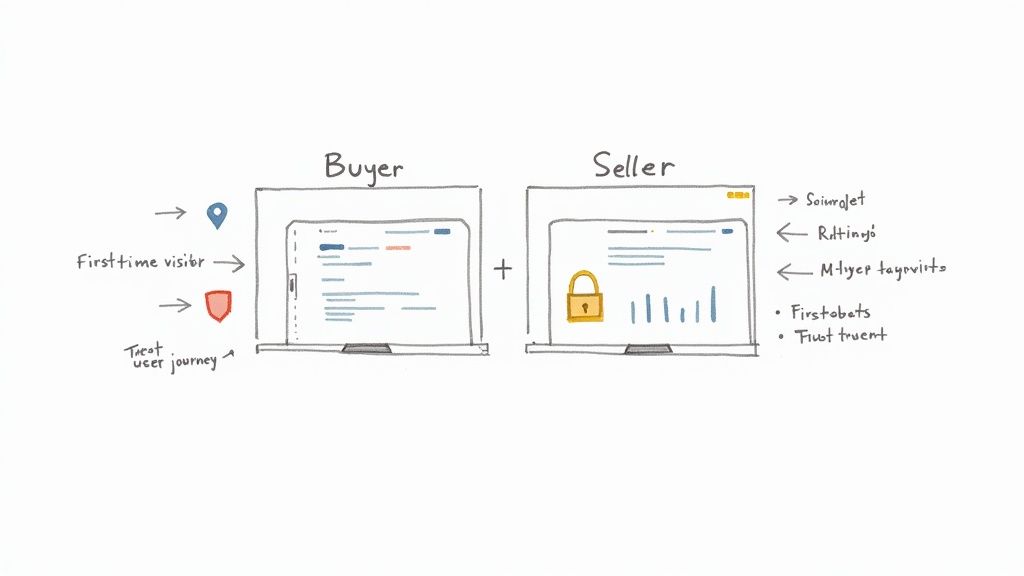
It all starts with getting inside your users' heads and mapping out every single step they take. You have to think about the entire lifecycle, from someone stumbling upon your site for the first time to a seller getting that exciting "you've been paid" notification. Every one of those touchpoints is a chance to either build confidence or introduce friction that sends them running.
Mapping the User Journey to Reduce Friction
Every marketplace is a balancing act. You have two completely different user journeys—the buyer's and the seller's—happening at the same time. Your design has to serve both flawlessly without getting in the way of either one.
Actionable Insight: Use a free tool like Miro or even just sticky notes on a wall to physically map out the two paths side-by-side. For the buyer journey, write down every step: "Lands on homepage," "Searches for 'vintage lamp'," "Applies 'price under $50' filter," "Adds to cart," "Enters shipping info," "Completes purchase." Do the same for the seller. This visualization will instantly reveal where the process is too complicated.
As you map this out, you need to be ruthless about spotting potential friction points.
- Practical Example (Buyer): If a user has to click six times to check out, that's too many. Can you reduce it to three?
- Practical Example (Seller): If the product listing form has 20 fields, can you make 15 of them optional to get them started faster?
Your job is to hunt down and eliminate every moment of hesitation or confusion. When a platform just works—when it feels smooth and logical—users trust it without even thinking about it. A clean journey is the first and most vital step toward earning that trust.
Finding these weak spots on your own can be tough when you're too close to the project. If you're struggling, getting a professional user experience audit can give you that crucial outside perspective and point you toward the quick wins.
Designing Purpose-Built Dashboards
One of the most common mistakes I see is a generic, one-size-fits-all dashboard. Buyers and sellers are on your platform for totally different reasons. Their toolkits should reflect that.
- For Buyers: Their dashboard should be all about their shopping. Keep it simple. Show them their order history, saved items or wishlists, and maybe a list of sellers they follow. A clear link to their message inbox is a must. Actionable Insight: Look at Amazon's "Your Orders" page. It's clean, simple, and focuses on tracking, returns, and re-ordering—exactly what a buyer needs.
- For Sellers: This is their mission control. It needs to be powerful. Give them the tools to manage listings, check their sales analytics, see their earnings, handle shipping, and respond to customers. Practical Example: Think about Airbnb's host dashboard—it’s brilliant at separating upcoming bookings, messages, and performance stats into clean, actionable modules. A new booking is a prominent notification, not buried in a generic activity feed.
By separating these experiences, you avoid overwhelming either user. A buyer has no need for inventory management tools, and a seller needs to see their core business functions at a glance, not just a list of things they’ve bought.
Small Details That Create Big Trust
While the big picture and user flow are critical, it's often the small, deliberate details that truly cement a user's confidence. These little design choices and micro-interactions are constantly sending signals about safety, transparency, and reliability.
Actionable Insight: Weave these trust signals throughout your platform from day one:
- Transparent Rating Systems: Don't just show five stars. Practical Example: Take a page from Etsy's playbook and feature review photos from actual customers—it’s incredibly powerful social proof. Letting users sort reviews by "Most Recent" also shows you aren't trying to hide anything.
- Integrated Messaging: A built-in messaging system is a non-negotiable. It keeps all communication on-platform, which protects both the buyer and the seller. Actionable Tip: Add a small disclaimer within the messaging UI like, "For your protection, never share personal contact or payment information here."
- Visible Security Icons: When a user is about to hand over their credit card details, they need reassurance. Prominently display trust badges for your payment gateways like Stripe or PayPal. A simple padlock icon next to the URL reinforces that their data is secure.
- Clear Policies: Never make people hunt for your return policy, terms of service, or dispute process. Hiding the fine print is a huge red flag. Practical Tip: Add a link to your "Buyer Protection Policy" directly on every product page.
Choosing Your Tech Stack and Must-Have Features
The technology you build your marketplace on is its engine. Get this right, and you’re set up for growth. Get it wrong, and it can feel like you’re dragging an anchor. This decision will ripple through everything—your budget, your launch date, and your ability to scale when things (hopefully) take off. It's a big one.

You’ve got three main paths you can go down, each with some serious trade-offs in cost, speed, and how much control you have. Understanding what you’re giving up and what you’re gaining with each option is the key to picking the right foundation.
Comparing Your Development Paths
Let's break down the real-world options for building a marketplace, from the quick-and-dirty to the powerful-and-pricey. Each approach serves a different purpose for a business at a different stage.
SaaS Builders (e.g., Sharetribe): This is the fast lane. Platforms like Sharetribe give you a pre-built marketplace in a box, letting you get a functional site live in days, not months. It’s a fantastic way to validate your idea without betting the farm. The catch? You're playing in their sandbox, which means you're limited by their feature set and customization options.
CMS with Plugins (e.g., WordPress + Dokan): This is the happy medium. You can take a familiar platform like WordPress, add a multi-vendor plugin like Dokan, and get a lot more control over the look and feel. The massive plugin library is a huge plus, but now you’re on the hook for hosting, security, and maintenance. It adds a layer of complexity.
Fully Custom Solution: This is the go-big-or-go-home route. It's the most expensive and time-intensive path, but it gives you total freedom. Building from the ground up lets you craft a one-of-a-kind user experience and proprietary features that can become your secret weapon. This is really for well-funded startups that have already proven their concept and have a clear vision.
To put it all into perspective, here's how these choices stack up side-by-side.
Marketplace Development Paths Compared
This table helps visualize the trade-offs between cost, speed, and scalability for each approach.
| Development Path | Initial Cost | Time to Launch | Scalability | Best For |
|---|---|---|---|---|
| SaaS Builder | Low (monthly fee) | Days to Weeks | Good (Platform-Managed) | Validating an idea quickly on a tight budget. |
| CMS + Plugins | Moderate | Weeks to Months | Fair (Requires Optimization) | Founders who need more customization than SaaS but aren't ready for a custom build. |
| Custom Solution | High | Months to Year+ | Excellent (Built to Scale) | Well-funded startups with unique features and long-term scalability needs. |
Actionable Insight: Start with the simplest, fastest option that allows you to test your core idea. If users flock to your Sharetribe site and start transacting, that's the proof you need to justify investing in a more custom solution later.
The Non-Negotiable MVP Features
No matter which path you take, your first version—the Minimum Viable Product (MVP)—needs a core set of features to even function. The point isn't to launch with every bell and whistle. It’s about launching with the right things that make the core transaction possible and start earning trust.
Your MVP should solve the main problem for your first users in the simplest way possible. It’s not about being perfect; it’s about being useful enough to get your first buyers and sellers on board.
These are the features you just can't skip.
Essential Building Blocks for Your Marketplace
User Profiles and Dashboards: Buyers and sellers both need a home base. Profiles let users build their identity and reputation, while separate, clean dashboards are critical for managing listings, orders, and messages without getting lost.
Smart Search and Filtering: If users can't find it, they can't buy it. A basic keyword search is just the start. Good filters are what make a platform feel intuitive. Practical Example: For a marketplace for freelance writers, your MVP must include filters for "topic expertise" (e.g., finance, tech) and "rate per word," as these are the primary decision-making factors for buyers.
Secure Payment Gateway Integration: Trust is everything when money is involved. Integrating a battle-tested payment gateway like Stripe Connect or PayPal for Marketplaces is the only way to go. Actionable Insight: Don't try to build your own payment system. These tools are built to handle the complexities of splitting payments, managing commissions, and keeping everything secure and compliant so you don't have to.
Built-in Messaging System: Communication is the glue that holds a marketplace together. An internal messaging system keeps all conversations on your platform, which protects everyone and creates a record if a dispute pops up. Crucially, it also stops users from taking their business offline.
As your platform grows, you'll need to connect these features to other tools. For a deeper dive into the technical side of expansion, our guide on using an API for third-party integration explains how you can plug into other services and scale your capabilities. Getting this initial feature set right is the foundation for everything that comes next.
Building a Safe and Legal Marketplace
It’s easy to get lost in the excitement of features and design when you're figuring out how to build a marketplace website. But the real foundation for long-term success isn't your UI—it's trust. A marketplace lives or dies by its reputation, and that reputation is built on safety, transparency, and clear rules for everyone.
This isn't just about covering your legal bases. It's about creating an environment where high-quality sellers want to do business and buyers feel confident hitting that "purchase" button. If you neglect this framework, even the most brilliant tech stack won't save you.
Crafting Your Core Legal Documents
Think of your legal documents as the official rulebook for your platform. They're not just fine print; they set expectations, define who's responsible for what, and protect you, your sellers, and your buyers from headaches and disputes. Vague or missing policies are a massive red flag for any savvy user.
Actionable Insight: While you should consult a lawyer, you can start with templates from services like Termly or LegalZoom to understand the scope. You absolutely need three core documents in place from day one:
- Terms of Service (ToS): This is the master agreement between you and every user. It needs to spell out what's allowed, what's forbidden, how your fees work, and what happens if someone needs to be removed from the platform.
- Privacy Policy: In an era of constant data breaches, this is non-negotiable. Be crystal clear about what data you collect (names, emails, payment details), why you need it, and how you're protecting it. Make sure it aligns with major regulations like GDPR or CCPA.
- Vendor Agreement: This is a specific contract just for your sellers. It should detail your commission rates, payout schedules, rules for listing products, and their obligations for things like shipping and customer service.
These documents are essentially your platform's constitution. They create the structure needed for a fair and functional digital economy, making sure everyone knows the rules of the game before they even start playing.
Implementing User Verification and Safety Measures
Trust starts with knowing who you're dealing with. A completely anonymous marketplace is a playground for scammers and bad actors. You don't need to be invasive, but you do need simple, effective verification protocols to build a reputable community.
Practical Example: A multi-layered approach to safety often works best. For a marketplace selling used luxury watches, a simple email verification for buyers is fine. But for sellers, you should require a more robust identity check (like a government ID scan via a third-party service) before they can list their first item. This tiered system balances user friction with necessary security. Following established software development best practices is key to integrating these security features correctly from the start.
A visible and fair dispute resolution process is another cornerstone of a safe marketplace. Actionable Tip: Create a dedicated "Resolution Center" in the user dashboard. Look at how eBay handles this; their automated system walks both parties through the process step-by-step, de-escalating conflict and providing a structured way to upload evidence and find a solution.
Finally, you need to be proactive about fraud prevention. Actionable Insight: Set up simple automated alerts. For instance, a brand-new seller suddenly listing 100 high-demand electronics at prices that are too good to be true is a classic red flag. This should automatically flag the account for manual review by your team, letting you shut down scams before they hurt your users and tank your credibility.
Launching and Scaling for Long-Term Growth
Getting your platform deployed is a huge win, but let's be honest—it’s just the starting line. The real work begins now. How you handle the launch and subsequent growth will decide if your marketplace explodes into a bustling ecosystem or just... fizzles out. A smart growth strategy is every bit as important as the code it’s built on.

This isn’t about just throwing money at ads and hoping for the best. It's a calculated dance of pre-launch hype, surgical post-launch marketing, and an almost obsessive focus on the data that tells you what's actually working.
Igniting Growth From Day One
Your launch plan needs to kick in long before you actually go live. The big fear for any new marketplace is the "empty store" problem. Your primary goal is to have both buyers and sellers chomping at the bit from the moment the site is public.
Actionable Insight: Build a waitlist using a simple landing page tool like Carrd or Mailchimp. Sell the dream—your core value proposition—and offer a tangible bonus for signing up, like "Get 50% off your first transaction fee" or "Be one of the first 100 sellers to get a featured listing." You’re not just collecting emails; you’re validating your idea and building an audience you can activate on day one.
Once the switch is flipped, your energy shifts to kickstarting that two-sided network effect. I’ve seen these practical strategies work time and time again:
- Targeted Digital Ads: Get surgical. Practical Example: If you’re launching a marketplace for handmade furniture, your Facebook Ads should be laser-focused on people with interests in "Interior Design," "Etsy," and "Apartment Therapy." Don't waste money on broad audiences.
- Smart Referral Programs: Turn your first few users into your most passionate evangelists. Practical Example: Dropbox gave away free storage for referrals. You could offer sellers a 0% commission rate for one month for every new vendor they bring on, or give buyers a $10 credit for referring a new customer who makes a purchase.
- Authoritative Content Marketing: Become the go-to resource in your niche. If you’re running a marketplace for freelance photographers, publishing a practical blog post on "A Freelancer's Guide to Invoicing" or "5 Poses to Nail Your Next Portrait Shoot" will attract the exact sellers you need to seed your platform.
Measuring What Truly Matters
You can't grow what you don't measure. In the world of marketplaces, vanity metrics like raw website traffic can fool you. You need to zero in on the key performance indicators (KPIs) that reflect the health of the actual transactions happening on your platform.
Let’s face it, we’re up against giants. In 2024, online marketplaces drove a staggering 63.5% of all global online sales, showing just how much consumers have embraced these platforms. This highlights the challenge, but also confirms the massive opportunity. You can see the full breakdown by reading the 2025 online marketplace tracker from Forrester.
To compete, you need to live and breathe these core KPIs:
- Gross Merchandise Volume (GMV): This is your north star. It's the total value of all goods and services sold through your marketplace in a given period. It's the purest measure of your platform's economic pulse.
- Customer Acquisition Cost (CAC): How much do you spend to get one new buyer or one new seller? Actionable Insight: Calculate this separately for buyers and sellers. If it costs $50 to acquire a buyer who only spends $30, your model is broken.
- Churn Rate: What percentage of users—on both sides—stop using your platform each month? High churn is a fire alarm; it signals a problem with your user experience or value proposition that needs immediate attention.
Tracking these metrics tells the real story of your marketplace. A rising GMV with a low CAC is the classic sign of a healthy, growing platform.
Preparing Your Tech and Operations to Scale
A sudden spike in growth is a great problem to have, but it will absolutely break a platform that isn't ready for it. As you go from hundreds of users to thousands, every part of your technology and internal workflow will be strained. Planning for this from the outset isn't optional; it's a survival tactic.
Practical Example (Tech): Use a cloud hosting provider like AWS or Google Cloud that allows you to easily scale your server resources up or down based on traffic. This is more cost-effective and prevents your site from crashing during a traffic spike.
Practical Example (Operations): Create a library of templated email responses for common customer support issues (e.g., "password reset," "how to track my order"). This simple step saves hundreds of hours as you grow.
This usually means automating as many repetitive tasks as possible, freeing up your team to focus on growth initiatives instead of manual data entry. Building with a foundation designed for growth is a core tenet of any scalable business model. If you anticipate these growing pains, you’ll be able to ride the wave of success instead of getting crushed by it.
Got Questions About Building Your Marketplace? We've Got Answers
Even with the best blueprint in hand, building a marketplace from scratch can feel like a huge undertaking. It's completely normal to have questions pop up, especially around the big hurdles like cost, getting traction, and making the right tech choices. Let's dig into some of the most common questions I hear from founders.
What's the Real Price Tag on a Marketplace?
Honestly, there's no single answer. The cost can swing from a few hundred dollars a month for a tool like Sharetribe to well into six figures for a completely custom build. It all comes down to matching your investment to your current stage.
Think of it in tiers:
- Bootstrapping (Under $5,000): You're in the land of SaaS builders and WordPress plugins here. This is the smart play for testing your core concept. You can validate your idea and get your first few users without betting the farm.
- Seed Stage ($10,000 - $50,000): With this kind of budget, you can bring in freelance talent for a more polished build on a platform like WordPress or even start a very basic custom MVP. It gives you more say over the user experience and lets you add a few unique features.
- Venture-Backed ($50,000+): Now you're talking about a fully custom platform built by a professional agency. This is for founders who have already proven their model, have money in the bank, and need a powerful, scalable engine for growth.
Actionable Insight: The smartest move is almost always to start lean. Prove your concept with a low-cost MVP, then use that traction—and revenue—to fund the custom platform of your dreams.
How Do I Get My First 100 Users?
Ah, the classic chicken-and-egg problem. It's the puzzle every marketplace founder has to solve: you can't get buyers without sellers, but you can't get sellers without buyers.
The secret? Don't try to solve both at once. Manually seed one side of the market first.
Forget a big, flashy launch. Go small. Find a tiny, passionate community and become obsessed with serving them. Practical Example: Building a marketplace for rare vinyl records? Spend your time in the Discogs forums, relevant subreddits (like r/vinylcollectors), and niche Facebook groups. Answer questions, offer advice, and become a trusted member of the community before you ever mention your marketplace.
Here are a few actionable tactics that work:
- Give the "White Glove" Treatment: Don't just invite your first 10-20 sellers; roll out the red carpet. Personally onboard them via a Zoom call, offer them zero commission for the first six months, help them build their profiles, and maybe even offer to professionally photograph their first few items. Treat them like co-founders.
- Fake It 'Til You Make It (A Little): In the very beginning, you might need to be the supply. List some of your own items or get a few friends to post things. This makes your marketplace look alive and gives those first brave buyers something to actually buy, building that critical initial trust.
- Solve One Tiny Problem, Perfectly: Don't start with "a marketplace for art." That's too broad. Start with "a marketplace for custom watercolor pet portraits." This laser focus makes it infinitely easier to find your first sellers and buyers because you know exactly who they are and where they hang out online.
Custom Build vs. Template: Which Path Is Right?
This is a huge decision, and it’s a balancing act between speed, cost, and future-proofing your business.
A custom solution gives you ultimate freedom. You can build that one killer feature that nobody else has, creating a real competitive moat. But it’s a marathon, not a sprint, and it requires a significant investment of time and money.
Using a template or SaaS builder is the express lane. You can get to market in a fraction of the time and for a fraction of the cost. The catch? You're playing in someone else's sandbox. You'll eventually hit a wall when you want to build something the platform doesn't support.
The expectations of today's shoppers are a big piece of this puzzle. By 2025, it's predicted that 85% of global consumers will be shopping online, with the number of active digital shoppers hitting 2.77 billion. That's a massive audience with sky-high expectations for a slick, mobile-first experience. You can see more digital commerce stats to get a feel for the landscape. A good template can help you meet these baseline expectations right out of the gate, which is a huge advantage.
Ready to turn your marketplace idea into a reality? At Pixel One, we specialize in building scalable, user-centric digital products that drive growth. We help startups and enterprises navigate every stage of development, from strategy and design to a successful launch.