
How to Validate Business Idea: A Quick Guide
Discover how to validate business idea with real-world steps, including customer interviews, smart research, and low-cost MVP tests.Before you pour your life savings and countless hours into your brilliant business idea, you need to answer one critical question: will anyone actually pay for this?
This isn't about just doing some basic market research. It's about getting cold, hard proof that real people have the problem you think they have, and that they're willing to open their wallets for your solution. It's the difference between building something you're passionate about and building something that solves a proven need.
Why Smart Founders Validate Ideas First
Every great idea feels like a winner in the beginning. That initial rush of excitement is powerful, making it easy to fall into the "if I build it, they will come" trap. But let's be honest—that's a gamble, and it's one of the biggest risks you can take as an entrepreneur.
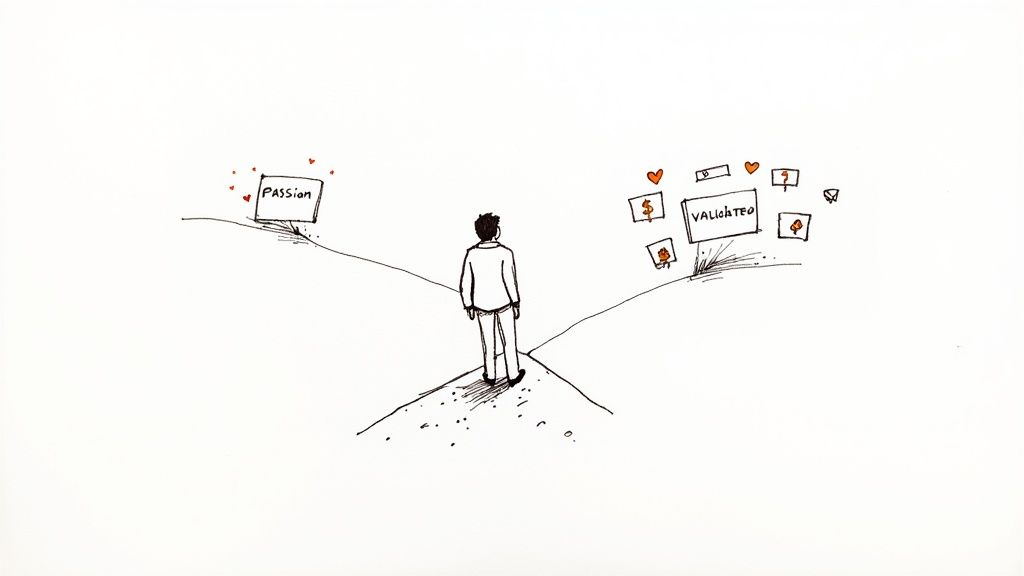
Passion is fuel, but it's not a business plan. When you skip the validation process, you're running on assumptions. You're assuming people have the problem, assuming it's a top priority for them, and assuming they'll choose your solution over all the others (or doing nothing at all).
The Real Cost of Skipping Validation
So many promising startups flame out not because the product was poorly built, but because they never stopped to have a real conversation with their target customers. The numbers tell a sobering story: around 90% of startups fail, with over 20% not even making it past their first year. One of the top reasons? They built something for a market that didn't exist or simply didn't care enough.
"The real cost of not validating isn't just wasted money or time. It's the emotional toll of pouring your heart into creating something that nobody needs. Validation is your first, most important investment."
This process forces a crucial mental shift. You stop focusing on building a product and start focusing on solving a problem. That's the core difference between passive research (like checking out competitors) and active validation.
Active validation is about getting concrete proof of commitment. This could be a pre-order, a paid pilot program, or even just a long list of people eagerly signed up for your waitlist. Taking the time to do this transforms your idea from a hopeful guess into a data-backed plan, which dramatically tilts the odds of success in your favor.
To see how this fits into the bigger picture, you can learn more about the complete process of how to bring a product to market.
Before diving deep, it helps to have a clear picture of what you're trying to prove. The entire validation journey is about finding solid answers to a few core questions.
Core Validation Questions to Answer
| Validation Question | Why It Matters | Example Metric |
|---|---|---|
| Is the problem real and painful? | If the pain isn't significant, people won't be motivated to find a solution. | 75% of interviewees rate the problem an 8/10 or higher in terms of frustration. |
| Are people actively trying to solve it? | This shows existing demand. If they're using makeshift solutions, that's a great sign. | 20 out of 30 potential customers are already using a spreadsheet or competitor tool. |
| Is my proposed solution a good fit? | Your idea must be a clear improvement over what's currently available. | A/B test of a landing page shows a 25% conversion rate for a waitlist sign-up. |
| Will customers pay for this solution? | This is the ultimate test. It separates polite interest from genuine market demand. | Securing 10 pre-orders or paid pilot customers at a specific price point. |
Answering these questions with evidence, not just gut feelings, is what sets a solid foundation for your business. It's the difference between hoping for success and building for it.
Uncovering Real Insights Through Smart Research
Before you write a single line of code or sketch out a landing page, you have to do your homework. Proper validation starts with smart, targeted research, not just a few hours of Googling. Your first job is to become an absolute expert on the problem you think you're solving. That means getting past the obvious data and digging into the raw, unfiltered frustrations of the people you want to serve.
Forget simply looking at your competitors' features for a moment. Instead, become a digital detective. Dive deep into their customer reviews on sites like G2 or Capterra. Look for patterns. What do people rave about? Even more importantly, what are they constantly complaining about? Those complaints are pure gold—they point directly to the gaps in the market your idea could potentially fill.
Go Where Your Future Customers Are Already Talking
Some of the most powerful insights you'll ever get won't come from surveys; they'll come from eavesdropping. Your mission is to find the online communities where people are already gathered and just listen. The goal here isn't to jump in and pitch your idea. It's to absorb the language, the pain points, and the context of their world.
Think about niche subreddits, private Facebook groups, or specialized forums related to your industry. Once you're in, here's what you're looking for:
- Listen for pain points: What are the recurring frustrations people bring up over and over? Are they jerry-rigging clumsy workarounds or juggling multiple tools to get one job done? For example, a small business owner might complain, "I spend 5 hours a week manually creating invoices from three different payment systems." That's a specific, actionable pain point.
- Note their exact language: Pay close attention to the specific words and phrases they use. This is the secret ingredient for your future marketing copy and is incredibly helpful when you learn how to conduct user interviews later.
- Identify unmet needs: Are people constantly asking for features or solutions that the big players don't offer? That’s a massive signal of real demand.
Let’s get practical. Searching for a generic term like "project management tool" will just show you the big names. You need to go deeper. Try searching for threads with titles like, "I can't get my team to update their tasks" or "What's the best tool for a non-technical user?" This tiny shift takes you from a generic product category to a specific, emotionally charged problem.
For example, look at this Reddit post. The user is asking for a "super simple" task manager. This immediately tells you that mainstream solutions like Asana or Jira are probably overkill and too complex for what they need.
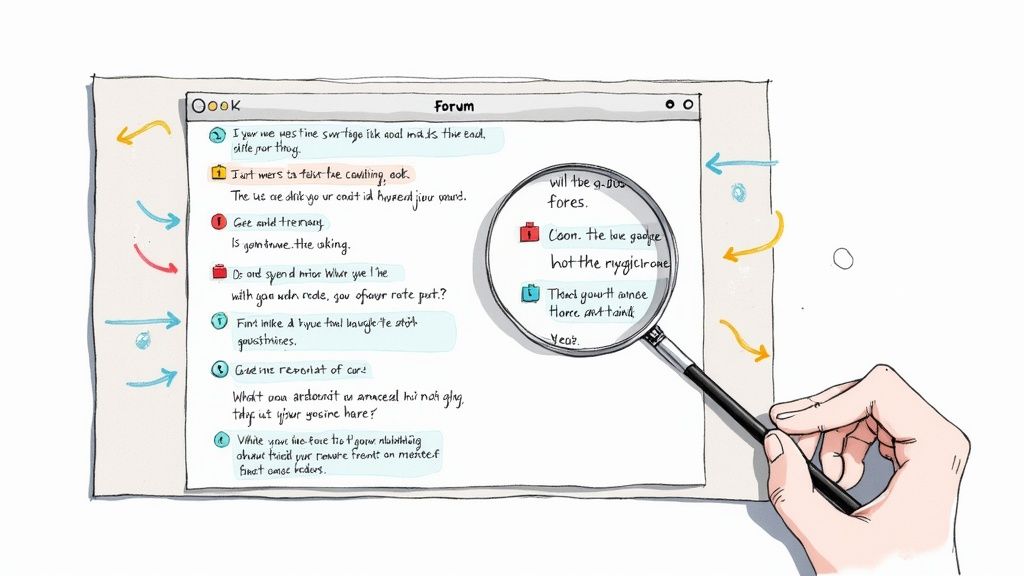
This one post reveals a clear desire for simplicity over a mountain of features. That’s a critical insight that could become the entire foundation of your product strategy.
Key Takeaway: This initial research isn't about proving your idea is a winner. It's about gathering enough raw, unbiased evidence to form a solid hypothesis about a specific problem that a specific group of people is experiencing.
When you do this right, you'll have the unfiltered data you need to move forward with real confidence. Your hypothesis is no longer just a gut feeling; it’s grounded in the real-world frustrations you’ve seen with your own eyes. This is the foundational work that separates a business idea that just feels good from one that actually stands a chance.
How to Talk to Potential Customers

Alright, you've done your homework and have a solid guess about a real problem people are facing. Now comes the most important—and often most intimidating—part of the whole process: actually talking to them. This is where your idea gets its first dose of reality.
Let’s be clear: these customer discovery interviews are not sales pitches. In fact, if you find yourself talking about your brilliant solution, you're doing it wrong. The entire point is to listen. You want to understand their world, their frustrations, and how they’re currently getting by.
This isn't just a "nice-to-have" step. It's a lifesaver. A staggering 42% of new products fail for the simplest reason: nobody actually wanted them. Getting out and talking to people is how you avoid becoming a statistic. You can learn more about how to validate your business idea quickly and save yourself a ton of grief down the road.
Finding the Right People to Interview
The insights you get are only as good as the people you talk to. You need to connect with individuals who are smack-dab in the middle of your target audience—the ones who are genuinely wrestling with the problem you aim to solve.
And whatever you do, don’t just interview your mom or your best friend. They care about you, which means they'll likely tell you what you want to hear. That's a surefire way to get bad data.
Instead, go where your potential customers already hang out.
- Online Communities: Remember those Reddit threads and Facebook groups from your initial research? Go back, but this time, start contributing. Once you've built a little rapport, send a direct message to a few key people.
- LinkedIn Connections:LinkedIn is a goldmine for this. You can search for specific job titles at specific companies and send a polite, non-salesy message asking for their expertise. Actionable Tip: If your idea is for marketing managers, search for "Marketing Manager" on LinkedIn, filter by industry, and send a message like the one below.
- Your Network (With Caution): Ask mentors or colleagues you trust for introductions. A warm intro from a mutual connection is almost always more effective than a cold email.
When you reach out, keep it simple and respectful of their time. This is research, not a sales meeting. Something as straightforward as, "Hi [Name], I'm doing some research on [the problem space] and saw you're an expert in this area. Would you be open to a 15-minute chat to share your experience?" often works perfectly.
Asking Questions That Uncover the Truth
The magic of a great customer interview is in asking open-ended questions that get people talking. Your goal isn't to gauge their opinion on your hypothetical product; it's to understand their past actions and current struggles. Why? Because people are terrible at predicting what they will do but are great at telling you what they have done.
Focus on real experiences, not imaginary futures.
Here’s what that looks like in practice:
| Instead of Asking This... | Ask This Instead... | Why It Works |
|---|---|---|
| "Would you use an app for meal planning?" | "Tell me about the last time you tried to plan your meals for the week." | This prompts a story about a real event, revealing genuine pain points and hacks they've created. |
| "Do you think this feature is a good idea?" | "What are you currently using to solve this? What do you like and dislike about it?" | This uncovers your real competition (which might just be a spreadsheet) and its specific flaws. |
| "How much would you pay for a solution?" | "Have you ever paid to solve this problem before? How did that work out?" | This grounds the conversation in actual purchase history—a much better indicator of a willingness to pay. |
When you zero in on their past and present, you get real stories full of emotion and detail. Those stories are what will tell you if the problem you're tackling is a nagging, five-alarm fire or just a minor annoyance they can live with. And believe me, that distinction is everything.
Testing Your Solution Without Writing Code
You've done the interviews, you've dug into the research, and you're confident you’ve found a real, painful problem. The natural instinct is to jump straight into building the solution.
Hold that thought.
Before you write a single line of code, you need to test the promise of your solution. This is where the rubber meets the road. It's about finding out if people are willing to give you something valuable—their email, their time, maybe even a small pre-payment—in exchange for what you're offering. This is how you separate polite nods from real buying intent.
Create a Simple 'Smoke Test'
A smoke test is my go-to for this. It's a quick experiment designed purely to gauge demand for something that doesn't exist yet. The classic, and still one of the most effective, is a simple landing page. The entire goal is to fake it 'til you make it—simulate a real product and see how many people try to sign up or buy it.
Let's say your idea is for a personalized dog food subscription. Forget about sourcing ingredients or building an e-commerce site. Instead, you could:
- Spin up a one-page website. Tools like Carrd or Webflow are perfect for this. You can get something professional-looking up in an afternoon.
- Nail the value proposition. Get straight to the point: "Custom meal plans for your dog's unique needs, delivered to your door."
- Have a clear call-to-action (CTA). Instead of a "Buy Now" button that leads nowhere, use something like "Join the Waitlist" or "Get Early Access."
This isn't just about looking busy; it's about collecting data. Every single email you collect is a vote of confidence, a small signal that you're onto something.
As you can see, you don't need to be a designer or a developer to create a compelling front door for your idea.
Choosing Your Low-Cost Validation Test
A landing page is just one option. There are several low-effort, high-learning tests you can run to validate your solution. The key is to pick the one that best fits what you need to learn right now.
| Method | Best For | Pros | Cons |
|---|---|---|---|
| Landing Page | Gauging initial interest for a B2C or B2B product. | Quick to set up; provides quantitative data (e.g., conversion rates). | Can be hard to get traffic; lacks qualitative feedback. |
| Concierge MVP | High-touch services or complex automated processes. | Provides deep customer insights; builds strong early relationships. | Not scalable; requires significant manual effort. |
| Wizard of Oz MVP | Testing a solution that appears automated but is manual behind the scenes. | Creates a realistic user experience; tests the complete workflow. | Can be labor-intensive to operate; risk of service failure. |
| Slide Deck Demo | B2B software or complex product flows. | Great for sales conversations; forces you to clarify your product story. | Can feel abstract; relies heavily on your presentation skills. |
Choosing the right test is about balancing effort with the quality of feedback you need. For most digital products, starting with a landing page and then moving to a more interactive demo is a proven path. Actionable example: If your idea is a service that creates social media content, a Concierge MVP would mean manually creating content for your first 5 clients to perfect the process before building any software.
From Landing Page to Low-Fidelity Prototype
If a landing page feels a bit too thin, or if your solution is more complex, you can create an experience that feels more like a real product. Again, no developers needed.
A slide deck demo is surprisingly effective. I've seen founders close their first deals with nothing more than a well-crafted Google Slides or PowerPoint presentation. You map out the entire user journey, with each slide acting as a screen or a step. In a one-on-one call, you can walk a potential customer through it, and it feels much more tangible than just talking about an idea.
This is essentially a manual version of a prototype. It forces you to think through the user flow, which is a foundational step in product design. If you want to get more formal with it, this process is very similar to the first steps of interface design. You can learn more about how to create wireframes to help map out these flows visually.
Key Takeaway: The whole point of no-code testing is to get the most learning for the least effort. Whether it's a simple landing page or a detailed slide deck, you're stress-testing the core promise of your solution before a dollar is spent on development.
Ultimately, these tests arm you with real data. A 15% conversion rate on your waitlist sign-up form is a powerful signal to keep going. Enthusiastic "where do I sign up?" feedback on your slide deck is gold. On the flip side, a trickle of interest tells you it’s time to rethink things. And that's a lesson that's far cheaper to learn now than six months and thousands of dollars down the line.
How to Analyze Feedback and Decide What's Next
So you've done the work. You've run the interviews, launched the landing page, and demoed your prototype. Now you’re sitting on a mountain of feedback, notes, and metrics. This is the moment of truth, and honestly, it’s where a lot of founders get overwhelmed and stall out. The real trick to validating your business idea is learning how to cut through the noise and find the meaningful signals.
Your first move is to get organized. Don’t let your notes languish in random documents. A simple spreadsheet or a tool like Airtable works wonders. For every conversation, landing page visitor, or demo user, log the key takeaways. What phrases kept coming up? Were there any strong emotional reactions—good or bad? You're hunting for patterns. If five out of ten people all describe their problem using the same words, that's a signal.
Spotting Patterns and Avoiding Confirmation Bias
We’re all wired to see what we want to see. This is confirmation bias, and it can be a startup killer. It's that little voice in your head that amplifies the one person who loved your idea while ignoring the nine who were lukewarm.
To beat it, you have to actively search for the feedback that pokes holes in your theory. And remember, actions speak louder than words. A pre-order is worth a dozen people saying, "Yeah, I'd probably buy that."
The data doesn't lie: around 34% of small businesses fail from a lack of product-market fit, and another 22% fold because of a poor marketing strategy. This isn't to scare you, but to highlight that an objective look at your feedback is your best defense. You can find more data on why this validation step is so important over on refgrow.com.
This whole process can feel complex, but it boils down to a pretty simple loop of testing an idea and seeing if people actually care enough to act.
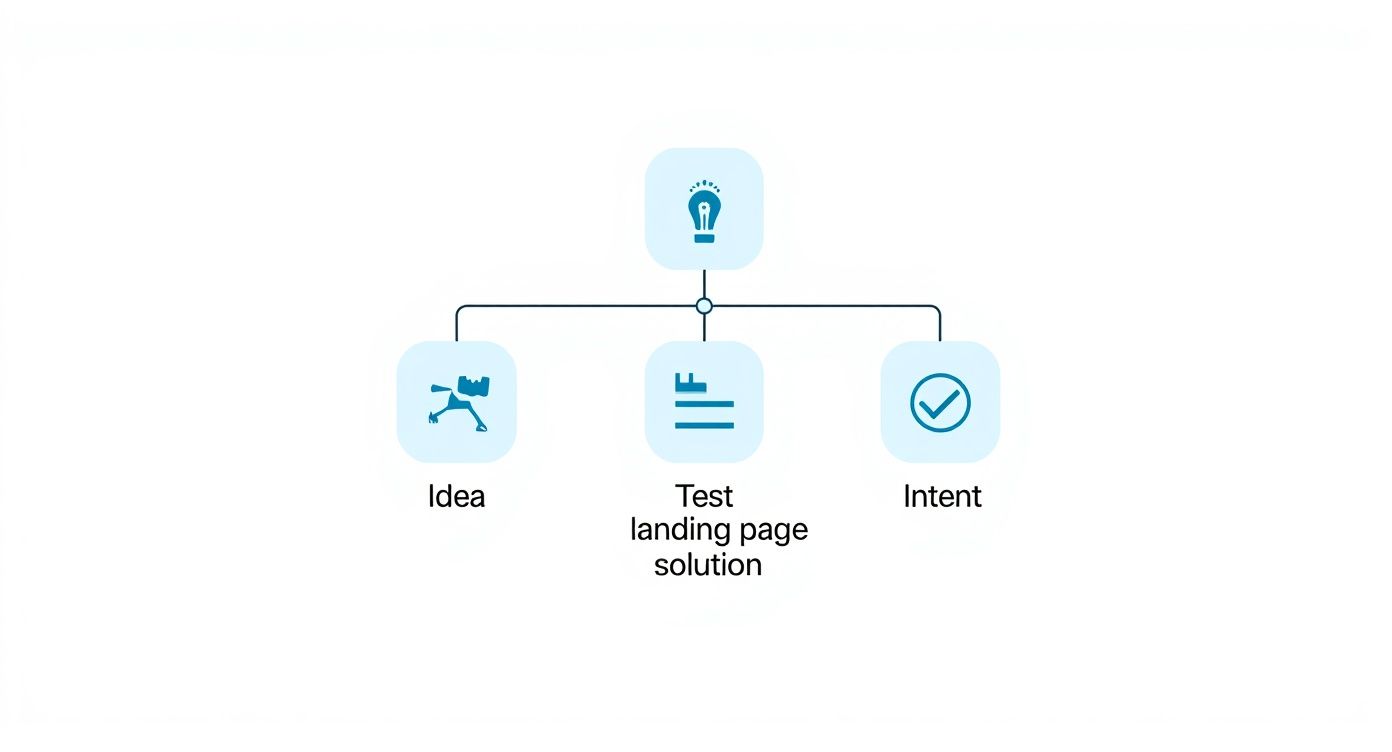
As the graphic shows, you're just looking for that clear sign of commitment before you pour more resources into building.
The Three Paths Forward: Validate, Pivot, or Invalidate
Once you’ve wrestled with your findings, you'll find yourself facing one of three doors. No matter which one opens, walking through it is progress.
- Green Light (Validate): The evidence is undeniable. Your interviews confirmed a real, painful problem. Your tests—like a waitlist or pre-orders—generated genuine commitment. Your core hypothesis holds up. It's go-time.
- Yellow Light (Pivot): You've definitely struck a nerve, but your solution isn't quite right. Maybe you found the right problem but for the wrong audience. Or perhaps your feature set just missed the mark. The core idea has merit, but it needs a course correction. Practical example: Dropbox famously pivoted. They initially targeted consumers, but found their real traction with business teams who needed to collaborate on files.
- Red Light (Invalidate): This one stings, but it’s crucial. The feedback shows the problem isn't painful enough for people to care, or they’re completely indifferent to your solution. Your tests generated crickets.
A "red light" isn't a failure—it's a success. You’ve successfully identified a dead end with minimal time and money spent, freeing you to pursue a better idea.
If you hit a green light, the next logical step is to build a more functional prototype or a Minimum Viable Product (MVP). Now is the perfect time to map out your next moves by exploring the complete product development process for startups.
For a yellow light, it’s back to the drawing board—but you’re not starting from scratch. You’re going back armed with real-world feedback to tweak your idea and test a new, smarter hypothesis.
Got Questions? We've Got Answers
You've got the roadmap for validating your idea, but let's be honest—the real world throws curveballs. You're not alone if you're hitting a few roadblocks or have some nagging questions. Here are the most common ones I hear from founders.
What’s This Really Going to Cost Me?
Believe it or not, the price tag for validation is surprisingly low. We're talking anywhere from $0 to maybe a few hundred bucks. Your biggest investment at this stage is your time, not your wallet.
Let's break it down:
- Research & Interviews: This costs you nothing but your time and effort. Hopping into online communities and actually talking to people is completely free.
- Simple Tools: You don't need a fancy website. A super simple landing page from a builder like Carrd costs less than $20 a year.
- Test Traffic: If you want to run a small ad experiment to see if people click, a budget of $100 to $300 is usually more than enough to get you some initial data. Actionable tip: Run a Facebook ad campaign targeting a specific demographic (e.g., new parents in Austin, TX) and direct them to your landing page. Measure the click-through rate and sign-up conversions to gauge interest.
The whole point here is to be scrappy. You're using these cheap, fast methods to test your riskiest assumptions before you even think about spending serious money.
But What if Someone Steals My Idea?
This is the fear that paralyzes so many first-time founders. But the truth is, the risk is almost always overblown. An idea by itself is worth very little; execution is everything. While you're out there talking to customers, you're building your real secret weapon: a deep understanding of the problem you're solving.
The risk of building something nobody wants is infinitely greater than the risk of someone stealing a half-baked idea. Secrecy is the enemy of feedback.
Sharing your concept is how you sharpen it. It’s how you turn a generic idea into something valuable and unique that can’t be easily copied.
How Many People Do I Actually Need to Talk To?
Forget about finding a magic number. You're not conducting a massive scientific survey. The real goal is to keep interviewing until you hit a point of "pattern matching"—when you start hearing the same pains, desires, and objections over and over again.
You're looking for qualitative insights, not statistical significance.
For most consumer products, you'll start noticing these patterns after just 10-15 solid conversations. If you're tackling a very specific B2B problem, you might get there even faster. Once you can predict what the next person is going to say, you've probably learned enough to move on.
These early conversations give you the raw material you need for the next step: a more concrete test. For many, that means building an MVP. You can learn more about how those interview insights directly shape a product in our guide to MVP development for startups.
At Pixel One, we specialize in helping founders transition from a validated idea to a real, scalable product. If you've done the legwork and are ready to build, we've got the strategic and development expertise to make it happen. Learn more at pixelonelabs.com.