
A Guide to Mobile App Ddvelopment Services
Discover how mobile app development services can transform your idea into a successful app. Learn about costs, processes, and choosing the right partner.So, you’ve got a great idea for an app. But how do you get it from a concept scribbled on a napkin to a real, working product in the hands of users? That’s where mobile app development services come in.
These services provide a complete, end-to-end process that guides your idea from its earliest stages to a fully polished application on someone's phone. It's not just about writing code; it's a true partnership covering strategy, design, testing, and long-term support. An actionable insight from the start is to view this not as a purchase, but as a strategic partnership. Your active involvement in each stage is crucial for success.
What Do Mobile App Development Services Actually Involve?

Hiring an app development agency is a lot like hiring a master builder to construct your dream house. You wouldn't just hire someone to hammer nails and pour concrete. You'd bring on a team with architects (the UI/UX designers), a general contractor (the project manager), and a construction crew (the developers).
This team handles everything, transforming your vision into a market-ready app. A professional firm brings a proven process and years of experience to the project, giving your investment the best possible shot at succeeding in a very crowded marketplace. For instance, an experienced agency knows the specific submission guidelines for both the Apple App Store and Google Play, preventing common rejection pitfalls that can delay your launch.
It's So Much More Than Just Writing Code
One of the biggest misconceptions is that these services are all about coding. In reality, the coding part is just one component of a much bigger machine. Some of the most critical work happens long before a developer writes the first line of code and continues well after the app has launched.
A great mobile app is 10% idea and 90% execution. Professional development services are laser-focused on that crucial 90%—turning a vision into a real-world product that people enjoy using and businesses can count on.
This complete, lifecycle approach is what sets a professional build apart. It’s a structured process designed to reduce risks and deliver a real return on your investment.
Core Components of App Development Services
A full-service project moves through several distinct stages, each one building on the last to ensure a high-quality result. Think of it as a blueprint for success. This process ensures the final app doesn't just work but is also intuitive, secure, and perfectly aligned with your business objectives. For big companies, these services are even more extensive, as detailed in our guide to enterprise app development services.
To give you a clearer picture, I've broken down the essential components using the custom home analogy.
Core Components of App Development Services
| Service Component | What It Delivers | A Practical Example |
|---|---|---|
| Strategy & Discovery | A clear project roadmap, user profiles, and a defined scope. | For a fitness app, this means defining the target user (e.g., a busy professional aged 30-45) and prioritizing features for a Minimum Viable Product (MVP), like workout tracking, over long-term goals like meal planning. |
| UI/UX Design | Visual mockups, wireframes, and interactive prototypes. | Creating a clickable prototype in a tool like Figma. You can test the entire user journey, from signup to logging a workout, before a single line of code is written, saving significant revision costs later. |
| Development & Engineering | The functional, coded application with front-end and back-end systems. | The team builds the user-facing interface (front-end) and the server-side logic that stores user data securely (back-end). This is where the prototype becomes a real, installable app. |
| Testing & Quality Assurance | A bug-free, stable, and secure application ready for public use. | A QA engineer tests the app on various devices (e.g., an older iPhone and a new Android tablet) to ensure the login button works for everyone, not just on the developer's high-end phone. |
| Deployment & Support | App store submission, launch management, and ongoing maintenance. | After submitting to the app stores, the team provides a "hypercare" period to fix any urgent bugs that emerge. They also plan for future updates, like ensuring compatibility with the next iOS release. |
This structured approach ensures nothing is left to chance, moving your project smoothly from an initial idea to a successful launch and beyond.
The App Development Journey From Idea to Launch
Turning a great idea into a real, working app isn’t a single event; it's a journey. Professional mobile app development services follow a tried-and-true lifecycle, with each phase building on the one before it. This structured approach is what ensures your concept gets properly validated, designed for actual users, and built to work without a hitch.
Think of it like building a custom car. You wouldn’t just start welding parts together. First comes the strategic planning, then the detailed blueprints. After that, you carefully assemble the engine, run it through tough safety tests, and only then do you roll it out of the factory—complete with a maintenance plan. Every step is crucial for ending up with a reliable, successful product.
Stage 1: Strategy and Discovery
Before a single pixel is designed or a line of code is written, everything starts with strategy. This is the foundational phase where you ask the hard questions: Who is this app actually for? What specific problem does it solve? What are competitors doing, and where are their weak spots? The goal here is to nail down a crystal-clear vision and a solid business case for the app.
A major outcome of this stage is defining the Minimum Viable Product (MVP). An MVP isn't a cheap, feature-light version of your app. It's the simplest, most focused version that solves the core problem for your ideal user. This lets you get to market faster, gather real-world feedback, and avoid pouring money into features no one actually wants.
For instance, a new food delivery app's MVP might simply let users order from a handful of local restaurants. All the extras—like loyalty programs, advanced filters, or live driver tracking—can be added down the road based on what users are actually asking for.
Stage 2: UI and UX Design
Once the strategy is solid, the focus shifts to the User Experience (UX) and User Interface (UI). This is where the app's entire look, feel, and flow are born. It's about so much more than picking nice colors; it's about crafting an experience that’s intuitive and keeps frustration at bay.
This process usually breaks down into a few key steps:
- Wireframes: Think of these as the basic architectural blueprints for your app. They are simple, black-and-white layouts that focus on structure and function, showing where every button, piece of text, and image will live.
- Prototypes: These are interactive mockups that bring the wireframes to life. You can actually click through the app as if it were real, which is invaluable for spotting usability problems long before the expensive coding begins.
- User Flow Diagrams: A diagram might map out the exact path a user takes from opening the app to making a purchase, making sure every single step feels logical and smooth. For an e-commerce app, this flow would detail every click from product discovery to the final "thank you" page.
A common mistake is to see design as just making things look pretty. But great design is all about function. Research shows that a staggering 88% of users are less likely to return to an app after just one bad experience, which makes intuitive design non-negotiable for success.
Stage 3: Development and Coding
This is where the magic happens—designs and plans are finally transformed into a functioning application. A big decision at this point is the technical path you'll take. Will it be a native app, a cross-platform app, or a web app?
- Native Apps: These are built specifically for a single operating system, like iOS or Android. They deliver the absolute best performance and user experience, but you have to build and maintain separate apps for each platform. Example: Instagram's iOS app, which leverages Apple-specific camera APIs for smooth, high-performance filters.
- Cross-Platform Apps: Built with frameworks like React Native or Flutter, these let developers write one set of code that works on both iOS and Android. It’s a great way to save time and money. Example: The Pinterest app, which uses React Native to deliver a consistent experience to its millions of users on both platforms.
- Web Apps: These are essentially websites that are designed to look and feel just like native apps. Users access them through a browser, so there's no need to download anything from an app store.
The right choice really depends on your project's goals, your budget, and the kind of user experience you're aiming for.
This infographic lays out the key benefits that come from a structured development journey, including greater efficiency, access to expertise, and faster delivery.
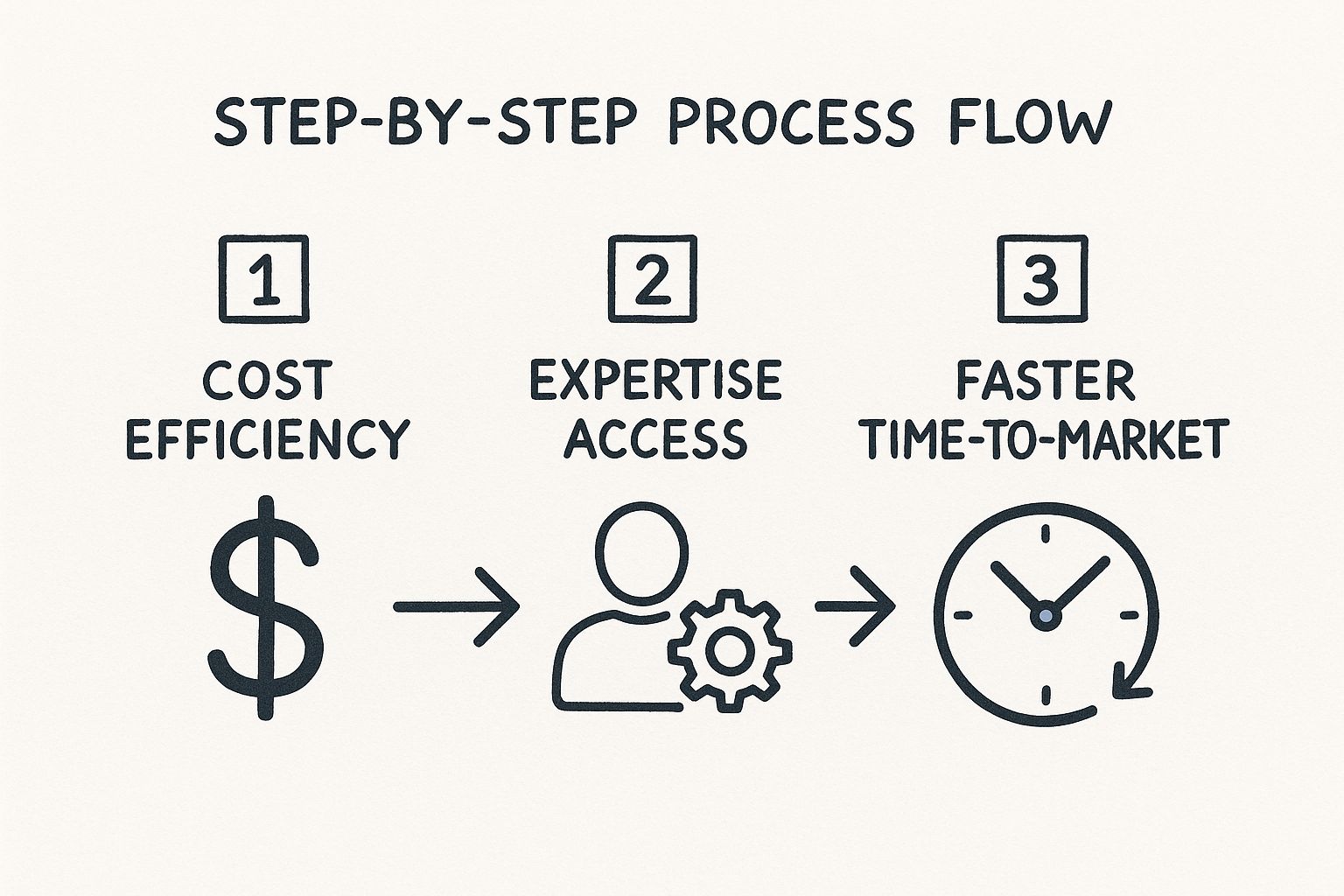
As you can see, the process isn't just about building something; it’s about hitting crucial business targets like cost savings and getting to market quickly.
Stage 4: Testing and Quality Assurance
Once the app is built, it's time for some serious testing. The Quality Assurance (QA) team becomes the first line of defense, hunting down and squashing bugs before your users ever see them. This goes way beyond just checking if buttons work; it's a deep dive into the app's stability, performance, and security.
Testing usually covers several critical areas:
- Functional Testing: Does the app actually do what it’s supposed to do? For example, does adding an item to the cart correctly update the total price?
- Performance Testing: How does it hold up under a heavy load? Is it a battery hog? For instance, testers will check how the app performs on a weak 3G connection.
- Usability Testing: Can a new user pick it up and figure it out easily? A practical test might involve giving the app to someone unfamiliar with it and asking them to complete a task, like creating a profile, without any instructions.
- Security Testing: Is user data locked down and protected from potential threats? This involves trying to exploit vulnerabilities to ensure personal information, like passwords and credit card details, is encrypted and safe.
Stage 5: Deployment and Maintenance
The final stage is getting the app out into the world. This means navigating the sometimes-tricky submission rules for the Apple App Store and Google Play Store. Once your app gets the green light, it's live!
But the work doesn't stop at launch. Ongoing maintenance is absolutely essential for long-term success. This means pushing out updates to fix bugs, staying compatible with new operating systems, and adding new features based on what your users are telling you. A truly successful app is a living product that keeps evolving.
You can dive deeper into this methodology by exploring our complete process to develop an app.
The Tech Powering Today's Best Mobile Apps
A great app is more than just a pretty face. Behind the slick designs and smooth performance of today's most successful apps, there's a whole world of advanced technology at play. These are the real game-changers, the secret ingredients that create unforgettable user experiences and give businesses a serious leg up on the competition.
Picking the right tech isn't just a nerdy detail for the developers to sort out. It's a huge strategic decision that directly shapes what your app can do and how long it will stay relevant. Think of it like a craftsman's workshop. You can build something solid with standard tools, but it's the specialized gear that allows you to add the intelligence, power, and intricate details that make the final product truly stand out. If you're looking into mobile app development services, getting a handle on these technologies is the first step toward building something that actually innovates.
Artificial Intelligence and Machine Learning
Artificial Intelligence (AI) and Machine Learning (ML) have moved far beyond the realm of sci-fi. They are now the engines driving some of the smartest, most intuitive features in the apps we use every day. These technologies allow an app to learn from how you use it, getting smarter and more helpful over time.
A classic example is the recommendation engine in apps like Netflix or Spotify. They don't just throw random content at you. Instead, their ML algorithms analyze what you watch or listen to, then suggest new things you'll almost certainly love. It’s this deep personalization that keeps people hooked. A practical application for a new app could be an e-commerce platform that learns a user's style preferences and shows them tailored clothing recommendations.
AI's influence is exploding. In fact, AI chatbot apps saw a massive 112% year-over-year growth in 2024. With the global mobile app market on track to hit $626.39 billion by 2030, it's clear that technologies like AI are at the heart of this growth. If you want to dig deeper, you can explore more data on mobile technology trends to see just how big this shift is.
Augmented Reality and Immersive Experiences
Augmented Reality (AR) is completely changing how we interact with the world through our phones. By overlaying digital information onto a live view from your camera, AR creates powerful and immersive experiences that are both fun and incredibly useful. It's not just for gaming anymore; it’s becoming a staple in retail and other industries.
AR doesn't replace reality—it enhances it. For a business, this means giving customers the power to see how a product looks in their own home, which is a fantastic way to build confidence and make it easier for them to click "buy."
Here’s how some big brands are already using it:
- Retail: The IKEA Place app lets you virtually drop a sofa into your living room to check the size and style.
- Beauty: Sephora’s Virtual Artist feature lets you try on different shades of lipstick or eyeshadow without ever leaving your house.
- Home Improvement: With the Dulux Visualizer app, you can point your camera at a wall and instantly see how it would look in hundreds of different paint colors.
Cloud Integration and Scalability
For an app to succeed, it has to be fast, dependable, and available 24/7. That's where cloud integration comes in. By running an app's backend—all its data, servers, and business logic—on the cloud, you ensure it can grow with your user base without skipping a beat. This is the bedrock of a scalable app.
It’s a bit like a restaurant kitchen. A small, local server is like a tiny kitchen that can handle a few dinner guests. But what happens during a Friday night rush? It gets completely overwhelmed. A cloud-based backend, on the other hand, is like a massive, flexible kitchen that can instantly bring in more chefs and cooking stations the second it gets busy. Whether you have ten users or ten million, everyone gets the same fast, seamless experience. For example, a photo-sharing app built on the cloud can effortlessly handle a sudden surge in traffic after a major event without crashing.
What’s This App Going to Cost Me?
It's the first question on everyone's mind when they start thinking about mobile app development services: "So, how much is this actually going to cost?" The honest answer is... it depends. There’s no simple, one-size-fits-all price tag. The final cost is a moving target, shaped by dozens of decisions you'll make along the way.
Think of it like building a house. You could build a small, functional starter home, or you could commission a sprawling custom mansion with an infinity pool. Both are houses, but the materials, labor, and complexity are worlds apart—and so is the budget. Your app works the same way.
Key Factors That Drive the Cost Up (or Down)
Several key ingredients mix together to determine the final price of your app. Getting a handle on these factors is the first step to setting a realistic budget and having a productive conversation with a development agency. Every choice, from the visual design to the number of platforms you launch on, directly impacts the hours and expertise your project will need.
Here’s what really moves the needle on your development costs:
- App Complexity: A straightforward app with a few screens and a user login is a completely different beast than a sophisticated platform with real-time chat, custom animations, and complex data processing. Practical Example: A simple calculator app might take 50 hours, while a social media app with live messaging could easily exceed 1000 hours.
- Platform Choice (iOS vs. Android): Are you targeting iPhone users, Android users, or both? Building two separate native apps—one for each platform—is like running two parallel projects, and it can nearly double the cost. Cross-platform tools can be a more budget-friendly route, but they come with their own set of considerations.
- Design Intricacy (UI/UX): A clean, simple design built from standard elements is far more affordable than a fully custom user interface loaded with slick animations. A deep-dive UX process with extensive user research and prototyping adds to the upfront cost but almost always pays for itself with a better, more engaging final product.
- Third-Party Integrations: Does your app need to shake hands with other services? Connecting to payment processors like Stripe, social media logins from Facebook, or mapping data from Google Maps requires tapping into their APIs, which adds another layer of complexity and time.
Ballpark Estimates by App Type
To help you get a clearer financial picture, we can group apps into general tiers based on their complexity. These aren't exact quotes, of course, but they offer a solid starting point for your budget planning. Any professional agency providing mobile app development services will likely quote you somewhere in these ranges, fine-tuning the price based on your unique vision.
A word of caution: the cheapest quote is almost never the best deal. A suspiciously low bid often signals cut corners, messy code, and a product that will disappoint you. Investing in quality from the start saves a ton of money and headaches later on.
To make this more concrete, the table below provides a breakdown of what you can generally expect to pay based on the feature set and overall complexity.
Estimated App Development Cost Ranges
| App Complexity Level | Example App | Estimated Cost Range |
|---|---|---|
| Simple App | A basic calculator or a simple note-taking app with local storage. | $15,000 – $40,000 |
| Moderate App | A restaurant reservation app with user profiles, booking system, and payment integration. | $40,000 – $100,000 |
| Complex App | A social networking app with real-time chat, video streaming, and a complex recommendation algorithm. | $100,000+ |
These numbers give you a high-level view. For a more granular look at what goes into these figures, check out our complete guide to mobile app development cost.
Smart Ways to Keep Your Budget in Check
A limited budget doesn't mean you have to settle for a subpar app. If you're strategic, you can manage your spending effectively and still end up with a fantastic product.
- Embrace the MVP: Start with a Minimum Viable Product (MVP). Focus on building the one core feature that solves your users' biggest problem. This approach gets your app to market quickly and lets you collect real-world feedback before you spend money on features nobody asked for. Actionable Insight: For a new taxi app, an MVP would focus solely on booking a ride and processing payment. Features like ride-sharing or scheduled trips can wait for a future version.
- Pick the Right Tech: Talk through the technology choices with your development partner. Sometimes, a cross-platform framework like React Native or Flutter is the most cost-effective way to get on both iOS and Android right out of the gate.
- Phase Your Rollout: You don't have to build everything at once. Map out your features in distinct phases. Launch the core functionality in Phase 1, then use the revenue or user data you gather to fund and prioritize the features for Phase 2 and beyond. This turns a massive one-time cost into a more manageable, spread-out investment.
How to Choose the Right Development Partner
Picking the right team for your mobile app is, without a doubt, the most critical decision you'll make in this entire journey. This isn't just about hiring a few coders. It's about finding a partner who becomes a genuine extension of your team, someone who buys into your vision and is in the trenches with you when challenges pop up.
A great partnership can put a brilliant idea on the fast track to success. The wrong one can sink it before it even has a chance to set sail.
The best firms don't just blindly build what you ask for. They push back, challenge your assumptions, and use their experience to offer smarter, more efficient solutions. They act as your strategic ally.
Evaluate Their Portfolio With a Critical Eye
Your first real task is to take a deep dive into their past work. Don't just get wowed by the slick screenshots on their homepage. A solid portfolio needs to show clear, undeniable proof that they can handle a project with the same scope and complexity as yours.
Look for more than a simple list of apps. You want detailed case studies that tell the whole story. A truly compelling case study will walk you through the client's initial business problem, the specific solution the agency built, and—this is the most important part—the measurable results they delivered.
Did they boost user engagement by 30%? Did their work help a client secure a new round of funding? That’s the kind of hard evidence you’re looking for.
Key Questions for Portfolio Review
As you dig into their work, keep these practical questions in mind:
- Industry Relevance: Have they worked in your industry before? A team that already understands the ins and outs of fintech will be far better prepared to build a secure banking app than a team that’s only ever made games.
- Technical Match: Does their tech stack line up with your vision? If your app idea hinges on advanced Augmented Reality features, you need to see that they have real, demonstrable experience building exactly that.
- Proven Success: Are their past projects actually successful? Go to the app stores. Check the user ratings and, more importantly, read the reviews. An app with a 4.8-star rating and thousands of glowing reviews tells you a lot about the quality of their craftsmanship.
Assess Their Process and Communication Style
A brilliant portfolio doesn't mean much if the team is a nightmare to work with. How a firm manages its projects and communicates with clients is just as crucial as its technical prowess. You need a partner who is transparent, collaborative, and buttoned-up.
During your first calls, ask them to walk you through their project management methodology. Most modern shops run on an Agile approach, breaking the project down into short "sprints." This keeps things flexible and ensures you're checking in regularly, which is absolutely essential. A key part of this is the Minimum Viable Product, a concept we explore in our guide from our MVP development agency.
A partner’s communication style is a direct reflection of their process. If they are vague, slow to respond, or can't clearly explain their approach during the sales process, imagine what it will be like once they have your money. An actionable tip is to ask: "What project management tools do you use (e.g., Jira, Trello), and how often can I expect progress updates?"
The mobile development market is exploding, with a projected value of $243.55 billion in 2025 expected to nearly double to $480.58 billion by 2030. This rapid growth, especially in cloud deployment which already holds a 73% market share, means a lot of new players are entering the field, making your vetting process more important than ever. You can find more data about the mobile application development market on Mordor Intelligence.
Watch Out for These Red Flags
Finally, knowing what to run away from is just as important as knowing what to look for. Keep your eyes peeled for these major warning signs:
- Unrealistically Low Quotes: If a price seems too good to be true, it is. A rock-bottom quote is often a tell-tale sign of inexperienced developers, a mountain of hidden costs, or a team that will cut corners on critical stages like QA and testing.
- Vague Proposals: A professional proposal is detailed. It should clearly outline specific deliverables, a realistic timeline, and a complete cost breakdown. If all you get is a one-page document with a single number on it, turn and walk away.
- Lack of Transparency: Are they cagey about letting you speak directly with their project managers or developers? A confident, professional team will be proud to introduce you to the people who will actually be bringing your app to life.
Driving Success and ROI After Launch
Here's a common misconception: launching your app is the finish line. In reality, it's the starting gun. The moment your app goes live in the store, the real race begins—the race for users, engagement, and a meaningful return on your investment.
This post-launch phase is what separates the apps that thrive from those that fizzle out. Truly great mobile app development services don't just hand you the keys; they help you build a strategy for what comes next. The goal isn't just to launch, but to create a cycle of constant improvement that’s fueled by real-world data and user feedback.
Turning Downloads into Engaged Users
Getting someone to download your app is a win, but it’s only half the battle. The real challenge is making sure they stick around. This all starts with getting found.
That's where App Store Optimization (ASO) comes in. Think of it as SEO, but for the app stores. By fine-tuning your app’s title, keywords, and description, you make it much easier for the right people to discover it organically. Actionable Insight: Use a keyword research tool like AppTweak or Sensor Tower to find phrases your target audience is actually searching for, such as "free workout tracker" instead of just "fitness app."
But discovery is just step one. You need a solid plan to keep users coming back. Analytics tools are invaluable here, giving you a clear picture of how people actually use your product. A seamless first impression is also non-negotiable; for more on that, see our deep dive on product-led onboarding.
Using Data and Feedback for Continuous Growth
Your users are your ultimate source of truth. Their behavior and their direct comments are the roadmap for your app's future. Trying to build without this insight is like driving blind.
Your first version of the app is your best guess. Your users' data and feedback are the facts you need to turn that guess into a proven success. Treat every user interaction as a lesson.
A strong post-launch strategy is all about creating a constant feedback loop. It looks something like this:
- Analytics Deep Dive: Keep a close eye on key metrics—daily active users, session length, screen flow. Find out where people are getting stuck and which features they love most. Example: If you see users dropping off during your signup process, that's a clear signal to simplify it in the next update.
- User Feedback Channels: Proactively monitor app store reviews and use in-app surveys to get feedback straight from the source. This is gold for figuring out what to build next and which bugs to squash first.
- Iterative Updates: Use what you've learned to push out regular, meaningful updates. Each new release should solve a real user problem or make their experience better, showing them you're listening.
This cycle of listening, analyzing, and improving is what drives long-term growth and keeps your app from becoming obsolete. After all, the global mobile app market generated over $935 billion from app revenues in 2024. As you can see from the booming app economy on DesignRush, there's massive potential for apps that can adapt and grow with their audience.
Got Questions? We've Got Answers
How Long Does App Development Really Take?
This is the big question, and the honest answer is: it depends entirely on what you're building. Think of it like constructing a house. A simple, pre-designed cabin can be up in a few months, whereas a custom-designed mansion with all the bells and whistles will take much, much longer.
It's the same with apps. A straightforward app with a core set of features might be ready to go in 3-4 months. But if you're dreaming up something more complex—with custom art, a heavy-duty backend, and connections to other software—you're likely looking at a timeline of 6-9 months or more. Good things take time.
Native vs. Cross-Platform: What’s The Real Difference?
Let’s break this down.
Native apps are like a finely tailored suit, made exclusively for one platform (either iOS or Android). They fit perfectly, run incredibly fast, and take full advantage of every feature the device has to offer. The performance is top-notch, but you need to build two separate apps to be on both Apple's App Store and Google Play.
Cross-platform apps are more like a high-quality, versatile jacket. You build it once, and it works on both iOS and Android. This approach saves a lot of time and money, making it a fantastic choice for many businesses. The trade-off can sometimes be a slight compromise on performance or a less platform-specific feel, but modern tools have made this gap smaller than ever.
Do I Absolutely Need An App For Both IOS And Android?
Not necessarily, but you need to know your audience. If your market research screams that 90% of your potential customers use iPhones, it makes perfect sense to start with an iOS app and nail that experience first. Practical example: The exclusive audio app Clubhouse launched on iOS only, building massive hype and validating their concept before expanding to Android.
On the other hand, if your users are split pretty evenly, a cross-platform app is an incredibly efficient way to reach everyone from day one without doubling your budget. This is a crucial strategic conversation to have with your development partner. They can help you weigh the pros and cons based on your specific goals.
Ready to turn your app idea into a reality? At Pixel One, we specialize in building high-impact digital products that drive growth. Let's discuss your vision and create a plan for success.