
MVP Development Services for Startups
Discover top MVP development services for startups. Learn how to validate your idea, secure funding, and accelerate growth with a strategic MVP partner.MVP development services for startups are all about building smarter, not bigger, right out of the gate. The core idea is to launch a basic, functional version of your product—a Minimum Viable Product (MVP)—to see if people actually want it before you sink a ton of cash and time into a full-blown launch. For example, a startup envisioning a complex AI-powered scheduling platform might launch an MVP that is a simple, manually-managed calendar booking tool. This tests the core demand for their service without building the expensive AI first. It’s the ultimate reality check for your business idea.
Why an MVP Is a Startup’s Smartest First Move

As a founder, it’s easy to get lost in the dream of a perfect product, loaded with every feature imaginable. But that dream can be paralyzing. The fear of building something nobody wants is very real, and the task of creating the "perfect" product from day one is just massive. An MVP flips that entire script. The goal isn't to build everything; it's to learn as fast as you possibly can.
Here’s a practical way to think about it. Your big vision is to build a car. The old way would be to spend a year in a garage, burning through money, and finally rolling out a finished car, hoping people like it. The MVP approach? Start with a skateboard.
Sure, it's not a car. But it tests your most fundamental assumption: do people actually need a better way to get from A to B? Your first users (the skateboard riders) give you instant feedback. Maybe they say it's wobbly or hard to steer. That feedback is gold. It helps you iterate to a scooter, then a bicycle, and eventually, that car you always dreamed of—only now it’s built based on what customers have already told you they want.
The Strategic Value of an MVP
Don't mistake an MVP for just a cheap, half-baked product. It’s a powerful strategic tool designed for one thing: learning. By getting a streamlined version into the hands of real users, you can:
- Validate Your Core Idea: Get concrete proof that there’s a real market for your solution before you go all in. Actionable Insight: Set a clear validation metric before launch, such as "achieve 100 paying customers in 60 days" or "get 500 active users with a 20% weekly retention rate."
- Reduce Financial Risk: You stop wasting precious capital building features that sound cool in a boardroom but nobody actually uses. Actionable Insight: Use tools like Hotjar or Mixpanel on your MVP to see which features get clicks and which are ignored, guiding your budget for the next development sprint.
- Accelerate Learning: Collect real-world data and user feedback that guides every single decision you make on your product roadmap. Actionable Insight: Implement a simple feedback widget (like UserVoice or Canny) directly into your MVP to capture user ideas in real-time.
This intense focus on validation and learning is exactly why the market for MVP development is exploding. It was valued at USD 1.2 billion in 2023 and is on track to hit USD 3.8 billion by 2032. It's a clear sign that founders are choosing to build with data, not just gut feelings.
At the end of the day, working with an MVP development service is how you turn a brilliant idea into a business that has been tested and proven in the real world. This isn't just about coding an app; it's a foundational part of the much larger journey of product development for startups, making sure you create something people will actually line up to buy.
What Kind of MVP Development Help Do You Need?
When you start looking for MVP development services for startups, you're doing more than just hiring someone to write code. You’re choosing a partner and a specific way of working together. The right service model will feel like a perfect fit for your team's skills, your budget, and how hands-on you want to be.
Making the right call here can be the difference between a project that flows smoothly and one that's a constant struggle. Let's look at the three main ways you can work with a development partner to figure out which one makes the most sense for you.
H3: The Dedicated Team Model
Think of this as hiring an entire, ready-made product team that slots right into your company. That’s the dedicated team model in a nutshell. You get a complete crew—project managers, designers, developers, and testers—all focused 100% on your MVP.
Practical Example: A founder with a background in marketing, not tech, wants to build a complex SaaS platform. They opt for a dedicated team. The team handles all technical strategy and execution, while the founder focuses on securing pilot customers and building a marketing plan, leveraging their own expertise.
H3: The Project-Based Outsourcing Model
This one is more straightforward and hands-off. You give the development agency a detailed blueprint of exactly what you want, and they agree to build it for a fixed price and by a specific deadline. It’s like hiring a builder to construct a house based on architectural plans you’ve already signed off on.
Practical Example: A startup has already created detailed wireframes, user stories, and technical specifications for a simple mobile app. They choose a project-based model because the scope is crystal clear, allowing them to get a predictable price and timeline without needing daily management.
H3: The Staff Augmentation Model
What if your team is already solid, but you’re just missing someone with a very specific skill? Staff augmentation is the answer. This model lets you bring in individual experts—maybe a single machine learning engineer or a senior mobile developer—to join your existing team for a while.
Staff augmentation is like calling in a specialist. You get precisely the expertise you're missing, right when you need it, without the long-term commitment of a full-time hire.
Practical Example: An established web development team needs to build a native Android app for their product. Instead of hiring a full-time Android developer, they use staff augmentation to bring in a senior expert for the 6-month project duration, allowing them to upskill their team and meet the deadline.
Choosing a model isn't just a logistical decision; it’s a strategic one that shapes the entire journey of your digital product development services.
Choosing the Right MVP Development Service Model
Deciding between these models depends entirely on your startup's unique situation. Are you a non-technical founder needing a full team? Or do you have an existing team that just needs a little extra help? This table breaks down the pros and cons to help you find the perfect match.
| Service Model | Best For | Pros | Cons |
|---|---|---|---|
| Dedicated Team | Non-technical founders or startups without an in-house tech team. | - Fully committed team - Deep project immersion - Self-managing | - Higher cost - Requires significant trust and alignment |
| Project-Based | Startups with crystal-clear, well-documented project requirements. | - Fixed budget and timeline - Minimal management overhead - Predictable outcome | - Inflexible to changes - Less collaboration - Depends heavily on initial scope |
| Staff Augmentation | Startups with an existing tech team needing specific, niche skills. | - Highly flexible - Cost-effective for targeted needs - Full control over the project | - Requires internal management - Integration can be a challenge |
Actionable Insight: Before deciding, write down your internal resources. List your team's skills, your available budget, and how many hours per week you can dedicate to project management. This simple exercise will often make the right model obvious.
The Tangible Business Impact of an MVP
An MVP isn't just a stripped-down version of your product; it's a strategic business tool built to deliver real, measurable results. For founders, leaning on mvp development services for startups is about much more than just a fast launch. It fundamentally changes how you protect your cash, prove your vision, and tell your company’s story.
Instead of pouring months and a mountain of cash into a feature-packed product built on assumptions, an MVP forces you to solve one critical problem for one specific user. This laser focus isn't a limitation—it's a massive strategic advantage that delivers tangible outcomes that both customers and investors can get behind.
Drastically Reduce Time to Market
The most obvious win is speed. In a crowded market, being first—or at least, being fast—can be everything. The MVP development process cuts out all the "nice-to-have" features, letting you launch a working product in a fraction of the time it would take to build the whole shebang.
Getting to market faster means you start collecting real-world data sooner. It kickstarts that crucial "Build-Measure-Learn" feedback loop while your competitors are still stuck at the drawing board. It’s all about getting out there and starting a conversation with your users as quickly as humanly possible.
This infographic breaks down the core benefits that give an MVP its business punch.
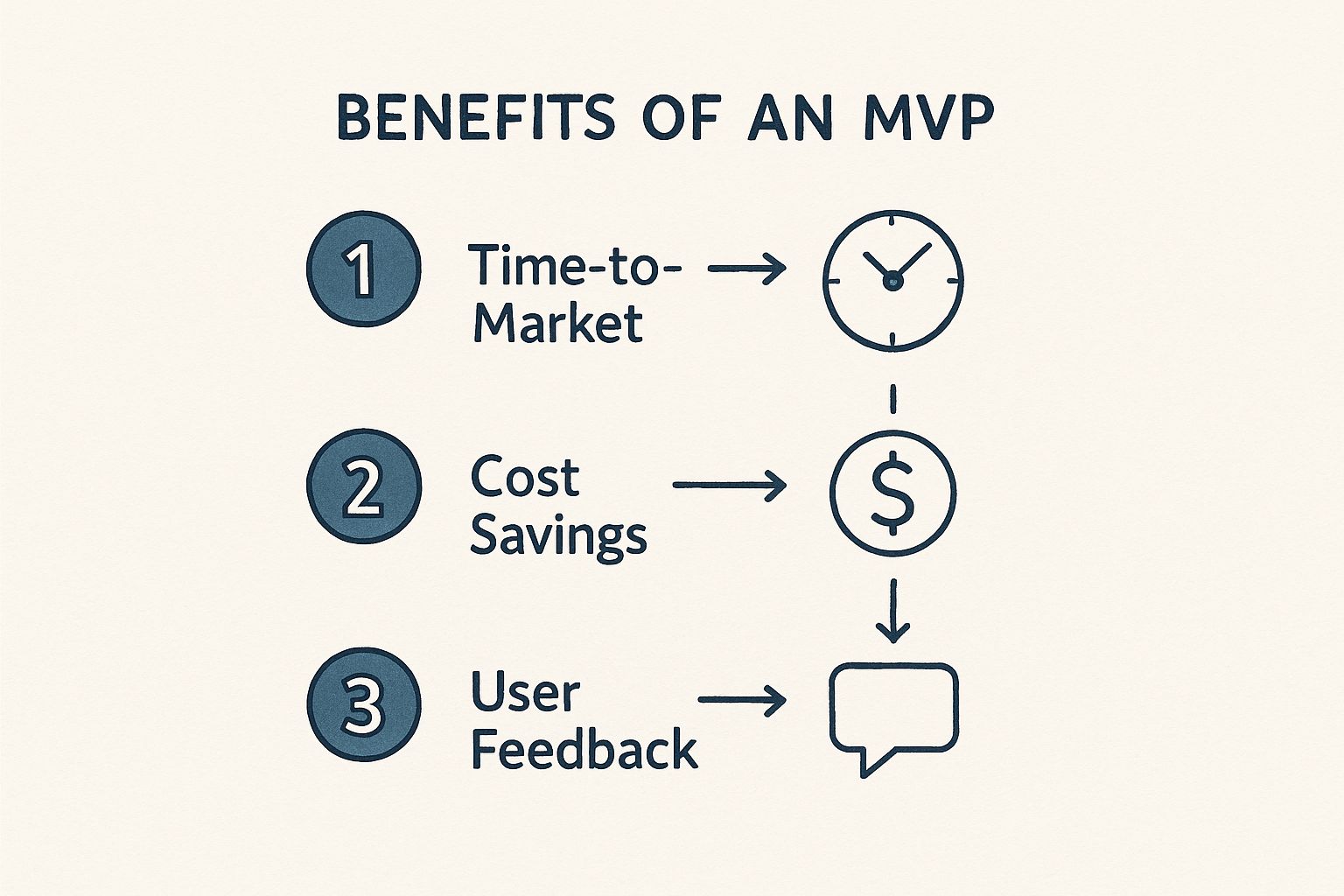
As you can see, a faster market entry directly cuts costs and opens the floodgates for invaluable user feedback, creating a powerful, self-reinforcing cycle of growth.
Conserve Precious Early-Stage Capital
For a startup, cash is oxygen. Burning through it by building features nobody asked for is one of the quickest ways to fail. By concentrating only on core functionality, an MVP dramatically lowers your initial development spend, preserving your runway for marketing, hiring, and future product improvements.
The financial upside here is huge. Startups that embrace a lean MVP approach can see up to a 50% reduction in upfront development costs and slash their time-to-market by as much as 70%. This strategy directly tackles the number one reason 42% of startups go under: a lack of product-market fit. By testing the waters with an MVP, you're making investment decisions based on evidence, not just a gut feeling.
This cost-saving also directly benefits your marketing budget. When you spend less to build the initial product, you have more capital freed up for actually acquiring users. Getting a handle on these numbers is critical, and you can play with different scenarios with our customer acquisition cost calculator.
Generate Invaluable User Validation for Investors
Maybe the most powerful thing an MVP does is create proof. Investors don’t fund ideas; they fund businesses that can show evidence of traction. An MVP delivers exactly that—hard data and real user validation that turns your pitch from a speculative concept into a market-tested opportunity.
Just look at the classic Dropbox story. Before they ever built their complex file-syncing tech, their MVP was just a simple explainer video.
The video simply showed what Dropbox would do. It was an incredibly low-cost, low-risk way to see if anyone even cared. The response was explosive—their beta sign-up list rocketed from 5,000 to 75,000 people overnight.
That wasn't just feedback; it was undeniable proof of massive demand. This brilliant, simple MVP gave them all the validation they needed to build the full product with confidence and lock in crucial early-stage funding. It showed investors a clear, validated market need, making the decision to write a check a whole lot easier. Your MVP can do the exact same thing: it’s the most compelling piece of evidence you can possibly bring to the table.
Navigating the MVP Development Lifecycle
https://www.youtube.com/embed/jpQJ8aOThNY
Building an MVP can feel like a huge, intimidating undertaking. But it’s not as chaotic as you might think. Experienced mvp development services for startups don’t just wing it; they follow a well-defined process designed to get your idea from a sketch on a napkin to a real, market-ready product.
This process is about more than just coding. It's a strategic journey of discovery, smart decision-making, and constant learning. Understanding the stages puts you, the founder, in the driver's seat. It cuts through the jargon and gives you a clear roadmap, ensuring the product we build together is the one you actually envisioned.
Let’s walk through what that journey looks like.
Phase 1: Discovery and Market Analysis
Before we write a single line of code, we have to do our homework. The discovery phase is where your development partner really gets inside your head and understands your idea, your target customer, and the exact problem you’re trying to solve. This isn't just a quick phone call; it's a deep dive to make sure your core assumptions are solid.
This initial groundwork involves a few key things:
- Competitor Analysis: We'll figure out who’s already playing in your sandbox. What are they doing right? Where are they dropping the ball? This is how we find the gap in the market your product can fill. Actionable Insight: Create a simple spreadsheet listing 3-5 competitors. For each one, note their core features, pricing model, and read user reviews to identify common complaints—this is your opportunity.
- User Persona Development: We create profiles of your ideal customers. Who are these people? What keeps them up at night? What are their real-world motivations and frustrations?
- Technical Feasibility Study: Can this thing actually be built with current tech, without an astronomical budget or a five-year timeline? We need to answer this question honestly from the start.
This phase is all about asking the tough questions early on to avoid expensive missteps later. It ensures your MVP is built on a solid foundation of real data, not just a gut feeling.
Phase 2: Strategic Feature Prioritization
Okay, we understand the market and the users. Now comes the hard part: what do we actually build? This is arguably the most critical stage, where we define the "Minimum" in your Minimum Viable Product. The biggest enemy here is feature creep—that temptation to add just one more cool thing, and then another, until your project is bloated, late, and way over budget.
To stay focused, we often use a simple but powerful framework called the MoSCoW method. It helps us sort every potential feature into one of four buckets:
- Must-Have: These are the absolute essentials. Without them, the product simply doesn't work or solve the core problem. Example: For a food delivery app, "search for restaurants" and "place an order" are must-haves.
- Should-Have: These are important features that add a lot of value, but the product could still launch without them. Example: "Live order tracking" is a should-have; the app works without it, but it's a key value-add.
- Could-Have: These are the "nice-to-haves." Great ideas for the future, but not necessary for the first version. Example: "Splitting the bill with friends" is a could-have.
- Won't-Have: Features we all agree are out of scope for now. This helps keep everyone on the same page and protects the timeline. Example: "A loyalty points system" is a won't-have for the MVP launch.
By being ruthless with prioritization, we make sure the team’s energy is laser-focused on the leanest possible product that still delivers massive value. This discipline is what separates a successful MVP launch from a failed one.
Phase 3: UI/UX Design and Prototyping
With the core features locked in, we can start thinking about what the product will look and feel like. User Interface (UI) is all about the visuals—the colors, fonts, and button styles. User Experience (UX), on the other hand, is about the overall journey. Is the app intuitive? Is it easy to use, or confusing?
Good design isn't about making things "pretty"; it's about creating a smooth, frictionless path for the user. We start with basic wireframes—think of them as simple blueprints—before moving to high-fidelity mockups and clickable prototypes. These prototypes let you and potential users test the flow and spot confusing parts long before any code is written, which saves a ton of time and money on rework.
Phase 4: Agile Development and Testing
Now, the fun begins—it’s time to build. Nearly all modern MVP development relies on an agile methodology. We work in short, focused cycles called sprints, which usually last one or two weeks. In each sprint, the team commits to building a small batch of features and delivers a working piece of the product at the end.
This iterative approach is a game-changer for a few reasons:
- Flexibility: If we learn something new, we can easily adjust course. No need to stick to a rigid, outdated plan.
- Transparency: You see tangible progress every couple of weeks, not just a big reveal at the end.
- Continuous Testing: Quality assurance (QA) isn’t an afterthought. We test for bugs and usability issues constantly throughout the process.
This build-test-repeat rhythm is a core part of the larger digital product development process and ensures we’re building the right product, and building it well.
Phase 5: Launch and Feedback Loop
Getting your MVP launched isn't the finish line—it's the starting gun. Once your product is in the hands of real users, the most important phase kicks off: gathering data and feedback. This is the entire reason you built an MVP in the first place.
Your team will use analytics tools to track everything from user engagement and sign-up rates to which features people are actually using. At the same time, you should be actively talking to your first users through surveys, interviews, and support chats. This feedback is gold. It tells you which of your hypotheses were right, which were wrong, and gives you a data-driven roadmap for what to build next. This is the famous "Build-Measure-Learn" loop in action, turning your MVP from a simple product into a powerful learning machine.
How to Budget for Your MVP Development
Trying to set a budget for your MVP can feel a lot like guessing. The honest answer is, there’s no magic number. What you'll ultimately spend on mvp development services for startups comes down to a few key factors that every founder should get to grips with early on.
It’s a bit like building a house. A small, simple cabin is going to have a very different price tag than a sprawling mansion with all the custom bells and whistles. The same holds true for software. The bigger and more intricate your vision, the more time and money it's going to take to build.
The final price you see on a proposal is really just a reflection of your project's size, the tech it's built on, and the team you hire. Nail down those three things, and you'll be well on your way to a budget that feels less like a guess and more like a plan.
Key Factors Driving MVP Costs
So, what exactly are you paying for? It really boils down to four main things that will have the biggest sway on your budget.
Project Complexity: This one's the biggie. A simple app with just a login and a single core feature is worlds away from a platform that needs custom algorithms, hooks into multiple external services, or has to process data in real-time. Example: An app that simply displays curated content is low complexity. An app that uses machine learning to personalize that content is high complexity.
Number of Features: Think of every single button, screen, and function as an item on a receipt. Each one adds to the development time and, consequently, the cost. This is where you have to be ruthless. A tight, focused feature set is the secret to keeping your MVP budget in check.
Technology Stack: The specific programming languages, frameworks, and databases used to bring your product to life also play a role. Some technologies are more common and have a larger talent pool, while others require highly specialized (and more expensive) developers.
Team Location: Where your developers are based makes a huge difference. A development team in North America or Western Europe might bill anywhere from $100-$250 per hour. In contrast, equally talented teams in Eastern Europe or Asia could be in the $30-$75 per hour range.
Knowing how these levers work allows you to have smarter conversations with potential partners and understand what’s really behind the numbers they give you.
Estimated MVP Development Costs by Complexity
To put some real numbers to this, let's look at what you can generally expect to spend. The following table breaks down typical cost ranges based on how complex a project is. Think of these as a good starting point for your financial planning.
| Complexity Level | Example Features | Estimated Cost Range (USD) | Estimated Timeline |
|---|---|---|---|
| Simple MVP | Basic user login, simple task list, static content pages. | $15,000 - $30,000 | 2-3 Months |
| Mid-Range MVP | Custom UI/UX, payment gateway integration, admin dashboard. | $30,000 - $60,000 | 3-5 Months |
| Complex MVP | AI/ML algorithms, real-time chat, multiple third-party APIs. | $60,000+ | 5+ Months |
A "simple" MVP might be a straightforward task management app. A "complex" one, on the other hand, could be a fintech platform with its own fraud detection engine. These examples give you a feel for where your idea might land on the spectrum.
The real goal isn't just to find the cheapest option. It’s about getting the most learning and value for every dollar you invest. Cutting corners now to save a few thousand dollars can easily lead to much bigger headaches—and costs—down the road from fixing bugs and losing frustrated users.
Budgeting for an MVP is all about striking that perfect balance between your grand vision and what's practical right now. By understanding these cost drivers and having some realistic numbers in mind, you can make smarter financial decisions that set your startup up for the long haul.
For a more granular breakdown of what goes into these numbers, our guide on mobile app development cost digs even deeper.
Choosing the Right MVP Development Partner

Picking a partner to build your MVP is one of the most critical decisions you'll make as a founder. This isn't just about hiring someone to write code. It's about finding a strategic ally who buys into your vision and is genuinely invested in seeing you succeed.
Get this choice wrong, and you could face a blown budget, missed deadlines, and a product that just doesn't resonate with users. But the right partner acts as a true extension of your team. They'll challenge your assumptions, offer priceless insights, and help you navigate the tricky process of launching something new. You have to look past the slick sales pitch and focus on what really matters for a successful collaboration.
Evaluate Their Portfolio and Industry Experience
Start by taking a hard look at their past work. A flashy portfolio is nice, but you need to dig deeper for specific, relevant experience. Don't just skim their case studies—look for concrete proof that they've built and launched products in a similar industry or with a business model like yours.
Actionable Insight: When reviewing a portfolio, ask for a demo of a past project or, even better, a reference from that client. Ask the reference specific questions like, "How did the agency handle unexpected roadblocks?" or "How did their work impact your key business metrics?"
Assess Technical Expertise and Communication Style
Naturally, their technical skills have to match your product vision. If your roadmap involves machine learning, make sure they have real AI expertise, not just a casual mention on their website. Ask them tough questions about their preferred tech stack and why it's the right fit for your project's future scalability and performance.
Just as important, though, is how they communicate. A great partnership is built on transparency and collaboration.
Your goal is to find a team that feels less like a vendor and more like a co-creator. A partner who communicates proactively, provides regular updates, and integrates your feedback seamlessly is essential for keeping the project on track and aligned with your vision.
Key Questions to Ask Potential Partners
Before you even think about signing a contract, get on a discovery call with a list of questions that will show you how they really operate. These conversations are your chance to gauge their strategic thinking and see if they’re a good cultural fit.
- How do you handle scope changes and feature requests mid-sprint? Their answer here is a huge tell. It reveals how flexible they are and if they have a solid process for managing the pivots every MVP goes through.
- Can you walk me through a past project that faced unexpected challenges? This question gets right to their problem-solving skills and their honesty.
- How do you incorporate user feedback after each development cycle? This one is non-negotiable. A team that specializes in MVP development services for startups must have a bulletproof process for turning user insights into product improvements.
The MVP development market is crowded. You've got giants like Accenture and IBM offering huge service packages, right alongside smaller, nimble agencies. Your job is to find the provider—big or small—that truly fits your startup’s needs and long-term goals. You can read more about the competitive MVP development ecosystem to get a better sense of the landscape. Taking the time to properly vet your partners is an investment that will pay off, ensuring you find the team that helps turn your idea into a success.
Common Questions About MVP Development Services
Even with a solid plan in hand, you probably still have a few nagging questions about building an MVP. That's completely normal. Getting these last uncertainties sorted out is what helps you move forward with real confidence.
Let's clear up some of the most common things founders ask when they're looking into mvp development services for startups.
How "Minimum" Should My MVP Really Be?
The "minimum" in Minimum Viable Product can be a real hang-up. It doesn't mean building something cheap or broken. It means focusing on the absolute fewest features needed to be viable—that is, to solve a core problem for a specific user and solve it well.
Practical Example: Zappos started by testing the hypothesis that people would buy shoes online. Their MVP wasn't a complex e-commerce site with a huge warehouse. Founder Nick Swinmurn went to local shoe stores, took pictures of their inventory, and posted them online. When an order came in, he bought the shoes from the store and shipped them himself. It was the absolute "minimum" required to validate the core idea.
What Happens Right After My MVP Launches?
Launching your MVP isn't crossing the finish line; it's the sound of the starting pistol. The second your product is live, your job shifts entirely to the "Build-Measure-Learn" feedback loop. This is where you actually start building a business.
Your immediate priorities are twofold:
- Collecting Quantitative Data: Watch the numbers. Track user sign-ups, see which features they're using, and measure how often they come back. This tells you what people are doing.
- Gathering Qualitative Feedback: Talk to your first users. Send surveys, jump on calls, and read every support ticket. This tells you why they're doing it.
This mix of hard data and real human feedback is pure gold. It gives you the evidence you need to decide what to build next, what to fix, and when to pivot, making sure your next move is based on facts, not just your gut.
Are No-Code Platforms a Good Option for an MVP?
They can be, but you have to know what you’re getting into. For certain types of projects, no-code and low-code tools like Bubble or Webflow are brilliant. They let you get a simple web app, internal tool, or basic marketplace up and running fast and without a huge budget.
However, be realistic about their limits. You'll likely run into trouble with:
- Scalability: They can start to creak and groan under the pressure of a large user base.
- Performance: Anything that requires heavy lifting or complex logic can get sluggish.
- Customization: You’re often stuck with the building blocks the platform gives you.
Actionable Insight: Use a no-code tool if your core hypothesis is about market demand, not technical feasibility. For instance, building a no-code marketplace to see if sellers and buyers will even sign up is a great idea. If your idea relies on a unique algorithm or a custom user experience, custom code is the better path from the start.
Ready to turn your idea into a market-tested reality? The team at Pixel One specializes in building strategic MVPs that deliver real insights and drive growth. Let's build your product the smart way.