
A Guide to the Product Market Fit Framework
Discover how to use a product market fit framework to validate your startup idea. Learn proven strategies, metrics, and steps to achieve sustainable growth.A product-market fit framework is less of a rigid set of rules and more of a strategic blueprint. It's designed to guide you through the messy, uncertain process of creating something a specific market truly needs—and is actually willing to pay for. This isn't a one-time checklist; it's a deliberate process of testing your assumptions until you've built a must-have solution for a real, painful problem.
Your Startup's Strategic GPS

Think of a product market fit framework like a GPS for your startup. Without one, you're just driving around, hoping to stumble upon a neighborhood full of customers. A framework gives you a clear, step-by-step route to validate your core ideas before you run out of gas. This structured approach is what separates a business from a passion project, preventing you from building a solution that’s desperately searching for a problem.
It’s the tool that helps you shift from saying, "I think people want this," to confidently stating, "I have evidence that this specific group needs this specific solution."
Why Structure Is Your Greatest Asset
Product-market fit is often talked about like it's a lightning-strike moment of genius. The reality is far less glamorous and much more systematic. It's the outcome of methodical work, and a framework provides the structure for that journey. It helps you de-risk your venture by turning guesswork into a focused, evidence-based process.
For a deeper dive into that critical early stage, our guide on how to validate a business idea is a great resource.
Here’s why leaning on a framework is so important:
- It Cuts Out the Waste: You stop wasting time, money, and energy building features no one will ever use. Actionable Insight: Before adding a feature to your roadmap, ask, "Which specific customer problem does this solve, and how will we measure its impact?" If you can't answer, don't build it.
- It Creates Laser Focus: It forces you to get incredibly specific about who your customer is and what keeps them up at night. Actionable Insight: Create a "no" list—a document outlining the customer types and feature requests you will intentionally ignore to stay focused on your core audience.
- It Provides a Roadmap: Your entire team gets a shared language and a clear process for making decisions, from engineering to marketing. Actionable Insight: Use a tool like a Lean Canvas to display your core assumptions publicly so every team member, from marketing to engineering, understands the hypotheses you're testing.
A framework is your best defense against wishful thinking. It systematically replaces your assumptions with real-world data, ensuring every move you make brings you closer to a product customers can't imagine living without.
From Idea to Indispensable Product
Look at Airbnb's origin story. Their initial idea of renting out air mattresses on a living room floor wasn't exactly an overnight success. They found product-market fit not by luck, but by systematically testing, listening, and iterating. They pinpointed a genuine pain—the lack of affordable places to stay during sold-out city events—and relentlessly refined their solution until it clicked.
Their journey shows the power of a deliberate process over a blind leap of faith. This guide will equip you with the frameworks to navigate your own path from a promising idea to an indispensable product.
The Three Pillars of Product Market Fit

Hitting product-market fit isn’t a one-shot deal. It’s more like balancing a three-legged stool—get one leg wrong, and the whole thing topples over. Nail all three, however, and you’ve built an unshakable foundation for growth.
A good product market fit framework is simply a roadmap. It gives you a structured way to test your ideas and make sure each of these "legs" is solid, turning guesswork into actual evidence.
Pillar 1: The Target Customer
First things first: who are you actually building this for? And I mean exactly who. Going beyond basic demographics like age and location is crucial here. You need to get inside the heads of a specific group of people and understand what makes them tick.
This means creating detailed customer personas that feel like real human beings. What does their day look like? What tools are they already using (and hating)? What keeps them up at night? "Millennial professionals" is way too broad. But "a project manager at a mid-sized tech company struggling to keep remote teams on the same page"? Now we're talking.
Actionable Example: Instead of "fitness enthusiasts," get specific: "Busy mothers in their 30s who want 30-minute, at-home workouts they can do while their kids are napping." This level of detail instantly clarifies what features matter (quick setup, minimal equipment) and which don't (complex gym routines).
Pillar 2: The Underserved Need
Once you’ve locked in who your customer is, you have to find a problem they have that isn’t being solved well enough by anyone else. This is the underserved need, and it's where great companies are born. You're looking for the deep, nagging frustrations that people are desperate to fix.
A fantastic way to dig these up is through the "Jobs to be Done" (JTBD) theory. The idea is to stop asking people what features they want and instead ask what "job" they’re trying to get done. Think about it: nobody buys a quarter-inch drill bit because they want a drill bit. They buy it because they need a quarter-inch hole.
This simple shift in perspective reveals the true motivation. Your product is just the tool they "hire" to get that job done better, faster, or cheaper than anything else out there.
Actionable Example: The founders of Slack didn't ask, "Do you want another chat app?" They observed that teams were struggling with the "job" of keeping project communications in one searchable place. Existing tools like email and multiple chat apps were failing at that job. Slack was "hired" to solve that specific pain.
Pillar 3: The Value Proposition
This last pillar is your promise. It’s the bridge that connects your product directly to the customer’s need. Your value proposition has to answer one simple question from the customer’s point of view: "Why should I pick you over everyone else?"
A powerful value proposition is never just a list of features; it's a specific promise of an outcome. It speaks directly to the pain point you uncovered in the second pillar.
- Weak Value Prop: "Our platform offers collaborative task management and real-time updates." (This is all about features.)
- Strong Value Prop: "We stop project updates from getting buried in emails, so your team stays in sync and never blows a deadline again." (This is all about the outcome and solving a real problem.)
To make sure you’re headed in the right direction, you can follow established models. The 7 Fits Framework, for example, is a comprehensive guide that separates the journey into creating value before you launch and building the business after. It pushes you to confirm your customer-problem fit with simple prototypes, just like Zappos did when they tested demand with photos of shoes before buying a single pair of inventory. You can learn more about how to validate your value proposition before launch on 7-fit-framework.com.
Getting these three pillars perfectly aligned is everything. You could build the most brilliant product in the world, but if it's for the wrong person or solves a problem nobody cares about, it's dead in the water. Tracking the right user experience metrics is a great way to see if your value prop is actually hitting the mark with your audience.
Proven Frameworks You Can Use Today
Alright, theory is one thing, but making real progress means rolling up your sleeves and using actual tools. To get from a big idea to a real-world product people love, you need a reliable product market fit framework. Think of these not as some stuffy academic exercise, but as a practical guide—a compass, really—to help you read the signals your market is sending.
Let's walk through three of the most effective frameworks people are using right now. Each gives you a different way to look at your product and its connection to your customers, so you can start testing your ideas and getting real feedback immediately.
The Sean Ellis PMF Survey
One of the most straightforward ways to figure out if you've got product-market fit comes down to a single, potent question. This survey method, made famous by growth expert Sean Ellis, goes straight to your most active users and asks: "How would you feel if you could no longer use this product?"
The answers are simple: "Very disappointed," "Somewhat disappointed," or "Not disappointed." The magic number you're aiming for is 40%. If at least 40% of your users say they’d be "very disappointed" to lose your product, that's a powerful signal you're on to something. It means you’ve built a must-have tool for a solid core audience. A great example is the email client Superhuman, which famously boosted its score from 22% to a stellar 58% by zeroing in on what its most passionate users truly valued. You can dig into how Superhuman achieved this benchmark on productboard.com.
Actionable Tip: Don't just blast this survey out to everyone. Be strategic. Send it to users who have actually experienced your product's core value—for instance, people who have completed a key action at least twice in the last two weeks. This way, you're getting feedback from those who really get what you're offering.
The Lean Canvas Model
The Lean Canvas is a game-changer for early-stage ideas. It's a one-page business plan, adapted by Ash Maurya from the original Business Model Canvas, that forces you to break down your idea into its most basic assumptions. It's the perfect product market fit framework because it cuts through the noise and makes you focus on what really matters.
Instead of getting bogged down in a 50-page document, you map out your entire strategy on a single sheet. This makes it incredibly easy to see how all the pieces of your business fit together and, crucially, to spot your riskiest assumptions right away.
Here are the key building blocks you’ll fill out:
- Problem: What are the top 1-3 problems you're solving?
- Customer Segments: Who are you building this for? Who are your earliest believers?
- Unique Value Proposition: What's your single, clear message that grabs a visitor's attention?
- Solution: What are the top three features that solve those problems?
- Channels: How will you actually reach your customers?
- Revenue Streams: How will the business make money?
- Cost Structure: What will it cost to run this thing?
- Key Metrics: What numbers will tell you if you're succeeding?
- Unfair Advantage: What's your secret sauce that can't be easily copied or bought?
Actionable Example: Imagine you're creating a meal-planning app. Your Lean Canvas might list the Problem as "Busy professionals struggle to cook healthy meals at home." Your Solution would be "AI-generated weekly meal plans and grocery lists." Your riskiest assumption to test first might be your Revenue Stream: "Will users pay a $10/month subscription for this convenience?" Before building the full app, you could test this with a simple landing page and a "pre-order" button.
Net Promoter Score as a PMF Proxy
While the Net Promoter Score (NPS) wasn't designed specifically to measure product-market fit, it’s an incredibly useful proxy for customer loyalty and satisfaction—two essential ingredients. It all hinges on one simple question: "On a scale of 0-10, how likely are you to recommend our product to a friend or colleague?"
Based on their answers, customers fall into one of three buckets:
- Promoters (9-10): These are your die-hard fans. They love your product and are actively telling others about it.
- Passives (7-8): These folks are content, but not wowed. They like your product, but they could easily be tempted by a competitor.
- Detractors (0-6): These are unhappy customers. At best they churn, at worst they spread negative feedback.
You calculate your NPS score by subtracting the percentage of Detractors from the percentage of Promoters. A consistently high NPS is a fantastic sign that you’re creating real value and generating positive word-of-mouth.
Actionable Insight: The real magic is in the follow-up question: "What is the primary reason for your score?" The answers here are pure gold. Promoters will tell you exactly what you're doing right—your "aha!" moments—while Detractors will literally hand you a to-do list for making your product better. By listening closely to both, you can sharpen your value proposition and get much closer to solidifying your place in the market.
Comparison of Popular Product Market Fit Frameworks
To help you decide which approach might be best for you, here’s a quick side-by-side look at the three frameworks we've discussed. Each has its own strengths and is suited for different stages or goals.
| Framework | Primary Metric | Methodology | Best For |
|---|---|---|---|
| Sean Ellis Survey | Percentage of users who would be "very disappointed" without the product. | Direct user survey with a clear 40% benchmark. | Validating if an existing product is a "must-have" for a core user group. |
| Lean Canvas | Validated learning about business model assumptions. | One-page business model mapping and iterative testing. | Early-stage startups and new products trying to find a viable business model. |
| Net Promoter Score | A score from -100 to 100 based on likelihood to recommend. | Customer loyalty survey that segments users into Promoters, Passives, and Detractors. | Gauging ongoing customer satisfaction and identifying drivers of growth and churn. |
Ultimately, these frameworks aren't mutually exclusive. Many of the most successful companies use a combination of these tools to get a complete, 360-degree view of how their product is really landing with customers.
How to Measure Your Progress with Hard Data

While gut feelings and glowing user interviews feel great, they don't tell the whole story. To really know if you’re on the right track, you have to look at the numbers. This is where a quantitative approach becomes non-negotiable, turning subjective feedback into cold, hard proof that your product is gaining real traction.
Moving from qualitative hunches to quantitative measurement is a sign your business is growing up. Venture firms like Tribe Capital have practically turned this into a science by studying the data behind giants like Slack and Facebook. They blend revenue signals with user engagement data, tracking user groups over time to get a clear, scientific read on retention and growth. This lets founders measure what matters and track progress with precision.
Decoding Retention with Cohort Analysis
The single most powerful indicator of product-market fit is retention. Plain and simple: do people stick around? A cohort analysis is the best tool for the job. It works by grouping users based on when they signed up (for example, everyone who joined in the first week of March) and then watching their activity over the following weeks and months.
This method is brilliant because it shows you if your product improvements are actually making things stickier. If your January cohort has a 15% retention rate after three months, but your April cohort is holding strong at 25%, that’s a powerful sign you’re moving in the right direction.
Actionable Insight: A flattening retention curve is the holy grail of product-market fit. It means that after an initial, expected drop-off, a core group of users finds your product so valuable they simply can't imagine leaving. For a B2B SaaS product, seeing this curve flatten out around 20-30% after six months is a very strong signal.
Calculating Customer Lifetime Value and Acquisition Cost
A sustainable business isn't just about getting users; it's about getting the right users profitably. This is where the LTV to CAC ratio comes into play, a fundamental health check for your business model.
- Customer Lifetime Value (LTV): This is the total revenue you can reasonably expect from a single customer over their entire relationship with you. It’s a measure of long-term health.
- Customer Acquisition Cost (CAC): This is the total sales and marketing cost required to bring one new customer through the door.
A healthy LTV should be at least 3x greater than your CAC. If your ratio is lower, you might be burning cash to acquire customers who don't stick around long enough to pay you back. To get a better handle on your own numbers, try working them out with our customer acquisition cost calculator.
Measuring Stickiness with Engagement Metrics
High retention is fantastic, but you also need users to be active. A "sticky" product is one that weaves itself into a user's daily life or work. The DAU/MAU ratio is one of the best ways to see if this is happening.
This metric compares your Daily Active Users (DAU) to your Monthly Active Users (MAU). In essence, it tells you what percentage of your monthly users show up on any given day.
- For social products: A DAU/MAU ratio of 50% or more is world-class (think Facebook-level engagement).
- For B2B SaaS: A ratio between 15% and 30% is often a strong signal that you've built something that delivers consistent, can't-live-without-it value.
Actionable Example: Imagine you run a project management tool. If you see that users in your "sticky" cohort are creating, on average, 5+ tasks per week, you've identified a key engagement behavior. Your next step is to redesign the new user onboarding process to guide every new user toward creating their first 5 tasks as quickly as possible.
Your Step-By-Step Implementation Playbook
Knowing the theory behind product-market fit is one thing, but actually putting a framework into action is a whole different ballgame. This is where the rubber meets the road—your practical guide to turning a raw idea into a validated product that real people genuinely want and need.
Think of it as a five-stage mission. Each step builds directly on the last, giving you a clear, repeatable roadmap for your journey from concept to reality. The goal here is to replace massive, risky gambles with small, smart, calculated tests, letting you learn as quickly and cheaply as possible.
Step 1: Formulate Testable Hypotheses
Before you even think about writing a single line of code, you need to get your core assumptions down on paper. A fantastic tool for this is the Lean Canvas. It forces you to get brutally honest about who your customer is, what problem you’re really solving for them, and why your solution is the one they'll choose.
This isn’t about creating a rigid business plan. It's about laying out your best guesses. Your main task here is to pinpoint the riskiest hypothesis—that one single assumption that, if it turns out to be wrong, would bring the whole idea crashing down. That's your starting point.
Actionable Example: When Dropbox started, their biggest risk wasn't technology. It was behavior. Their core assumption was: "Will people trust a new startup with their personal files and go through the hassle of installing software to sync them?" They didn't build a full product to find out. Instead, they made a simple explainer video. That video drove thousands of sign-ups, proving people wanted what they were building before it was even ready.
Step 2: Build a Focused Minimum Viable Product
With a clear hypothesis in hand, it's time to build a Minimum Viable Product (MVP). Now, an MVP isn't just a buggy, stripped-down version of your final product. It's a precision tool. It's meticulously designed to do one thing exceptionally well: solve your target customer's most painful problem.
The trick is to fight the urge to add "just one more feature." Every bell and whistle you add just clouds the feedback and slows you down. The sole purpose of the MVP is to test your core value proposition and absolutely nothing else. If you're looking for a deep dive on this critical stage, our guide on how to build a Minimum Viable Product is a great resource.
Step 3: Engage with Your First Users
Once your MVP is live, your job fundamentally changes. You stop being a builder and become a listener. You need to get your product into the hands of your ideal early adopters and start talking to them—directly. This isn't about running big, splashy ad campaigns; it's about having deep, meaningful conversations.
- Conduct User Interviews: Sit down with your users (virtually or in person) and just watch them use your product. Ask open-ended questions like, "Show me how you were solving this problem before you found our tool."
- Establish Feedback Loops: Make it incredibly easy for users to talk to you. Set up a dedicated email, a simple feedback form, or a community channel where they can report bugs, request features, and share their thoughts.
Actionable Insight: Offer your first 20 users a "founding member" deal, like a lifetime discount or free premium features, in exchange for a 30-minute feedback call every month. This creates a dedicated group of invested users who are motivated to help you improve.
Step 4: Implement a Measurement System
While conversations give you context, you need hard data to track your progress objectively. This means choosing just a handful of key metrics that directly reflect the value your product delivers. The goal isn't to drown in data, but to focus on the vital signs.
Your initial measurement system should be simple but powerful, focusing on three core areas:
- Activation: What percentage of new users successfully complete the one key action that delivers your product's "aha!" moment?
- Engagement: Are people coming back? Tracking daily or weekly active users tells you if your product is becoming a habit.
- Retention: Are you building a loyal user base, or is your product a leaky bucket? A simple cohort analysis will show if new users are sticking around.
Step 5: Iterate Based on What You Learn
The final step is what ties everything together. This is where you take all the insights from your user interviews (the qualitative) and your metrics (the quantitative) and use them to make a smart decision. It's the very heart of the Build-Measure-Learn cycle made famous by the Lean Startup methodology.
Based on everything you’ve learned, you’ll either:
- Persevere: The data is looking good, and the feedback is overwhelmingly positive. You double down on what’s working and continue to refine the product.
- Pivot: Your core hypothesis was off. The numbers are weak, and users aren’t finding the value you thought they would. It’s time to make a significant change—to your strategy, your product, or even your target market.
This five-step playbook isn't a one-and-done process. It’s a continuous loop. You'll repeat it over and over, with each cycle bringing you one step closer to that sought-after state of true product-market fit.
To help you put these steps into practice, here is a quick checklist that summarizes the key actions and validation questions for each stage of the process.
Actionable PMF Implementation Checklist
| Stage | Key Action | Validation Question |
|---|---|---|
| 1. Hypothesis | Define your riskiest assumption using a tool like the Lean Canvas. | "If this one belief is wrong, does my entire business idea fail?" |
| 2. Build MVP | Develop a minimal version of your product that solves one core problem. | "Does this MVP effectively test our most critical hypothesis?" |
| 3. User Engagement | Conduct direct user interviews and establish clear feedback channels. | "Are we truly understanding the 'why' behind user behavior?" |
| 4. Measurement | Track key metrics for activation, engagement, and retention. | "Do our chosen metrics accurately reflect the value users are getting?" |
| 5. Iteration | Analyze all qualitative and quantitative data to decide whether to pivot or persevere. | "Based on the evidence, should we continue on this path or make a fundamental change?" |
Think of this table as your go-to reference guide as you navigate each cycle, ensuring you stay focused on what really matters: learning, adapting, and building something people love.
Answering Your Top Questions About Product-Market Fit
As you start working with these frameworks, you're bound to run into some common questions. Let's tackle a few of the big ones to clear up any confusion and help you put these ideas into practice more effectively.
What’s The Difference Between Problem-Solution Fit And Product-Market Fit?
Think of it as a two-act play. Problem-solution fit is Act One. This is the "aha!" moment where you've correctly identified a real, nagging problem for a specific group of people and sketched out a solution that makes them say, "Yes, that's exactly what I need!" You get here through customer interviews, building a bare-bones prototype, or creating a Minimum Viable Product (MVP).
Product-market fit is Act Two. It’s where the rubber meets the road. You’ve not only solved the problem, but you’ve also proven you can find, attract, and keep those customers in a way that actually builds a business. This is about nailing your pricing, finding the right distribution channels, and crafting a go-to-market strategy that works. You simply can't have PMF without first achieving problem-solution fit.
Practical Example: A team identifies that freelancers struggle with invoicing (problem-solution fit). They build a simple invoicing tool. However, they only achieve product-market fit after discovering that freelancers won't pay for the tool but will use it if it's free, with revenue coming from integrated payment processing fees. The solution was right, but the business model needed to match the market.
How Long Does It Realistically Take To Find PMF?
There’s no magic number here, and honestly, it almost always takes longer than you think. A good rule of thumb, based on research into successful B2B SaaS startups, is about two years from the initial idea to hitting that sweet spot of product-market fit.
Why so long? Because it's a marathon, not a sprint. That timeline is packed with endless cycles of building, measuring customer reactions, and learning from your mistakes. Trying to rush this stage is a classic startup killer; many fail because they try to scale before they have a solid foundation to build upon.
Can You Lose Product-Market Fit After Achieving It?
Absolutely. This is a crucial point many founders miss. Product-market fit isn't a trophy you win and put on a shelf; it's a living, breathing thing you have to constantly maintain. Markets are always in motion, and a company can lose its footing for a few key reasons.
Here are the main culprits that can knock you off balance:
- Shifting Market Needs: Customer pains and priorities change. What was a "must-have" yesterday can easily become a "nice-to-have" tomorrow as new technologies or better workflows appear.
- New Competition: A hungry competitor can suddenly show up with a solution that's faster, cheaper, or just plain better, grabbing your audience's attention and budget.
- Technological Disruption: Think about major shifts like the move to mobile or the recent explosion in AI. If you don't adapt your product to these new realities, you risk becoming a dinosaur.
- Product Complacency: The moment you stop listening to your customers and iterating is the moment you start sliding backward. The strategy that got you to PMF won't be the same one that keeps you there.
Practical Example: MySpace had incredible product-market fit in the mid-2000s. However, they grew complacent, failing to innovate on their product and user experience. When Facebook arrived with a cleaner interface and a focus on real-world connections, the market's needs had shifted, and MySpace quickly lost its fit.
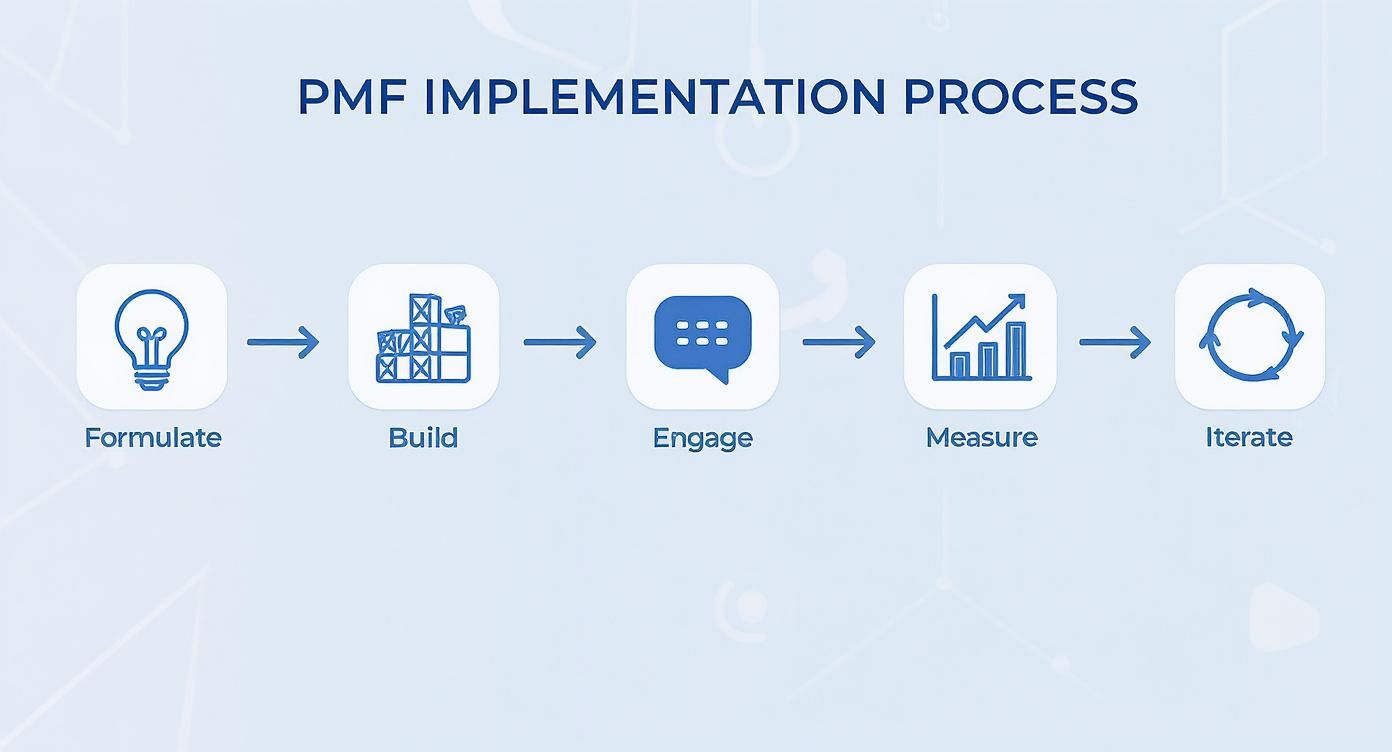
As you can see, it’s not a straight line. Finding and keeping PMF is a continuous loop of forming ideas, building solutions, getting them in front of users, measuring what happens, and doing it all over again.
Ready to turn your innovative idea into a scalable digital product? At Pixel One, we specialize in guiding startups and enterprises through every stage of the product journey, from strategy and design to development and launch. Let's build your next success story together.