
How to Build a Minimum viable product That Succeeds
Learn how to build a minimum viable product with our practical guide. Discover actionable strategies for validation, feature prioritization, and launch.Building a minimum viable product isn't about launching an unfinished product. It’s about being smart. You're launching the most basic version of your idea that solves one specific, painful problem for a clearly defined group of people.
Think of it less as a stripped-down product and more as a strategic experiment. The entire goal is to test your biggest, most critical assumptions with the least amount of time and money possible.
Why an MVP Is Your Startup's Best Insurance Policy
The startup graveyard is littered with beautifully engineered products that nobody actually needed. The number one killer of new businesses isn't a lack of funding or a bad team—it's building something for a problem that doesn't exist.
An MVP is your insurance policy against this exact scenario. It forces you to get out of the building and prove your core concept with real, breathing users before you go all-in on a full-featured, expensive solution. This simple shift in mindset changes the fundamental question from "Can we build this?" to "Should we build this?"—and that distinction makes all the difference.
A Tale of Two Startups
Let's imagine a team wants to take on the project management software market. In the traditional scenario, they spend a year and a huge chunk of their funding building an all-in-one tool. It has everything: Gantt charts, resource planning, team chat, complex dashboards. But when they finally launch, they discover their target users—small creative agencies—find it completely overwhelming. All those agencies really wanted was an easy way to track billable hours.
Now, picture the MVP approach. The team identifies their single biggest assumption: "Creative agencies will pay for a better way to track billable hours."
An MVP is not just a product with half of the features chopped out. It is a process that you repeat over and over again: identify your riskiest assumption, find the smallest possible experiment to test that assumption, and use the results of the experiment to course correct.
To test this, they build a single-feature MVP. It’s just a clean, simple tool for tracking time against client projects and spitting out a basic report. That's it. It takes them weeks, not a year. By getting this focused tool into users' hands, they can quickly find out if there’s real demand and then build the next feature based on what people are actually asking for.
MVP Approach vs Traditional Development
The difference between these two paths is stark. The MVP route prioritizes learning and validation, while the traditional approach is a high-stakes gamble on being right from the start.
| Factor | MVP Approach | Traditional Development |
|---|---|---|
| Risk | Lower. Tests core assumptions early with minimal investment. | High. Assumes market need without validation, risking everything. |
| Cost | Significantly lower upfront investment. | Extremely high, requiring a full development team and budget. |
| Speed | Fast. Time-to-market is weeks or a few months. | Slow. Can take a year or more to launch the first version. |
| Feedback | Gathers real user feedback from day one, guiding development. | Feedback is delayed until after the full product is built. |
| Flexibility | High. Easy to pivot or adjust based on market response. | Low. Major changes are expensive and difficult to implement. |
Choosing an MVP is about building a product with your customers, not just for them. It’s a smarter, safer way to bring an idea to life.
The Numbers Don't Lie
The data backs this up in a big way. Around 42% of startups fail because there was no market need for their product, and another 34% fail from poor product-market fit. These aren't small numbers; they show just how dangerous it is to build in a bubble.
Using an MVP to validate your ideas early on can flip those odds in your favor. You replace guesswork with real-world evidence.
Ultimately, building an MVP is a disciplined process of learning what your customers truly value before you bet the farm. It's a foundational step that's tightly connected to the entire idea validation journey. You can dive deeper into how to validate a business idea in our comprehensive guide.
Finding the Core Problem Your Users Will Pay For
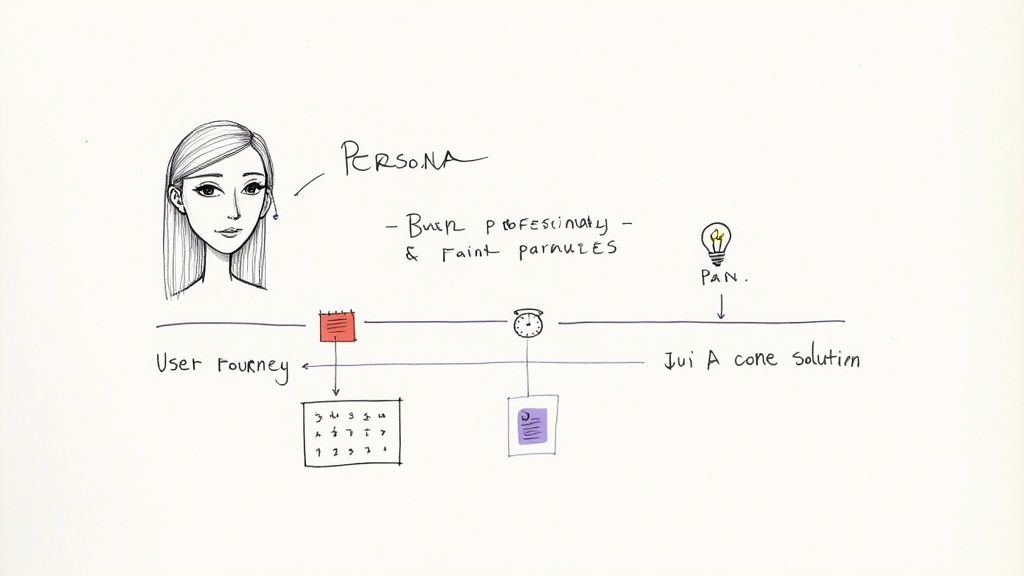
Before you write a single line of code or sketch out a wireframe, your success boils down to one thing: are you solving a problem that someone genuinely cares about? So many great ideas fail because they're solutions in search of a problem.
The real magic happens when you shift your mindset from features to frustrations. What daily friction are your potential users experiencing? What clumsy workarounds are they cobbling together with spreadsheets and a bunch of different apps? Nailing this is the foundation of an MVP people will actually use—and more importantly, pay for.
From Vague Idea to Specific Persona
Here’s a classic startup mistake: trying to build for everyone. If your target audience is "young professionals," you might as well be building for no one. You have to get radically specific.
Let's say you've got an idea for an app to help people find local events. That's a decent start, but it's way too broad. Let's zoom in and create a user persona:
- Meet Sarah: She’s a 29-year-old marketing manager living in a decent-sized city.
- Her Frustration: Sarah works long hours and wants to make her weekends count. She's sick of scrolling through generic event sites and social media feeds, only to find things that don't interest her or are already sold out.
- Her Goal: She needs a quick, reliable way to find curated, interesting plans—like a pop-up art show or a unique food festival—without all the research fatigue.
Suddenly, you’re not building a generic event calendar. You’re building a solution for Sarah. This focus becomes your north star, guiding every decision from the UI to the partnerships you pursue.
Uncovering Pain Points Through Real Conversations
Surveys are great for collecting data, but real, human conversations are where you find the gold. To truly get inside Sarah’s world, you have to talk to people just like her. This isn't about pitching your idea; it's about listening.
The goal is to dig deep and uncover genuine pain points. Asking the right questions is everything. Our guide on how to conduct user interviews offers a solid framework for having conversations that get you past surface-level answers.
A successful MVP solves a single problem so well that your first users are willing to overlook its missing features. Their need for the solution outweighs their desire for a polished, all-in-one tool.
During your interviews with a few "Sarahs," you might discover something surprising. Maybe the real headache isn't finding events, but actually coordinating with friends. A single insight like that could completely pivot your MVP from a discovery tool to a social planning app.
Mapping the User Journey to Find the Gaps
Once you have a handle on the user and their frustrations, it's time to map out their current process. This is what we call a user journey map. How does Sarah try to solve her weekend-planning problem right now?
- Trigger: It's Thursday afternoon, and she realizes her weekend is wide open. Panic sets in.
- Research: She opens three different apps, skims a local blog, and scrolls endlessly through Instagram.
- Coordination: She starts texting screenshots and links to two different friend groups. Chaos ensues.
- Decision: After a flurry of back-and-forth messages, the group either lands on a plan or, more often than not, gives up.
Laying it all out like this shows you exactly where the experience breaks. That friction between research and coordination? That’s your opening. Your MVP doesn't have to fix her entire life; it just needs to fix the most broken step in this journey better than anyone else.
Analyzing the Competition to Carve Your Niche
Let’s be honest, you're probably not the first person to have this idea. But that's okay. Analyzing your competitors isn't about copying them; it's about finding the gaps they've missed.
Actionable Insight: Go to the App Store or G2, find your top three competitors, and filter their reviews to show only 1-star and 2-star ratings. What are the common themes? Are people complaining about a buggy mobile app, poor customer service, or a confusing interface? These complaints are a treasure map pointing directly to opportunities for your MVP. By zeroing in on a pain point that existing solutions handle poorly, you give users a compelling reason to make the switch.
This rigorous process of market and user analysis is the biggest challenge in MVP development. The global market, valued at around $316 million in 2024, is expected to hit $569 million by 2031, driven by companies trying to nail this very process to reduce risk and launch products people actually want.
Prioritizing Features Without the Guesswork
Once you’ve nailed down the core problem your product solves, you hit the next big wall: deciding what to build first. This is where so many teams get bogged down in endless debates or fall victim to feature creep. The goal isn't to build your dream product right out of the gate; it's to build the absolute bare minimum needed to test your core assumption.
This calls for a ruthless and objective approach. Instead of running on gut feelings or listening to the loudest person in the room, a structured framework helps you cut through the noise. It ensures you’re putting your limited time and money into the features that will teach you the most, for the least amount of work.
Using Frameworks to Make the Tough Calls
Two of the most effective and straightforward frameworks I've seen teams use are the MoSCoW method and the Value vs. Effort matrix. They give everyone a shared language to talk about what's truly essential for launch day.
The MoSCoW method is a simple but powerful way to bucket features. It forces you to sort every potential idea into one of four categories, making it painfully clear what’s non-negotiable.
- Must-have: These are the absolute deal-breakers. Without them, the product doesn't work or fails to solve the user's primary problem. For a ride-sharing app, this would be "request a ride" and "see driver on a map."
- Should-have: These are important features that add a lot of value, but the product can still function without them. For the ride-sharing app, "scheduling a ride in advance" would fit here.
- Could-have: Think of these as the "nice-to-haves." They might improve the user experience, but their impact is minor. "Choosing your car's music playlist" is a classic could-have.
- Won't-have: Just as important as what you will build is deciding what you won't. Explicitly calling these out prevents scope creep. For launch, "a loyalty points system" is definitely a won't-have.
By clearly defining what you're leaving out, you manage expectations and protect your timeline.
Putting the Value vs. Effort Matrix to Work
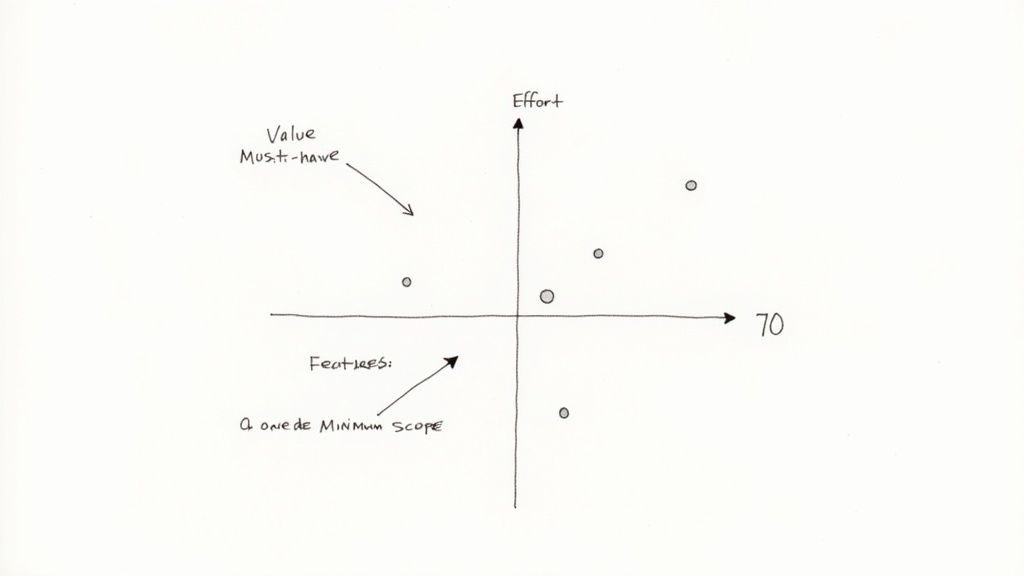
While MoSCoW is great for categorizing, the Value vs. Effort matrix is a fantastic visual tool for making trade-offs. You simply plot each feature on a 2x2 grid based on two simple questions: How much value does this bring to the user? And how much effort will it take to build?
Let's imagine we're building a new fintech budgeting app. After a brainstorming session, we have a list of potential features:
- Secure bank account linking
- Automatic expense categorization
- Custom savings goals
- Personalized investment advice
Now, we can plot them.
A prioritization framework isn't about setting a long-term plan in stone. It's a tool for making tough, immediate decisions on what to build right now to maximize learning. To see how this fits into the bigger picture, check out our guide on what is a product roadmap.
During the discussion, the team might realize that automatic expense categorization is incredibly high-value for users and relatively low-effort to implement. Bingo. That's a quick win and a core part of the MVP.
On the other hand, personalized investment advice is also high-value, but it's a massive undertaking, requiring complex algorithms and navigating regulatory hurdles. That's a clear candidate for a future release. Bank linking is high-value and high-effort, but it’s a foundational must-have for categorization to even work. Savings goals fall somewhere in the middle.
This exercise transforms a messy debate into a clear, data-informed conversation.
Feature Prioritization Matrix Example
Here’s a look at how you could score these features in a table to make the final call. This simple scoring system removes ambiguity and makes the decision process much more straightforward.
| Feature Idea | User Value (1-10) | Development Effort (1-10) | Decision (Include/Exclude) |
|---|---|---|---|
| Automatic Expense Categorization | 9 | 4 | Include |
| Secure Bank Linking | 10 | 8 | Include (Critical) |
| Custom Savings Goals | 6 | 5 | Exclude (Post-MVP) |
| Investment Advice | 8 | 10 | Exclude (Future Roadmap) |
Looking at this table, the MVP scope becomes crystal clear. We're building a simple, secure app that lets users link their bank account and see where their money is going. That's it. This tightly focused scope is the very definition of a "minimum" product that is "viable" enough to start learning from real users.
Choosing the Right Kind of MVP for Your Idea
When most people hear “MVP,” they immediately picture a stripped-down but functional app. That’s one way to do it, but it’s not the only way. The reality is, an MVP doesn't always involve writing a single line of code.
The smartest move you can make is picking the type of MVP that gets you the answers you need, fast. This is all about striking a balance between speed, cost, and the quality of feedback you're after. For some ideas, a simple landing page is all you need to see if you're onto something. For others, you absolutely need to give users something they can click around in. The trick is to match your MVP’s fidelity—its level of detail and functionality—to the biggest, scariest assumption you need to test.
Low-Fidelity MVPs: Getting Answers Without Code
Low-fidelity (or low-fi) MVPs are your go-to for answering the most fundamental question of all: "Does anyone actually want this?" They are designed to be incredibly quick and cheap, validating market demand before you sink a dollar into development.
Let's imagine you want to build a marketplace connecting local artisans with buyers. Your biggest risk isn't the tech; it's whether you can get both artisans and customers to show up. A low-fi MVP is perfect for this.
- Landing Page MVP: A practical example is Buffer, the social media scheduling tool. Before building anything, founder Joel Gascoigne created a simple landing page that explained what Buffer would do and collected emails from interested users. When enough people signed up, he knew he was onto something.
- Concierge MVP: Forget automation. You manually deliver the service to your very first customers. Food on the Table, a meal planning service, started this way. The founder would personally interview customers about their food preferences and then hand-deliver recipes and shopping lists. It’s unscalable, but the direct feedback is pure gold.
- Wizard of Oz MVP: This one is a bit sneaky. Zappos is the legendary example. Founder Nick Swinmurn wanted to test if people would buy shoes online. Instead of building a massive warehouse and inventory system, he posted pictures of shoes from local stores on a simple website. When an order came in, he would literally run to the store, buy the shoes, and ship them himself.
These methods are all about learning, not building. They let you test your core idea with the absolute minimum of upfront effort.
High-Fidelity MVPs: Testing the Actual Experience
Once you've got some proof that people want what you're selling, it’s time to test the user experience itself. This is where a high-fidelity (high-fi) MVP comes in. These feel much more like a real product and are built to see how users actually interact with your solution.
This is where no-code and low-code platforms have completely changed the game. The MVP building tool market was valued at around $1.2 billion in 2023 and is on track to explode to $3.8 billion by 2032. This isn't surprising—startups and even big companies are using these tools to get functional prototypes into users' hands faster than ever. You can read more on the trends in the MVP building tool market.
For our artisan marketplace, a high-fi MVP could mean using a no-code tool like Bubble to build a simple but working version of the platform.
Here’s a peek at the Bubble interface, which is all about building web apps visually.
This drag-and-drop environment lets you set up databases, design user workflows, and create an interactive front-end without touching traditional code. It's a massive shortcut.
The point of a high-fidelity MVP isn’t to launch a perfect product. It’s to build just enough of a product to watch real user behavior and get answers to critical questions about usability and whether people stick around.
With a Bubble-built MVP, artisans could create profiles and list their work, and buyers could browse and inquire. This allows you to test the core loop of your marketplace and see where people get stuck or what they love. Of course, before you jump into building, it helps to have a map. Our guide on how to create wireframes can walk you through that crucial planning phase.
When You Have No Choice But to Custom Code
As powerful as no-code is, it can't do everything. Sometimes, even for an MVP, custom development is the only path forward.
You'll likely need to go with custom code if your product's core value hinges on:
- A Unique, Complex Algorithm: If you're building a new kind of recommendation engine based on your own secret sauce, a no-code builder just won't cut it.
- High-Performance Demands: Does your app need real-time data processing or serious number-crunching? That almost always requires a custom-coded backend for speed and stability.
- Deep or Obscure Integrations: While no-code platforms have tons of plugins, if you need to connect with a niche or complex third-party API, you'll probably need a developer to build that bridge.
Picking the right MVP type is a strategic choice, not a technical one. The rule of thumb is simple: start with the lowest-fidelity option that can validate your biggest assumption. Only increase the complexity and investment once you have proof you're on the right track. This deliberate, step-by-step approach is what separates the MVPs that lead to success from the ones that just burn through cash.
Launching Your MVP and Learning from Users
Getting your minimum viable product into the hands of real users is the moment of truth. All the planning, prioritizing, and late-night coding sessions lead to this point, where theory crashes into the messy reality of the market.
Remember, the launch isn't the finish line. It's the starting gun for the most important part of the journey: the Build-Measure-Learn loop. You build a minimal version to test a core belief, you measure how people actually use it, and then you learn what to build next—or what to scrap entirely. This cycle is how you turn raw user data into a real, evidence-based roadmap.
Finding Your First Users
Forget a big, splashy marketing launch for your MVP. That's a huge waste of time and money right now. Your goal isn't to attract thousands of users; it's to find a small, dedicated group of early adopters who will give you brutally honest, high-quality feedback.
Think of this as a targeted, tactical operation. Your first users are probably already out there, talking about the very problem your MVP solves. You just need to find them.
- Product Hunt: This is a goldmine for tech-savvy early adopters. A well-timed launch here can bring a welcome flood of initial users and insightful comments.
- Reddit: Dive into the subreddits where your audience lives. If you built a tool for freelance writers,
r/freelanceWritersis your hunting ground. Just be human—engage in conversations and follow the community's rules on self-promotion. - Niche Facebook or LinkedIn Groups: Search for groups that cater to your target market. A B2B SaaS tool for inventory management will find its ideal first users in groups for e-commerce store owners or Amazon FBA sellers.
The strategy is simple: go where your users already congregate and introduce your MVP as a potential new solution to a problem they feel deeply.
This visual breakdown shows how an MVP evolves from a basic idea into a more polished product, ready for a wider audience.
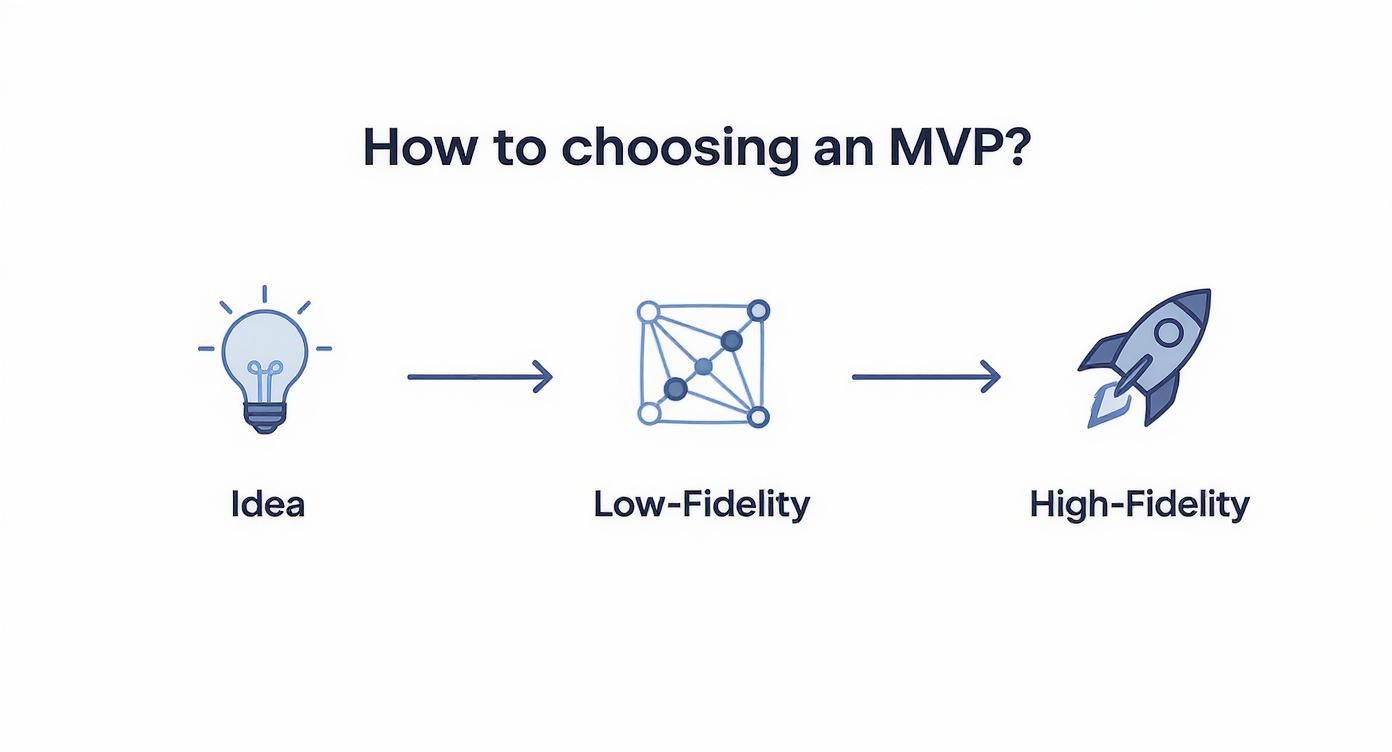
As the infographic shows, you only increase the complexity and investment after you've validated the previous stage.
Measuring What Actually Matters
Once people start using your product, it's easy to get fixated on vanity metrics. Sign-ups and page views feel great, but they don't tell you if your product has a future. They don't tell you if you're actually solving a problem.
You need to track actionable metrics that reflect real user engagement and answer the tough questions about user behavior.
- Activation Rate: What percentage of people who sign up actually complete the core action? For Dropbox's MVP, this was "uploading their first file." A high activation rate tells you users understand the product's value proposition quickly.
- Retention Rate: This one is critical. How many users come back a day, a week, or a month later? A low retention rate is a massive red flag, signaling your product wasn't valuable enough to earn a return visit.
- User Task Success Rate: Can people even figure out how to do what they came for? Using a tool like Hotjar to watch session recordings can be painful but incredibly revealing. You might discover that 80% of users drop off on a specific screen because a button is confusing.
The goal isn't just to measure clicks and sign-ups; it's to measure learning. Every metric you track should help you prove or disprove a core assumption about your product.
Turning Feedback into a Validated Roadmap
Collecting feedback is both an art and a science. You need quantitative data (the "what") from your analytics, but you absolutely need qualitative insights (the "why") from real conversations to understand what's behind the numbers.
Here are a few practical ways to get that crucial feedback:
- Direct User Interviews: Email your most active—and even your least active—users and ask for 15 minutes of their time. Prepare open-ended questions like, "What were you really hoping our product would do for you when you first signed up?" The answers will be gold.
- Simple In-App Surveys: Use a lightweight tool to pop up a one-question survey after a user completes a key action. For instance, after they export a report, you could ask, "On a scale of 1-5, how helpful was this report?"
- A "Feature Request" Board: Set up a simple public board where users can post ideas and upvote others. This is a fantastic, low-effort way to see what your most passionate users are craving next, helping you prioritize development based on actual demand.
When you combine what users do (analytics) with what they say (feedback), you close the loop. This data-driven approach takes the guesswork out of product development and ensures every new feature you build is a direct response to a proven user need. For a more structured approach to launch day, a comprehensive product launch checklist can help you keep everything on track.
Common Questions About Building an MVP
Even with a solid plan, building a minimum viable product can feel like navigating a maze. You're bound to run into tricky questions and a few roadblocks. Anticipating these common hurdles is the best way to tackle them head-on, keeping you focused on learning from your users instead of getting bogged down.
Let's walk through some of the biggest questions that come up.
How “Minimum” Should My MVP Be?
This is the classic MVP dilemma, and it trips up a lot of founders. The real answer has nothing to do with a specific number of features—it’s all about value. Your MVP should be minimal in scope, but it absolutely cannot be minimal in quality or its ability to solve a problem.
It must solve at least one core problem for your ideal user so well that they're willing to stick with you, even with a few rough edges.
A great way to frame this is the "painkiller vs. vitamin" analogy. Is your product a "nice-to-have" vitamin, or is it an essential painkiller that solves a nagging, urgent problem? Your MVP must be a painkiller.
For instance, imagine you're creating a new project management tool. Your MVP might literally just be a dead-simple, shareable task list. No Gantt charts, no time tracking, no fancy integrations. But if that single feature saves a small team from the daily chaos of managing projects in a messy email chain, you've created a powerful painkiller.
What if Someone Steals My Idea?
This fear keeps a lot of great ideas locked away in a notebook. But honestly, it's almost always misplaced. Ideas are a dime a dozen; what truly matters is execution. By keeping your idea a secret, you’re starving it of the one thing it needs to grow: real user feedback.
The risk of building something nobody actually wants is infinitely greater than the risk of a competitor swooping in on your unproven concept.
An MVP is not just a product with half of the features chopped out. It is a process that you repeat over and over again: identify your riskiest assumption, find the smallest possible experiment to test that assumption, and use the results of the experiment to course correct.
Getting your MVP into the hands of real users as quickly as possible gives you a massive head start. While you're busy learning, iterating, and building a loyal user base, any potential competitor is still stuck theorizing about their "perfect" product in a silo. Those early learnings become your moat.
How Much Should an MVP Cost to Build?
There's no single price tag. An MVP can cost anywhere from next to nothing to tens of thousands of dollars. The final number really boils down to the type of MVP you need to build to get answers.
- Low-Fidelity (Low Cost): A simple landing page to gauge interest and collect emails might just cost you the price of a domain name. A "Concierge" MVP, where you manually perform the service for your first customers, costs you time but very little cash.
- High-Fidelity (Higher Cost): Building a functional prototype with no-code tools could run you a few hundred dollars in subscriptions. A custom-coded MVP with a unique algorithm, on the other hand, will require a real investment in development talent.
The trick is to match your budget to your immediate learning goal. Always start with the cheapest, fastest method to test your biggest assumption before you even think about committing serious funds.
When Is My MVP “Done”?
Here’s the thing: your MVP is never "done" in the traditional sense. It's not a one-and-done product launch; it’s the very first step in a continuous loop of building, measuring, and learning.
You know you've successfully completed the first MVP cycle when you have enough hard data—both quantitative analytics and qualitative user feedback—to make a clear, informed decision about what to do next.
That decision will likely be one of three things:
- Persevere: The feedback is positive and the data backs up your core idea. Time to build the next feature.
- Pivot: Users are interested, but they want you to solve a slightly different problem than you originally thought.
- Pause: The response is overwhelmingly negative. It's time to head back to the drawing board before wasting more resources.
Remember, the goal isn't to launch a finished product. It's to launch a learning vehicle.
At Pixel One, we specialize in turning promising ideas into successful digital products. If you're ready to build an MVP that delivers real insights and sets your business up for long-term growth, we're here to help. Learn more about our product strategy and development services at pixelonelabs.com.