
Agile Development Best Practices to Ship Faster Software
Discover agile development best practices to optimize your workflow and boost team productivity while delivering high-quality software faster.Adopting agile is easy; mastering it is another story. Many teams go through the motions, holding daily standups and planning sprints, but fail to see the promised boost in productivity and innovation. They get stuck in a cycle of ceremonies without reaping the benefits of true agility, leading to frustration and missed deadlines. This isn't just about following a rulebook; it's about fundamentally changing how your team collaborates and delivers value.
This guide cuts through the noise. We will explore 10 proven agile development best practices that move beyond theory. Forget generic advice; we are providing actionable steps, practical implementation details, and real-world examples to help your team build better products, faster. You will learn not just what to do, but how to do it effectively within your unique environment.
Whether you are a startup aiming to launch a new product, an enterprise undergoing digital transformation, or a product manager looking to refine your team’s process, these insights will equip you to turn agile principles into tangible results. Our focus is on reducing friction, improving communication, and accelerating the delivery of high-quality software. Let's move from simply "doing" agile to truly "being" agile.
1. Daily Standup Meetings
The daily standup, or daily scrum, is a core ceremony in many agile frameworks. It's a short, time-boxed meeting, typically 15 minutes, where the development team synchronizes activities and plans for the next 24 hours. This practice is one of the most fundamental agile development best practices because it dramatically improves communication, uncovers impediments, and fosters a sense of shared commitment.
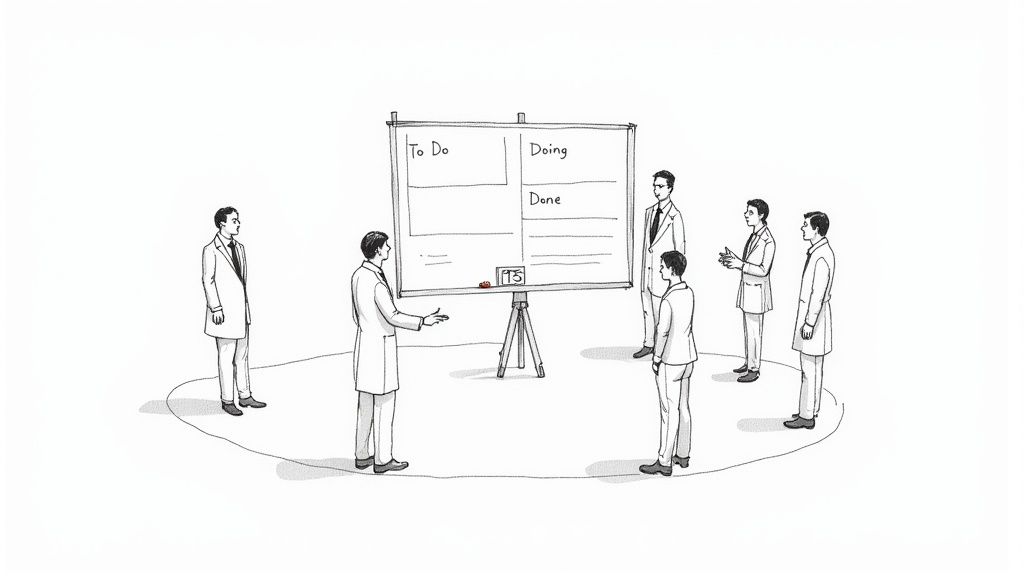
The classic format involves each team member answering three simple questions: What did I do yesterday? What will I do today? What blockers are in my way? This structure keeps the meeting focused and efficient. For example, instead of a vague update, a developer might say, "Yesterday, I finished the API endpoint for user authentication. Today, I'll start the password reset flow. I'm blocked because I'm still waiting for the final API key from the third-party service." This specific update immediately identifies a solvable problem.
How to Implement Daily Standups
To get the most value from this practice, it's crucial to treat it as more than just a status update. The goal is active problem-solving and collaboration.
- Keep it Brief: The 15-minute timebox is essential. Physically standing up (even on video calls) can help maintain brevity and focus. If a discussion takes more than 30 seconds, use the "parking lot" technique: table it for a follow-up meeting with only the relevant people.
- Focus on Blockers: The standup is for identifying blockers, not solving them. Actionable Insight: When a blocker is raised, the Scrum Master’s job is to immediately ask, "Who can help with that?" and ensure a follow-up is scheduled right after the standup.
- Visualize Progress: Conduct the standup in front of a physical or digital task board (like Jira or Trello). This provides visual context and keeps the conversation centered on sprint goals. Point to the specific ticket or task being discussed.
- Rotate Facilitators: Assign a different team member to lead the standup each day. This increases engagement and distributes ownership of the process, preventing it from becoming a status report to a single manager.
2. Sprint Planning
Sprint planning is the collaborative ceremony that kicks off every sprint. During this meeting, the entire development team, along with the Product Owner and Scrum Master, selects high-priority items from the product backlog and defines a clear sprint goal. This practice is a cornerstone of effective agile development best practices because it establishes a shared understanding of what can be delivered and ensures the team is aligned on the most valuable work.
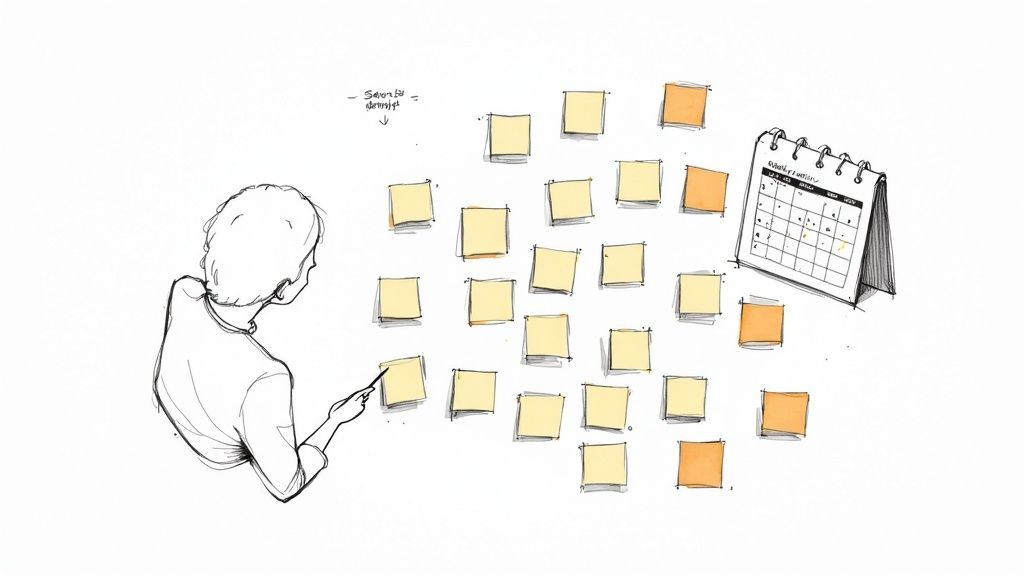
The outcome is a sprint backlog: a list of product backlog items the team commits to completing. This process transforms a list of possibilities into an actionable plan. For example, a team building an e-commerce site might have a sprint goal like: "Enable users to successfully add items to their cart and complete a guest checkout using a credit card." This goal gives purpose to the collection of individual stories in the sprint.
How to Implement Sprint Planning
Effective sprint planning is about creating a realistic and focused plan, not just filling a timebox with tasks. The goal is a commitment the team feels confident in achieving.
- Break Down Stories: Before committing, decompose larger user stories into smaller, manageable technical tasks (e.g., "Create database schema," "Build API endpoint," "Develop UI component"). Actionable Insight: A good rule of thumb is that no task should be longer than one day’s work.
- Estimate Collectively: Use techniques like Planning Poker with story points to estimate effort as a team. This leverages collective wisdom and fosters shared ownership. If estimates from two engineers vary wildly, it signals a misunderstanding that needs to be discussed.
- Define a Clear Sprint Goal: The Product Owner should propose a clear, concise goal for the sprint. This goal provides a unifying purpose. Example: A bad goal is "Complete tickets A, B, and C." A good goal is "Allow users to log in with their Google account."
- Respect Team Capacity: Don't plan to 100% capacity. Use the team's historical velocity (average story points completed per sprint) as a guide. Leaving a buffer allows the team to handle unexpected issues or technical debt without jeopardizing the sprint goal.
3. User Stories and Acceptance Criteria
User stories are a fundamental tool in agile development for capturing requirements from an end-user's perspective. They shift the focus from writing technical specifications to discussing outcomes, using a simple format: "As a [user type], I want [an action] so that [a benefit]." This approach keeps development human-centered and directly tied to user value, making it one of the most effective agile development best practices for building products that people actually need.
This method ensures that every feature has a clear purpose. Paired with clear acceptance criteria, which define the specific conditions a story must meet to be "done," this practice eliminates ambiguity. For example, a user story might be: "As a registered user, I want to reset my password so that I can access my account if I forget it." The acceptance criteria would then specify the exact behavior, such as "Given I am on the login page, when I click 'Forgot Password,' then I am prompted to enter my email address."
How to Implement User Stories and Acceptance Criteria
Effective user stories are a starting point for conversation, not a final contract. The key is to keep them collaborative and focused on user value.
- Follow the INVEST Model: Good stories are Independent, Negotiable, Valuable, Estimable, Small, and Testable. Actionable Insight: Before planning a sprint, quickly check each story against this acronym. If a story is too big (not "Small"), break it down.
- Use the "Given-When-Then" Format: For acceptance criteria, this structure (e.g., Given I am on the login page, When I enter valid credentials, Then I am logged in) provides clear, testable scenarios that can often be directly translated into automated tests.
- Involve User Proxies: Write stories collaboratively with product owners, designers, and even customers. To get deep insights into user needs, you need to understand how to conduct effective user interviews.
- Focus on the "Why": The "so that" clause is the most important part of the user story. It provides the business context and empowers the development team to make better technical decisions. Always challenge stories that lack a clear user benefit.
4. Continuous Integration and Continuous Deployment (CI/CD)
Continuous Integration (CI) and Continuous Deployment (CD) are automated practices that form the backbone of modern agile development. CI involves developers frequently merging their code changes into a central repository, after which automated builds and tests are run. CD extends this by automatically deploying all code changes that pass the testing stage to a production environment. This CI/CD pipeline is one of the most critical agile development best practices because it minimizes manual work, catches bugs early, and enables rapid, reliable software delivery.
The goal of CI/CD is to make deployments predictable, low-risk events. For example, every time a developer on a project pushes code, a CI server like GitHub Actions automatically runs all unit tests. If they pass, it builds the application and deploys it to a staging server for further testing. This immediate feedback prevents integration problems from festering. For a deeper look into connecting systems, you can learn more about API for third-party integration.
How to Implement CI/CD
Building a robust CI/CD pipeline requires a focus on automation, testing, and monitoring. The objective is to create a fast, reliable path from code commit to production deployment.
- Automate Everything: The pipeline should be fully automated from code commit to deployment. Actionable Insight: Start by creating a simple script that automates your build and test process locally. Then, integrate this script into a CI tool like Jenkins or GitLab CI.
- Maintain High Test Coverage: Automated testing is the safety net of CI/CD. Aim for high unit and integration test coverage (80%+) to validate changes. Without strong test coverage, CD is just a fast way to ship bugs.
- Use Feature Flags: Deploy new features behind feature flags (or toggles). Practical Example: A team can deploy the code for a new checkout flow to production but keep it hidden from users. They can then enable it for 1% of users to test its performance before a full rollout.
- Keep the Build Green: A failed build should be an "all hands on deck" event. The team should prioritize fixing a broken build above starting new work to ensure the pipeline remains trustworthy and usable.
5. Sprint Reviews and Retrospectives
At the end of each sprint, two distinct ceremonies provide crucial feedback loops: the Sprint Review and the Sprint Retrospective. The Sprint Review is an informal meeting where the team demonstrates what they accomplished, gathering feedback from stakeholders on the product. The Sprint Retrospective is an internal meeting for the team to reflect on their process and identify opportunities for improvement. These ceremonies are central agile development best practices that fuel continuous improvement.
Separating these meetings is key: the Review focuses on what was built, while the Retrospective focuses on how it was built. For example, during a Sprint Review, a stakeholder might say, "The new report is great, but can we add a PDF export button?" This is product feedback. In the Retrospective that follows, a developer might say, "We struggled to finish the report because our database queries were too slow." This is process feedback.
How to Implement Reviews and Retrospectives
To maximize value, these ceremonies must be treated as opportunities for honest feedback and actionable planning, not just formalities.
- Demonstrate Working Software: In the Sprint Review, avoid PowerPoint slides. Show the actual, working software. Let stakeholders click around in a staging environment. This generates much more valuable and concrete feedback.
- Keep Feedback Constructive: In Retrospectives, establish ground rules like the "prime directive": "Regardless of what we discover, we understand and truly believe that everyone did the best job they could." This creates psychological safety.
- Vary Retrospective Formats: To keep engagement high, use different formats. Practical Example: Use "Start, Stop, Continue" one sprint, then a "Sailboat" retro (anchors = what slows us down, wind = what pushes us forward) the next.
- Create Actionable Items: End every Retrospective with 1-2 specific improvement items for the next sprint. Actionable Insight: Assign an owner to each action item and add it to the next sprint's backlog to ensure it doesn't get forgotten.
6. Iterative and Incremental Development
Iterative and incremental development is a cornerstone of agile, focusing on breaking down large projects into smaller, manageable pieces. Each piece, or increment, adds value and results in working software delivered through a series of cycles, or iterations. This practice is one of the most critical agile development best practices because it minimizes risk by allowing for early and continuous user feedback, enabling the product to evolve based on real-world learning.
This approach contrasts sharply with traditional "big bang" releases. Instead of building a full user profile system at once, an iterative approach might deliver it in increments:
- Sprint 1: Users can register and log in with an email and password.
- Sprint 2: Users can add a profile picture.
- Sprint 3: Users can edit their personal information.
Each sprint delivers a small but complete piece of user value.
How to Implement Iterative and Incremental Development
Successfully adopting this model requires a shift in how work is planned and delivered, moving from large-scale project plans to small, value-driven cycles. To understand how this fits into a broader strategy, you can explore the digital product development process on pixelonelabs.com.
- Define Vertical Slices: Structure work in "vertical slices" of functionality. Actionable Insight: A slice should touch every layer of the application (UI, backend, database) to deliver a complete feature. For instance, build a simple end-to-end "add to cart" feature before building a complex product recommendation engine.
- Maintain Working Software: Each iteration must result in a stable, usable, and potentially shippable product increment. This discipline, enforced by CI/CD, ensures the product is always in a releasable state.
- Prioritize a Minimum Viable Product (MVP): For a new product, focus the first several iterations on building the smallest possible version that delivers core value to a user. This allows you to test your core business hypothesis with minimal investment.
- Integrate User Feedback: Actively seek feedback on each increment through user testing, analytics, or direct interviews. Use this feedback to guide the priorities for the next iteration.
7. Backlog Prioritization and Refinement
Backlog prioritization and refinement, often called backlog grooming, is the ongoing process of keeping the product backlog orderly, relevant, and ready for development. This agile development best practice involves the Product Owner and the development team working together to review, estimate, and prioritize user stories. A well-maintained backlog ensures that the most valuable work is always at the top and that upcoming items are clearly understood.
This continuous process ensures the team is always working on what matters most. An unrefined backlog might have a vague item like "Improve user dashboard." A refined backlog would break this down into specific, estimated user stories like "Add a 'Recent Activity' widget to the dashboard" and "Allow users to customize dashboard layout."
How to Implement Backlog Prioritization and Refinement
Effective refinement transforms the backlog from a simple to-do list into a strategic tool that aligns development efforts with business objectives.
- Make it a Regular Meeting: Schedule a dedicated backlog refinement meeting for about one hour every week. This is separate from Sprint Planning and focuses on looking ahead to future sprints.
- Prioritize with a Framework: Use a simple framework like a value vs. effort matrix or a more detailed one like RICE (Reach, Impact, Confidence, Effort) to make prioritization decisions more objective and transparent.
- Define "Ready": Create a team-wide "Definition of Ready." This checklist ensures a story is ready for a sprint. Example Checklist: 1) User story format is correct. 2) Acceptance criteria are present. 3) Story is estimated by the team. 4) Any external dependencies are identified.
- Involve the Whole Team: While the Product Owner is responsible for the final priority, the whole team should participate in refinement. Developers provide crucial insights into technical feasibility and effort, which informs the prioritization process. Learn more about how this fits into a product roadmap.
8. Self-Organizing and Cross-Functional Teams
A cornerstone of true agility is the empowerment of teams to own their work from end to end. This is achieved through self-organizing, cross-functional teams that possess all the necessary skills (e.g., frontend, backend, QA, design) to deliver a complete piece of value without external handoffs. This agile development best practice accelerates delivery, boosts accountability, and fosters innovation by placing decision-making authority with those closest to the work.
This model moves away from siloed functional departments. Instead of a "backend team" handing work over to a "frontend team," a single cross-functional team has both backend and frontend engineers who collaborate to build a feature from start to finish. This eliminates queues and delays, dramatically reducing the time from idea to delivery.
How to Implement Self-Organizing and Cross-Functional Teams
Building these teams requires a shift from top-down command to trust and empowerment. The goal is to provide a clear mission and the autonomy to achieve it.
- Define Clear Ownership: Grant teams explicit ownership over a specific product area or business domain (e.g., "the checkout experience" or "user authentication"). This clarity empowers them to make decisions within their domain.
- Trust and Verify: Provide the team with clear goals (the "what" and "why"), then trust them to determine the best way to achieve them (the "how"). Actionable Insight: Instead of assigning tasks, give the team problems to solve.
- Invest in T-Shaped Skills: Encourage team members to develop a deep expertise in one area (the vertical bar of the T) and a broad, working knowledge in others (the horizontal bar). Practical Example: A backend developer could learn to make minor CSS changes, preventing a bottleneck while waiting for a frontend specialist.
- Embrace Servant Leadership: The role of a manager or Scrum Master shifts to that of a servant-leader. Their job is not to direct tasks but to remove impediments, provide resources, and coach the team on the agile process.
9. Test-Driven Development (TDD)
Test-Driven Development (TDD) is a discipline where developers write an automated test before they write the production code to fulfill that test. This "test-first" approach flips traditional development on its head. The practice ensures that every piece of functionality is covered by a test from its inception, making it one of the most impactful agile development best practices for improving code quality and long-term maintainability.
The TDD cycle is simple: write a failing test, write the minimum code to make it pass, and then refactor the code. For example, to build a login function, a developer would first write a test that asserts a user with correct credentials can log in. This test will fail because the login function doesn't exist yet. Then, they write just enough code to make the test pass, and finally, they clean up the code, confident that the test will catch any regressions.
How to Implement Test-Driven Development
Adopting TDD requires a shift in mindset from "how do I build this?" to "how do I test this?" It builds a safety net that encourages confident refactoring and fearless feature additions.
- Start with a Bug Fix: Introducing TDD on a new feature can be daunting. Actionable Insight: A great way to start is by fixing a bug. First, write a test that reproduces the bug (it should fail). Then, fix the bug. The test will now pass, and you've prevented that bug from ever happening again.
- Focus on the Red-Green-Refactor Cycle: Strictly follow the pattern: 1) Write a failing test (Red). 2) Write just enough code to make it pass (Green). 3) Improve the code's structure (Refactor). Resist the urge to write production code before you have a failing test.
- Use Descriptive Test Names: Name your tests to describe the behavior, not the method name. Example: Instead of
test_login(), usetest_login_succeeds_with_valid_credentials(). This makes your test suite a form of living documentation. - Pair Program: TDD is easier to learn and adopt when done in pairs. One person can focus on writing the test while the other thinks about the implementation, then switch roles. If you want to explore this technique further, you can learn more about Test-Driven Development software best practices.
10. Transparent Communication and Information Radiators
Transparent communication is the practice of making project status, metrics, and progress highly visible to all stakeholders. Central to this is the concept of "Information Radiators," large, easy-to-read displays placed in a shared physical or digital space. This approach is one of the most impactful agile development best practices because it builds trust, reduces misunderstandings, and enables faster, more informed decision-making.
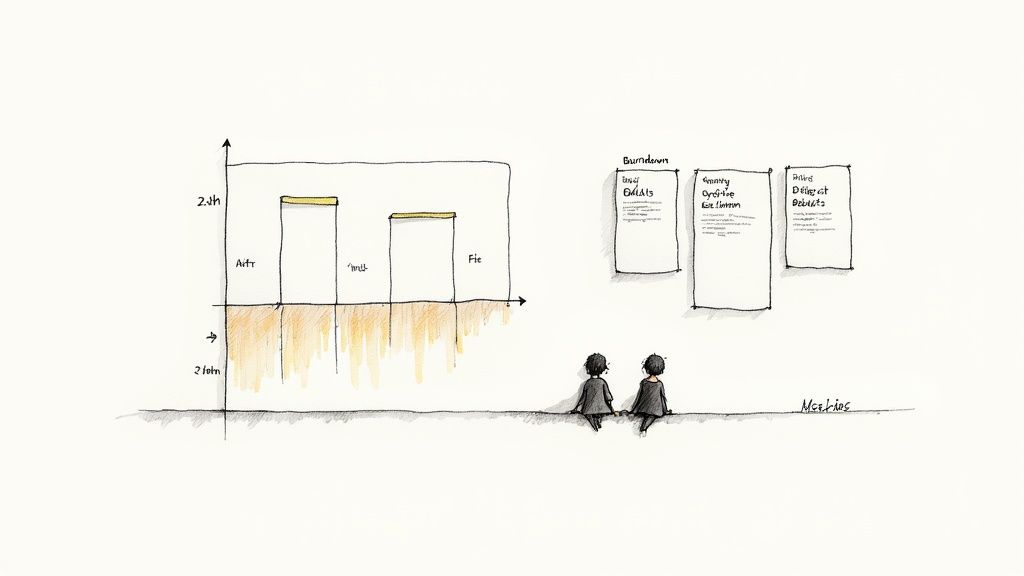
Information radiators can include anything from a physical Kanban board to a digital dashboard displaying burndown charts, CI/CD pipeline status, and key performance indicators (KPIs). The key is that the information is "pull" not "push"—anyone can look at it anytime without having to ask for a status report. This drastically reduces interruptions and lengthy status meetings.
How to Implement Transparent Communication
Effective transparency is about making data meaningful and accessible to drive action. The goal is to create a single source of truth that everyone can rely on.
- Make the Work Visible: The simplest information radiator is your task board (Jira, Trello). Ensure it's always up-to-date and accessible to everyone, including stakeholders outside the immediate team.
- Automate Your Radiators: Manually updated charts become outdated quickly. Actionable Insight: Use tools that integrate directly with your source code repository and project management software to automatically generate burndown charts, velocity trends, and build status dashboards.
- Focus on Actionable Metrics: Display metrics that help the team make decisions. Practical Example: A "Cycle Time" chart shows the average time it takes from starting a task to deploying it. If cycle time is increasing, it's an early warning that a bottleneck is forming in the process.
- Create a Dashboard Channel: For remote teams, create a dedicated Slack or Teams channel (e.g.,
#project-dashboard) where automated updates on deployments, build failures, and key metrics are posted. This makes vital information ambient and accessible.
10-Point Agile Best Practices Comparison
| Practice | Implementation complexity | Resource requirements | Expected outcomes | Ideal use cases | Key advantages |
|---|---|---|---|---|---|
| Daily Standup Meetings | Low | Minimal (15 min/day, facilitator) | Quick alignment and early blocker identification | Active development teams needing daily coordination | Low overhead; frequent synchronization |
| Sprint Planning | Moderate | Several hours per sprint; prepared backlog; PO & team participation | Clear sprint goals and committed backlog | Sprint-based development with prioritized work | Realistic commitments; reduced scope creep |
| User Stories & Acceptance Criteria | Low–Moderate | Product stakeholder time; writing discipline | Testable, user-focused requirements and less rework | Feature-driven work with stakeholder collaboration | Clarifies intent; improves testability |
| CI/CD | High | Tooling, infrastructure, automated tests, engineering effort | Faster, more reliable releases and early bug detection | Teams releasing frequently or at scale | Automation reduces deployment risk; faster feedback |
| Sprint Reviews & Retrospectives | Moderate | 1–2 hours per sprint; stakeholder and team time | Stakeholder feedback and continuous process improvement | Teams seeking iterative feedback and improvement | Validates work; drives actionable improvements |
| Iterative & Incremental Development | Moderate | Planning cadence; stakeholder engagement; short iterations | Early value delivery, risk reduction, evolving requirements | Projects with uncertainty or need for early feedback | Enables learning; faster ROI |
| Backlog Prioritization & Refinement | Moderate | Regular refinement sessions; PO involvement; metrics | Ready top backlog, faster planning, aligned priorities | Ongoing product development with changing priorities | Ensures highest-value work is prepared |
| Self-Organizing & Cross-Functional Teams | High | Skilled multi-discipline members; training; autonomy | Faster decision-making, ownership, reduced handoffs | End-to-end feature delivery and complex products | Increased accountability; improved quality |
| Test-Driven Development (TDD) | High | Developer time, testing frameworks, CI integration | Higher code quality, safer refactoring, fewer bugs | Core systems or codebases requiring long-term maintainability | Encourages better design; reliable tests as documentation |
| Transparent Communication & Information Radiators | Low–Moderate | Dashboards/tools and discipline to keep data current | Shared visibility, faster issue detection, aligned expectations | Distributed teams and stakeholder-heavy projects | Improves transparency; supports data-driven decisions |
From Theory to Impact: Implementing Your Agile Strategy
We've explored ten foundational agile development best practices, from the daily standup that synchronizes your team to the CI/CD pipeline that automates your path to production. Each practice, whether it’s crafting clear user stories, embracing test-driven development, or conducting insightful sprint retrospectives, serves a singular purpose: to deliver maximum value through an iterative, responsive, and human-centric process.
However, the true power of agile isn’t unlocked by simply adopting these practices as a checklist. It's about weaving them together into a cohesive strategy that fosters a culture of continuous improvement and deep collaboration. You don’t need to implement all ten at once. The agile way is to start small and iterate.
Your Actionable Path Forward
The journey to agile mastery begins with a single, deliberate step. Instead of attempting a massive organizational overhaul, identify the most significant bottleneck in your current workflow.
- Is communication a challenge? Focus on perfecting your daily standups and implementing transparent information radiators like Kanban boards. Make progress and blockers impossible to ignore.
- Are you struggling with product quality? Prioritize Test-Driven Development (TDD) and Continuous Integration. This builds a safety net that catches bugs early and ensures every code commit maintains a high standard of quality.
- Does your team feel disconnected from business goals? Double down on backlog refinement and sprint planning. Ensure every task is tied to a well-defined user story with clear acceptance criteria, connecting daily work directly to customer value.
Select one or two of these agile development best practices and commit to implementing them with discipline for the next few sprints. Use your sprint retrospectives not just to discuss what went wrong, but to quantitatively and qualitatively measure the impact of this new practice. Did it reduce bugs? Did it improve team morale? Did it shorten your feedback loop with stakeholders? Let the data guide your next move.
Beyond Practices: Cultivating an Agile Mindset
Ultimately, agile is more than a set of ceremonies and techniques; it's a fundamental shift in mindset. It’s about empowering cross-functional teams to self-organize and take ownership. It's about embracing transparency, celebrating learning from failures, and relentlessly seeking a better way to work.
By implementing these agile development best practices, you are not just optimizing a process; you are building a more resilient, adaptive, and innovative organization. You are creating an environment where your team can do its best work, respond to market changes with confidence, and consistently deliver products that truly matter to your users. This transformation is the ultimate goal, turning agile theory into tangible business impact.
Ready to see how these principles translate into real-world success? At Pixel One, we don't just talk about agile; we live it. Let us show you how our expert teams leverage these agile development best practices to build scalable, high-impact digital products for businesses like yours.