
What Is a Product Roadmap Your Ultimate Guide
Discover what is a product roadmap and how to build one. Learn proven strategies to align teams, prioritize work, and drive product success.So, what exactly is a product roadmap?
Let's cut through the jargon. At its core, a product roadmap is a high-level, visual plan that shows where your product is headed and, most importantly, why. It’s less about a rigid timeline of tasks and more about communicating the strategic vision behind what you're building. Think of it as the story of your product's future, shared with everyone who has a stake in its success.
Your Strategic GPS: What Is a Product Roadmap?

Imagine you're planning a cross-country road trip. Your final destination is the product vision. The major cities you plan to visit along the way are your big product initiatives. A GPS gives you the main route and estimated arrival times for those cities, but it doesn't map out every single turn or bathroom break.
A product roadmap works the same way. It's not a project plan packed with tiny tasks and fixed deadlines. Its real power lies in being a communication tool. It takes lofty company goals and turns them into a concrete, shared plan that keeps everyone—from engineers to marketers—on the same page and driving in the same direction.
A product roadmap is the manifestation of your strategy and the guide to its execution. It connects your big-picture vision to concrete steps over weeks, months, or years.
The Core Purpose of a Roadmap
At its heart, a roadmap exists to answer the big questions for everyone involved. It’s all about creating clarity, getting everyone aligned, and guiding smarter decisions. Without one, teams can easily lose focus, pouring time and money into features that don’t actually move the needle on key business goals.
Here’s a common scenario: the sales team gets a feature request from a big potential client and rushes it over to development. The devs, eager to help, might start building it right away. But a quick look at the roadmap could show that the company’s strategic focus for the quarter is improving user retention, not chasing new enterprise deals. This context empowers the product manager to prioritize work that supports the retention goal first, making sure every development hour is well spent.
This kind of strategic alignment is a crucial piece of the entire digital product development process, ensuring every action contributes to a unified objective. The roadmap acts as that single source of truth, preventing teams from drifting apart and working in silos.
Who Uses a Product Roadmap?
While the product manager is typically the one steering the ship, the roadmap is for everyone in the organization. Different teams look at it through different lenses, which is what makes it such a vital coordination document.
To help illustrate this, here’s a quick breakdown of how a roadmap serves various teams across a company.
Core Functions of a Product Roadmap at a Glance
This table summarizes the primary roles a product roadmap plays, helping you quickly grasp its multi-faceted purpose within an organization.
| Function | Description | Primary Audience |
|---|---|---|
| Strategic Alignment | Ensures product initiatives directly support larger business objectives and company goals. | Executives, Leadership |
| Communication | Provides a single source of truth for the product's direction, vision, and priorities. | All Stakeholders |
| Prioritization | Offers a framework for making tough trade-off decisions about what to build next. | Product, Engineering |
| Coordination | Helps interdependent teams (like marketing and engineering) plan their own activities around releases. | Sales, Marketing, Support |
| Motivation | Gives teams context and purpose by connecting their day-to-day work to the bigger picture. | Engineering, Design |
As you can see, the roadmap isn't just a document for product managers; it's a central hub that keeps the entire organization in sync.
Let's break down who looks for what:
- Executives and Leadership: They use it to see how the product strategy fits into the company's high-level goals and to make smart decisions about where to invest resources. For example, they might look at the roadmap to confirm that R&D spending for the next six months aligns with the company's objective to enter the European market.
- Engineering and Development Teams: It gives them the "why" behind their work. This context is gold, helping them make better technical decisions and plan their sprints effectively. Knowing that the upcoming "Performance Overhaul" theme is to reduce customer churn helps them prioritize architectural changes over small UI tweaks.
- Sales and Marketing Teams: They need the roadmap to get a jump on upcoming feature launches, align their campaigns, and set realistic expectations with new and existing customers. For example, seeing "AI-Powered Analytics Suite" in the "Next" column allows marketing to start planning a launch campaign and sales to begin teasing the new functionality to key prospects.
- Customer Support: They check it to get ahead of customer questions and prepare for any changes that might impact the user experience. If they see "New Navigation System" is coming soon, they can start drafting help articles and preparing training materials for the support team.
By giving everyone this shared view, the roadmap makes sure every person understands the product’s journey and how they play a part in its success.
Why a Roadmap Is Your Product's Secret Weapon
So, we know what a roadmap is. But let's get into what it actually does for you and your team. A product roadmap isn't just another document full of features; it’s the strategic glue that holds your entire organization together. It connects engineering, marketing, sales, and leadership, making sure everyone is rowing in the same direction.
Without that shared direction, chaos isn't far behind. Imagine marketing launching a huge campaign for a feature that engineering quietly pushed to the back burner. Or sales promising a major client a solution that completely veers from your product’s long-term strategy. Each team thinks they're doing the right thing, but they end up pulling the product apart at the seams.
A Single Source of Truth
A well-built roadmap stops that from happening by creating a single source of truth. It becomes the go-to reference for every stakeholder, clarifying not just what you are building, but also what you’ve decided not to build. That clarity is a lifesaver when you're navigating those tough, often heated, debates about what comes next.
When a shiny new idea pops up, the team can simply hold it up against the roadmap. Does it fit with our current theme of boosting user engagement? Does it support our goal of breaking into a new market? This simple framework turns subjective squabbles into objective, strategic conversations.
This focus is what keeps teams from sinking precious development cycles into work that won't make a real impact. Instead of just reacting to every incoming request, the roadmap gives product managers the power to guide development toward work that delivers the most value to both the customer and the business.
Improving Communication and Securing Buy In
One of the roadmap's greatest strengths is how it opens up communication. It takes that big, high-level vision and translates it into a plan everyone can actually grasp. For the C-suite, it connects the dots between product development and business results. For developers, it gives them the "why" behind their work, which leads to more motivation and smarter technical decisions.
A product roadmap simplifies complexity. It takes an abstract strategy and makes it concrete, providing a shared language for everyone from the CEO to the junior developer to discuss the future of the product.
Having that shared understanding is absolutely crucial for getting stakeholder buy-in. When people can see how their goals and needs are reflected in the plan, they're much more likely to get on board. The visual, easy-to-digest nature of a roadmap makes it perfect for presenting your direction, gathering feedback, and building a real consensus. All that alignment upfront saves you from a world of friction and last-minute surprises later on.
Driving Measurable Results
At the end of the day, a roadmap's true power is in its ability to drive results. And this isn't just a gut feeling—the data backs it up. One survey found that organizations with solid product roadmaps were 40% more likely to hit their annual product goals. The same study also revealed that 85% of high-performing product teams use roadmaps to prioritize what matters most: customer needs and business objectives. You can dig into more findings about roadmap effectiveness to see the full picture.
This data really drives home a key point: a roadmap isn't just for planning; it's for winning. It forces teams to think strategically, be ruthless about prioritization, and communicate with crystal clarity.
Here’s how that translates into real business wins:
- Faster Time-to-Market: When you focus only on what's truly important, you cut out the noise and get valuable features to customers sooner. A practical example: a team might decide to launch a simplified version of a feature now (an MVP) because the roadmap prioritizes speed-to-market over a full feature set.
- Increased ROI: Every hour of development is tied directly to a strategic goal, so you stop wasting resources on projects that don't move the needle. A company with a roadmap focused on "increasing customer lifetime value" will prioritize features like loyalty programs over one-off tools for new users, ensuring a better return.
- Enhanced Team Morale: People who understand the purpose behind their work and see its impact are simply more engaged and motivated. It’s a game-changer for team culture.
Think of the product roadmap as a strategic filter. It ensures that only the most critical, high-impact initiatives make it through. It’s the secret weapon that turns a group of talented individuals into a focused, aligned, and unstoppable product organization.
The Building Blocks of an Effective Roadmap
Think of a great product roadmap like a house. You can't just start throwing up walls; you need a solid foundation and a clear blueprint. The same goes for your product. A powerful roadmap is built from a few essential components that work together, connecting your big-picture vision to the day-to-day work your team is doing.
A truly effective roadmap isn’t some endless feature list. It's a story about where you're headed and why. This story is told through four key elements: the vision, strategic themes, major initiatives, and flexible timeframes. When you get these right, you create a clear, compelling plan that everyone can rally behind.
The Foundation Your Product Vision
Everything—and I mean everything—starts with the product vision. This is your North Star. It's a short, inspiring statement that answers the fundamental question, "Why do we exist?" It’s not about features or deadlines; it's about the ultimate impact you want to have on your users and the market.
A strong vision acts as a filter. When a new idea pops up, you can ask a simple question: "Does this get us closer to our vision?" If the answer is no, it becomes much easier to pass on it and stay focused on what really matters.
Organizing the Strategy with Themes
Next up are strategic themes, or goals. These are the high-level focus areas that break down your grand vision into more digestible chunks, usually for a specific period like a quarter or a semester. Themes should always describe the outcome you want for your customers or business, not the output you plan to build.
For example, instead of a dry theme like "Build a new dashboard," a much better one would be "Improve User Onboarding and Activation." See the difference? The second one focuses the team on solving a real user problem, which gives them the creative space to find the best possible solution.
This infographic shows how these pieces stack on top of one another to create clarity and value.
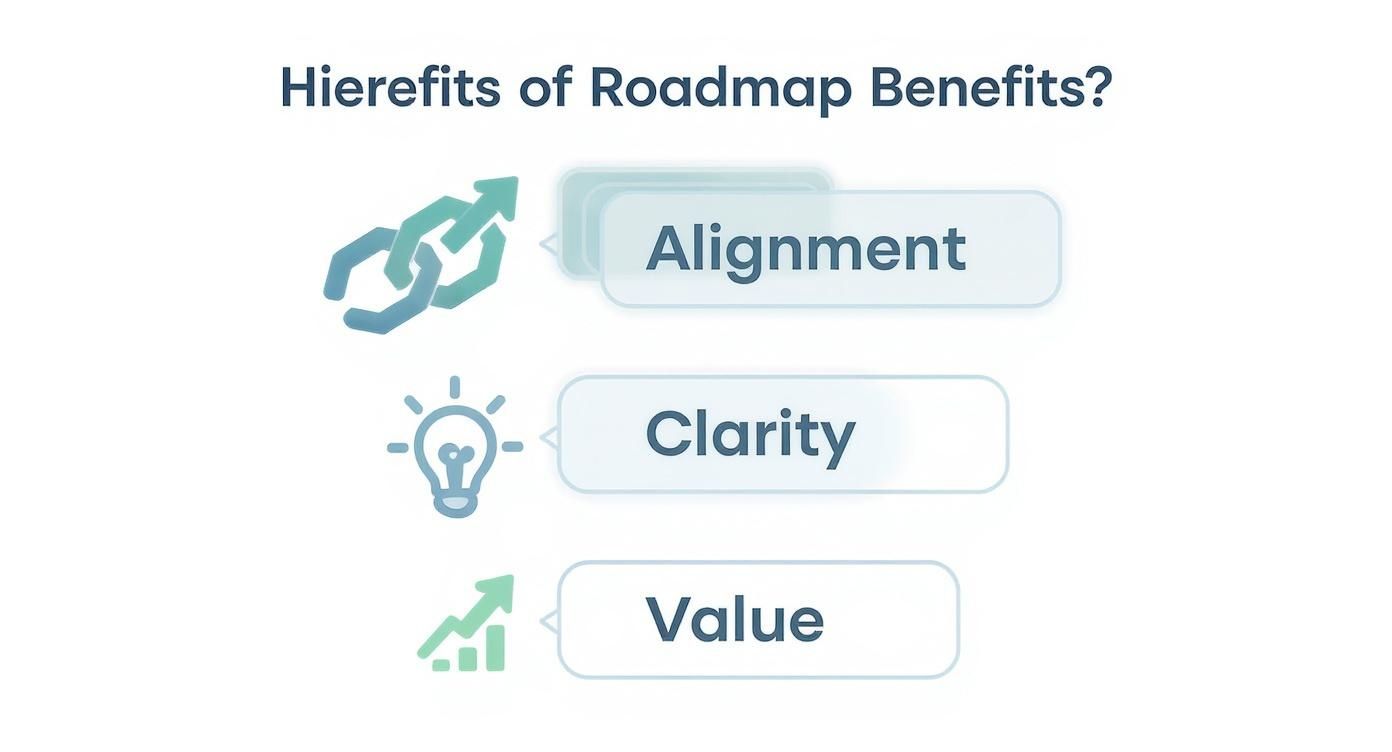
As you can see, a clear vision supports your themes, which then guide the specific initiatives that ultimately deliver real business value.
Turning Strategy into Action with Initiatives
Beneath each theme, you'll find your initiatives. These are the large-scale projects or efforts your team will tackle to achieve the theme's goal. Think of initiatives as the big rocks you need to move, not the tiny pebbles. They represent the specific problems you’ve decided to solve.
Let’s stick with our example. Under the theme "Improve User Onboarding and Activation," an initiative might be "Launch an Interactive Welcome Tour." This is a concrete project that directly contributes to the strategic goal. It gives the development team clear direction without getting lost in the weeds. Pinpointing the right initiatives often comes from deeply understanding your users, which is why it’s so important to learn how to conduct user interviews and gather that direct feedback.
To help you see how these elements fit together, here’s a quick breakdown of the core components.
Key Product Roadmap Components Explained
| Component | Purpose | Example |
|---|---|---|
| Product Vision | Your ultimate "why." The long-term, aspirational goal for the product. | "To make financial planning accessible to everyone, regardless of income." |
| Strategic Themes | High-level focus areas that break the vision into measurable outcomes. | "Increase user confidence in their first 30 days." |
| Initiatives | Large-scale projects or problems to solve that support a theme. | "Develop a personalized goal-setting wizard." |
| Timeframes | Broad horizons (Now, Next, Later) that communicate priority without rigid deadlines. | "Now: Launch wizard. Next: Integrate educational content." |
This table shows how each layer builds on the last, connecting your highest aspirations to tangible efforts.
Providing Context with Flexible Timeframes
Last but not least, you need timeframes. But on a modern roadmap, we're not talking about rigid, specific dates. Hard deadlines belong in project plans, not strategic roadmaps. Here, you should use broader, more flexible time horizons that communicate priority without making false promises.
A common and highly effective approach is the Now, Next, Later framework. It clearly communicates priority and urgency while maintaining the flexibility to adapt to new information.
This framework is brilliantly simple:
- Now: What the team is actively working on. These items are well-defined, scoped, and committed to for the short term. For example, "Finalize user profile redesign."
- Next: What’s coming up soon. These initiatives are being designed and scoped but aren't in active development yet. For example, "Explore third-party API integrations."
- Later: Big ideas and potential opportunities for the future. These are less defined and represent possible directions that could change based on what you learn. For example, "International expansion" or "AI-powered recommendations engine."
By using these building blocks, you elevate your roadmap from a simple to-do list to a dynamic, strategic guide. It tells a clear story, aligns the entire company, and ensures every bit of effort pushes your product in the right direction.
Choosing the Right Type of Product Roadmap
Think of a product roadmap like a map for a road trip. A detailed, turn-by-turn printout is perfect for the driver, but for someone just asking where you're headed, a simple "we're driving up the coast to see the redwoods" is a much better answer. The same idea applies here—there’s no one-size-fits-all roadmap.
The format you choose is a strategic decision. It hinges on who you're talking to, how mature your company is, and what you’re trying to achieve. Picking the right one transforms a simple document into a powerful tool for getting everyone on the same page.
Start With Your Audience
The most important question to ask is: "Who is this for?" A roadmap that gets the executive board excited about the company's direction will feel frustratingly vague to an engineer trying to plan their next sprint. You have to serve up the right level of detail to the right people.
Let's break it down:
- For Executives and Investors: They need the 30,000-foot view. A high-level, theme-based roadmap is your best bet. It connects product initiatives to business outcomes, like "Capture a new user segment in Q3." It's all about the "why," not the nitty-gritty details.
- For the Development Team: This is where the rubber meets the road. Devs need more substance. An outcome-focused or Now-Next-Later roadmap gives them a clear picture of what they’re building today ("Now"), what's in the queue ("Next"), and what’s on the horizon ("Later"). This context is crucial for making smart technical decisions.
- For Sales and Marketing Teams: These folks live and breathe by deadlines and customer impact. A timeline-based roadmap showing major feature releases helps them plan campaigns, set customer expectations, and hit their own goals.
It's common practice to create different views of the same roadmap. This way, every stakeholder gets the information they need without getting lost in details that aren't relevant to them.
Startup Agility vs. Enterprise Coordination
Your company’s size and stage also play a huge role. A scrappy startup trying to find its footing has entirely different needs than a massive enterprise coordinating a global launch.
For an early-stage startup, flexibility is everything. A rigid, date-driven roadmap is a trap, promising things that could change a month from now. A theme-based roadmap works much better here. It focuses on big-picture goals like "Validate Core Value Proposition" or "Achieve First 1,000 Active Users," giving the team room to experiment, learn, and pivot. This approach is essential for successful MVP development for startups, where the main objective is learning, not just shipping features.
A roadmap for a startup is a compass, not a map. It sets a clear direction (the vision) but allows the team to navigate the terrain as they discover it.
Now, flip that script for a large enterprise. Imagine a company planning its massive annual software release. They need precision. Partners, marketing teams, and support staff all depend on knowing when things are happening. A more detailed, timeline-based roadmap is essential for keeping dozens of moving parts in sync for a smooth launch.
The Modern Roadmapping Landscape
Product management has moved away from rigid, unchangeable plans. Today, everyone understands that a roadmap is a living document that has to adapt to reality.
A Netguru analysis shows this shift clearly. The average roadmap now looks ahead 12 to 18 months, and 60% of companies update theirs at least quarterly. This rhythm allows teams to react to new customer feedback or shifts in the market. The study also found that 72% of product teams use visual formats like timelines or Gantt charts to make their plans easy to understand. You can discover more insights about modern roadmap practices on Netguru.com to see how top teams are working.
Ultimately, choosing the right roadmap comes down to understanding your own environment. By thinking about your audience, company stage, and strategic goals first, you can pick a format that provides clarity, drives alignment, and turns your product vision into a reality.
Best Practices for a Living Product Roadmap
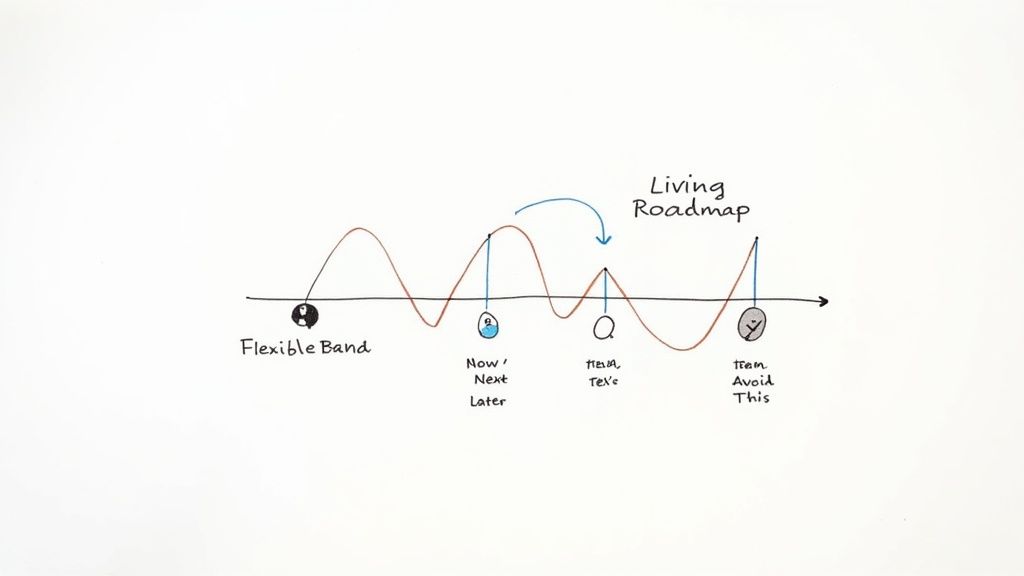
Putting together a product roadmap is a huge step, but the real magic happens in how you use it day-to-day. A roadmap isn't a static document you create, print, and forget. Think of it as a living guide that needs to breathe and evolve right alongside your product, your market, and your customers.
The biggest mistake I see teams make is treating their roadmap like a rigid project plan, crammed with hard deadlines and a laundry list of features. That kind of thinking kills agility and turns what should be a strategic guide into a source of constant friction and frustration. A great roadmap, on the other hand, is flexible, adaptive, and keeps everyone pointed toward the same north star.
Focus on Outcomes Over Outputs
This is probably the single most important shift you can make: focus on outcomes, not outputs. An output is the thing you build, like a new password reset button. An outcome is the value you create, like "Reduce password-related support tickets by 20%." See the difference?
When you focus on outcomes, you empower your team. You give them a clear problem to solve and the creative freedom to find the best solution. Suddenly, your roadmap isn't just a checklist of features; it's a powerful tool that connects every single task to real, measurable business impact.
- Actionable Insight: Frame your next roadmap initiative as a problem statement. Instead of "Build in-app chat," try "Reduce the time it takes for users to get help from 24 hours to 5 minutes." This sparks more creative solutions, like an improved FAQ or a chatbot, rather than locking you into one specific feature.
- Do This: Frame your roadmap items around goals or problems. Think in themes like "Improve new user activation rates" instead of just listing features.
- Avoid This: Clogging up your roadmap with granular feature names and technical specs. That stuff belongs in the backlog, not here.
Keep It High-Level and Strategic
Your roadmap is your strategic compass, not a turn-by-turn GPS. It’s there to communicate the "why" and the "what," while leaving the "how" to your brilliant development team. If you find your roadmap is drowning in user stories, bug fixes, and specific release dates, you’ve accidentally created another project plan.
Keeping it high-level is what gives you the flexibility to adapt. When you learn something new from a customer or the market shifts, a strategic roadmap lets you pivot without having to tear down and rebuild a complicated document. It keeps the conversation where it should be: on the big picture.
A roadmap that is too detailed becomes brittle. It breaks the moment you learn something new from your customers, forcing you to choose between sticking to an outdated plan or enduring a painful replanning process.
Involve Stakeholders to Build Consensus
At its core, a product roadmap is a communication tool. For it to work, you need buy-in from everyone. You simply can't build it in a silo. Make it a habit to connect with leaders from engineering, marketing, sales, and customer support to get their perspective and ensure the plan reflects a shared vision.
This isn’t about building a product by committee. The product manager still owns the roadmap. But the process of gathering input builds trust, uncovers potential roadblocks early on, and creates a powerful sense of shared ownership. When your stakeholders feel heard, they become your biggest champions.
Data backs this up. A recent report from Airtable found that companies with clear, transparent roadmaps saw a 35% jump in cross-functional collaboration. That's the power of alignment in action.
Treat It as a Living Document
Finally, and most importantly, your roadmap has to be a living document. Markets change, competitors make moves, and customer feedback rolls in constantly. A roadmap that isn't regularly updated becomes irrelevant—fast.
Schedule regular roadmap reviews with your key stakeholders, probably once a quarter. These meetings are your chance to:
- Check in on progress toward your current goals.
- Bring in new data and learnings.
- Re-evaluate and re-prioritize what’s in your "Next" and "Later" columns.
- Communicate any and all changes to the rest of the company.
This rhythm keeps your roadmap a reliable source of truth and reinforces the idea that your plan is meant to be responsive. A well-tended roadmap is also essential for creating a smooth product-led onboarding experience, ensuring the entire customer journey is perfectly aligned with your strategic goals.
Putting Your Product Roadmap Into Action
You’ve got the theory down, and now it’s time to turn that knowledge into a real, working roadmap. This is where the rubber meets the road.
Remember, a product roadmap isn't a delivery schedule set in stone. It’s a strategic communication tool designed to get everyone on the same page. Its real job is to create alignment, make those tough prioritization calls easier, and show how the team’s day-to-day work connects to the bigger company vision. A great roadmap ensures every feature and every sprint is a deliberate step toward your most important goals.
Your Next Steps
Whether you're a product veteran or just getting started, here are a few practical steps you can take right now to make your roadmap the core of your product strategy.
- Create Your First Roadmap: Starting from zero? Keep it simple. Define your product vision, pick a few key strategic themes for the next quarter, and lay out your initiatives using a basic Now, Next, Later format. For example: Vision: "The easiest way for small businesses to manage their finances." Q3 Theme: "Streamline invoice creation." Now Initiative: "Launch one-click invoice templates."
- Audit Your Existing Roadmap: If you already have one, give it an honest review. Is it focused on the why (outcomes) or just the what (outputs)? Has it turned into a cluttered project plan instead of a high-level strategic guide? Use the principles we've discussed as a checklist to find quick wins.
- Start the Conversation: A roadmap is only useful if people buy into it. Book some time with your key stakeholders. Walk them through the plan, ask for feedback, and make sure everyone feels aligned on where you're headed. An actionable tip: instead of just presenting the roadmap, present the problems you're trying to solve and ask for their input on the priorities.
Think of your roadmap as an instrument for driving clarity. Use it to turn a complex strategy into a simple, shared story that empowers your entire team to build with purpose and confidence.
Ultimately, your roadmap is the bridge between your grand vision and the daily grind of execution. Building one is a critical piece of the larger process to develop an app that actually succeeds. By putting these ideas into practice, you’ll be able to lead your product with the focus it deserves.
Got Questions About Product Roadmaps? We’ve Got Answers.
Even after you get the hang of roadmapping, some questions always seem to pop up. Let's tackle a few of the most common ones to help you nail down the finer points of creating and managing a roadmap that actually works.
How Is a Product Roadmap Different from a Product Backlog?
This is a classic, and for good reason! A product roadmap and a product backlog are two sides of the same coin, but they serve very different purposes.
Think of it this way: the roadmap is your high-level travel itinerary. It shows the major destinations you're hitting—say, launching a new mobile app, then expanding into a new market. It’s all about the big picture and, most importantly, why you're going to those places.
The product backlog, on the other hand, is your detailed packing list for each leg of the journey. It's a tactical, granular list of everything the development team needs to build: user stories, bug fixes, and specific features. The roadmap sets the strategic direction; the backlog is where the day-to-day work gets organized.
Here's a simple way to remember it: The roadmap communicates the why (the strategic vision), while the backlog details the what (the specific tasks to get it done).
How Often Should I Update My Product Roadmap?
Your roadmap should be a living document, not a "set it and forget it" plan carved in stone. While there isn't a single right answer for every company, a solid rule of thumb is to formally review and adjust your roadmap at least once per quarter.
This rhythm is a sweet spot. It's frequent enough to stay agile but not so often that you're constantly changing direction and giving your team whiplash.
A quarterly check-in gives you a dedicated moment to absorb new customer feedback, react to what competitors are doing, and make sure you're still aligned with the company's bigger goals. The "Now" part of your roadmap might get small tweaks more often, but your big-picture "Next" and "Later" items will likely shift during these quarterly reviews.
Who Is Responsible for the Product Roadmap?
Ultimately, the product manager (or Head of Product) owns the roadmap. They are the ones driving the bus—responsible for creating it, keeping it current, and making sure everyone knows where you're headed. They have the final call on what makes it onto the roadmap and what doesn't.
But—and this is a big but—roadmapping is a team sport, not a solo mission. The product manager's real job is to be a facilitator. They need to pull in insights from every corner of the business to build a plan that everyone can get behind. This means constant collaboration with:
- Executive Leadership: To make sure the product strategy lines up with business goals.
- Engineering and Design: To gut-check what's possible and how long it might take.
- Marketing and Sales: To get a pulse on what customers are asking for and plan go-to-market strategies.
- Customer Support: To bring real user feedback and pain points directly into the planning process.
So while one person is officially in charge, a truly great roadmap is built on a bedrock of cross-functional buy-in and a shared understanding of the vision.
Ready to turn your product vision into a reality? The team at Pixel One specializes in product strategy and development, helping startups and enterprises build digital products that make an impact. Let's build something great together. Learn more about how we can help.