
How to define target audience: A quick, results-driven guide
Discover how to define target audience with practical steps: research, segmentation, and personas that drive real business growth.So, what does "defining your target audience" really mean? In simple terms, it's about pinpointing the exact group of people who are most likely to want—and buy—your product. This isn't just about demographics; it's about digging into their interests, their habits, and what makes them tick.
Think of it this way: you have to know precisely who you're talking to before you can say anything meaningful. A generic message aimed at "everyone" will resonate with no one. An actionable insight is knowing that your ideal customer for a new project management tool isn't just "small businesses," but "project managers at creative agencies with 10-50 employees who are frustrated with clunky, overpriced software." That level of specificity is the goal.
Why Defining Your Audience Matters
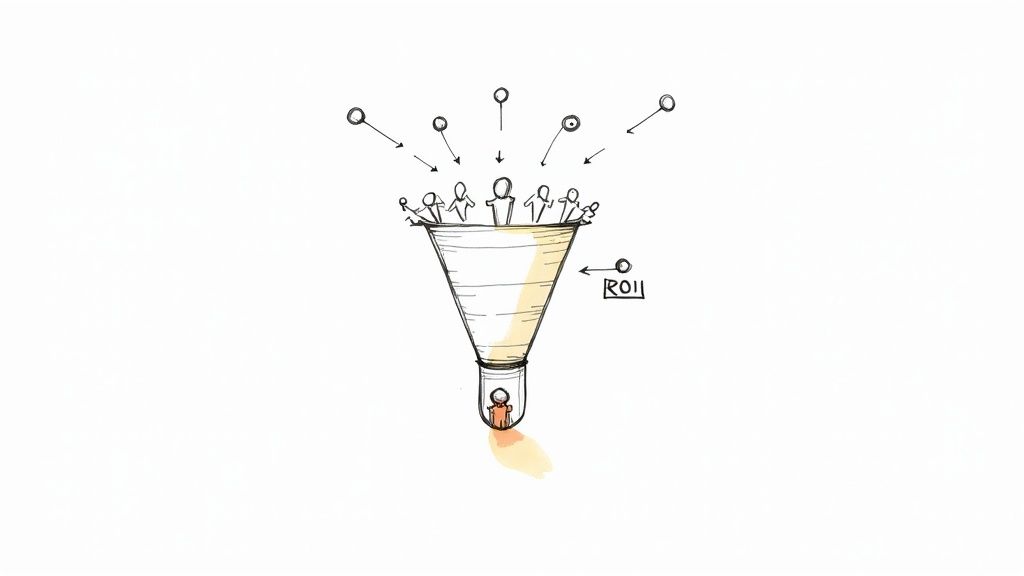
Let's be blunt: trying to market to everyone is the fastest way to burn through your budget and see zero results. It's like trying to be everything to everyone—you end up being nothing to anyone. When you get crystal clear on your target audience, your marketing stops being a guessing game and becomes a focused, efficient machine.
This clarity is the bedrock of a solid strategy. It means every blog post, every ad campaign, and every new feature you build is crafted for a real person with real needs. This focus is what drives real growth. For example, instead of a generic blog post titled "5 Productivity Tips," you can write "5 Ways Creative Agencies Can Streamline Client Revisions"—a title that speaks directly to your defined audience.
The Impact of a Clear Audience
Having a well-defined audience gives you a serious edge that goes far beyond just your ad campaigns. When you understand your customers deeply, you can personalize their experience, which has a massive impact on everything from sales to loyalty.
I've seen it time and again: a clear audience definition directly translates into tangible business benefits. Let's break down exactly what that looks like with some practical examples.
Key Benefits of Defining Your Target Audience
| Benefit | Impact on Your Business |
|---|---|
| Improved ROI | You stop wasting money on channels and messages that don't work. Actionable Example: A B2B software company discovers its audience lives on LinkedIn, not Facebook, and reallocates its ad budget accordingly, doubling its lead quality. |
| Stronger Product Development | You can build features that solve genuine problems because you understand your customers' biggest pain points. Actionable Example: A fitness app adds a "low-impact workout" filter after learning many users are recovering from injuries. |
| Content That Connects | Your content resonates on a deeper level, building trust and turning casual followers into loyal advocates. Actionable Example: A financial planning service creates a YouTube series on "first-time home buying," addressing the top concern of their millennial audience. |
| Higher Conversion Rates | When your messaging speaks directly to a prospect's needs, they're far more likely to take the action you want them to. Actionable Example: An e-commerce site changes its product descriptions to highlight "sustainability," a key value for their target shoppers, and sees a 15% lift in sales. |
Ultimately, a deep understanding of your audience lets you build something people genuinely want. This is a critical piece of the puzzle for getting your product to a place where it truly clicks with the market. For a deeper dive into this, our guide on the product-market fit framework shows how these concepts are linked.
Knowing your audience is the difference between shouting into the void and having a meaningful conversation with someone who wants to listen. It’s the first step to making every dollar count.
How to Gather Actionable Audience Data
Forget the guesswork. To truly understand your audience, you need to roll up your sleeves and dig into the data. The best part? You're probably already sitting on a goldmine of information. The real trick is knowing where to look and how to translate those raw numbers into insights you can actually use.
Let's start with what you already have. Your existing customer base is the most honest source of truth about who loves what you do. This is your ground zero.
Mine Your Current Data Sources
Your CRM and Google Analytics are treasure troves just waiting to be explored. Start looking for the common threads that tie your best customers together. Do they work in a particular industry? Share the same job title? What content did they look at right before they decided to buy?
Actionable Insight: Go into your CRM and filter for your top 10% of customers by lifetime value. Look for commonalities in their job titles, industry, or company size. This isn't just data; it's a blueprint of your ideal customer profile.
For instance, a local coffee shop might dig into their Instagram Insights and discover their most loyal fans are remote workers between 25 and 35. Boom. That one piece of information is enough to build a whole marketing campaign around, like a new midday "focus fuel" promotion aimed directly at that group.
This kind of data paints a clear picture of your current website visitors, giving you a solid foundation to build upon.
Analyze Your Competitors' Audience
Once you’ve got a handle on your own data, it's time to look next door. Your competitors are already engaging a slice of the market you want to reach. Watching them can reveal opportunities, expose gaps, and give you a shortcut to understanding the broader market.
Do some ethical snooping on their social media and customer reviews.
- Who are their biggest fans? Check out the profiles of people who comment and share their posts constantly. What are their job titles? What else do they seem to care about? Actionable Example: If you sell camping gear, look at the Instagram followers of a major competitor like REI. You'll likely find profiles of hikers, climbers, and van-lifers—giving you a visual mood board of your target lifestyle.
- What words do they use in reviews? Hop on sites like G2 or Capterra and read through their reviews. You'll find the exact language people use to describe their problems and what they value most.
- Where are they dropping the ball? Negative feedback is pure gold. Actionable Example: A competitor's review might say, "The software is powerful, but the user interface is a nightmare." This insight tells you to emphasize your product's intuitive design in your marketing.
Understanding your audience is no longer just about demographics; it involves piecing together complex digital behaviors. With over 5.24 billion social media users worldwide, the ability to analyze and segment this vast audience is critical. Our guide on how to conduct user interviews can provide qualitative depth to complement this quantitative data.
Using Segmentation to Find Your Ideal Customer
Piles of audience data are just noise until you give them structure. The real magic happens when you slice that data into meaningful groups, a process we call audience segmentation. It’s how you turn a blurry, faceless crowd into distinct groups of people you can actually connect with.
Think of it as the difference between shouting into a stadium and having a focused, one-on-one conversation. Segmentation lets you move past broad assumptions and speak directly to people based on who they are, where they live, what they believe, and how they act.
This simple flow shows how to turn that raw data into organized, usable insights.
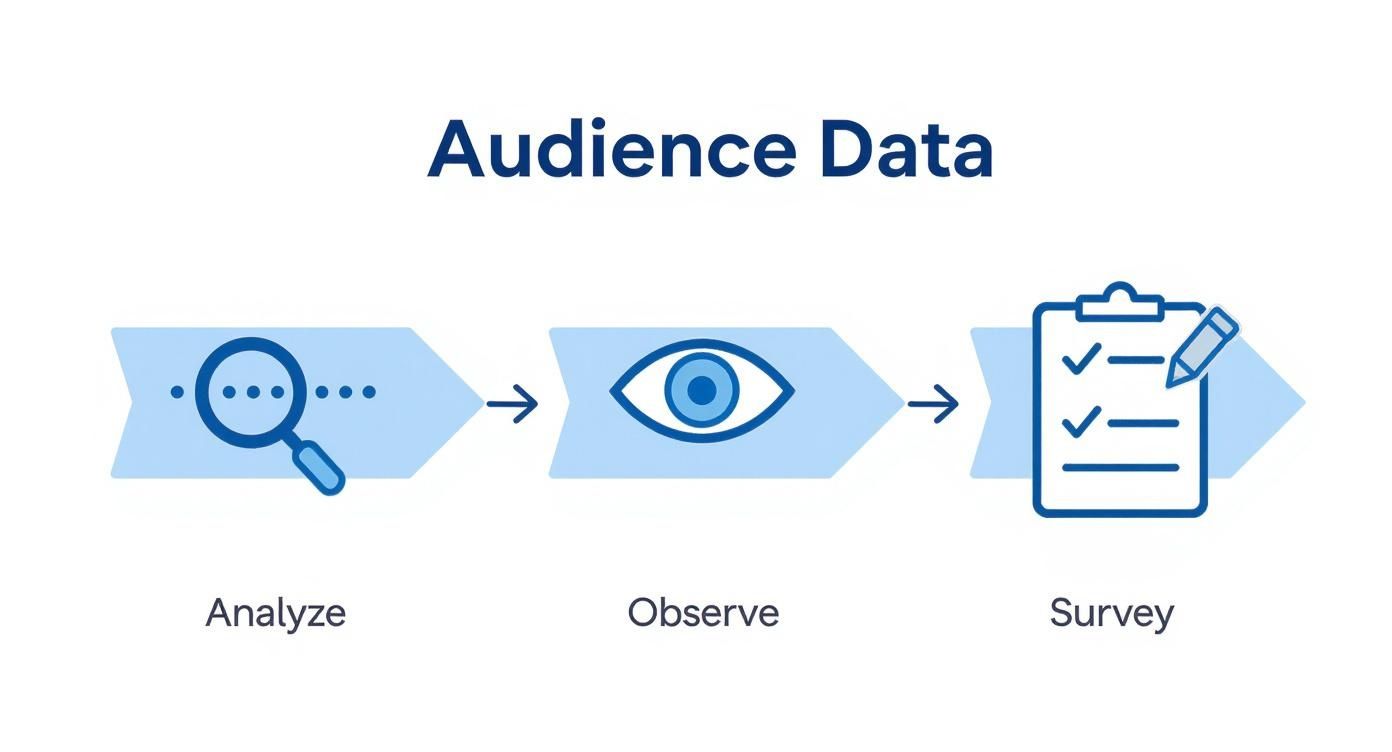
As you can see, defining your audience isn't a one-and-done task. It's a continuous loop of analyzing, observing, and refining your understanding.
The Four Key Ways to Segment Your Audience
The best way to start is by looking at your audience through four different lenses. Each one adds another layer of detail, sharpening your focus until a crystal-clear picture of your ideal customer emerges.
To make this tangible, let's imagine we're building a target audience for a fictional eco-friendly activewear brand. Their initial thought might be "women aged 25-40." That's a start, but it's way too broad. Let's see how segmentation brings it to life.
Here's a quick breakdown of the four main segmentation types.
| Audience Segmentation Types Explained |
| :--- | :--- | :--- |
| Segmentation Type | What It Tells You | Actionable Example for the Activewear Brand |
| Demographic | The "who" — objective, factual data about a person. | We're targeting women aged 28-35 with an annual income over $70,000. |
| Geographic | The "where" — their physical location and its characteristics. | They live in urban areas with a strong "green" culture, like Portland, OR or Boulder, CO. |
| Psychographic | The "why" — their values, interests, lifestyle, and beliefs. | They value sustainability, shop at Whole Foods, and follow yoga instructors on Instagram. |
| Behavioral | The "how" — their actions, purchasing habits, and brand interactions. | They have previously purchased from ethical brands like Patagonia or Allbirds. |
By asking these questions, you start to build a much more nuanced and actionable profile than just a simple age bracket.
Putting It All Together: From Broad to Specific
First, we'll start with the basics to get a foundational view.
Demographic (Who they are): Let's get more specific than "women 25-40." We'll narrow this to women aged 28-35 with a disposable income that allows them to invest in premium, sustainable products.
Geographic (Where they are): Location matters. Our brand will focus on urban-dwelling women in major cities like Austin, Denver, or San Diego—places with a strong health-conscious culture and access to boutique fitness studios.
Don't just take my word for it; the numbers prove this works. Research shows 81% of consumers are more likely to buy from brands that offer personalized experiences. Even more compelling, companies that use audience segmentation see an average 760% increase in revenue from email marketing. Segmentation directly impacts your bottom line.
Now, let's go deeper to understand their motivations and actions.
Psychographic (What they believe): This is where you uncover their why. Our activewear brand is for women who see wellness as a core part of their lifestyle. They value sustainability and believe their purchasing decisions reflect their personal identity. They aren't just buying leggings; they're buying into a belief system.
Behavioral (What they do): This is all about their actions. We're looking for women who already buy from other sustainable brands, follow specific fitness influencers on Instagram, and have a history of purchasing high-performance athletic wear.
Just like that, "women 25-40" has transformed into a hyper-specific, reachable audience. This level of detail is a non-negotiable part of any effective startup marketing strategies that actually drive growth.
How to Build a Powerful Customer Persona
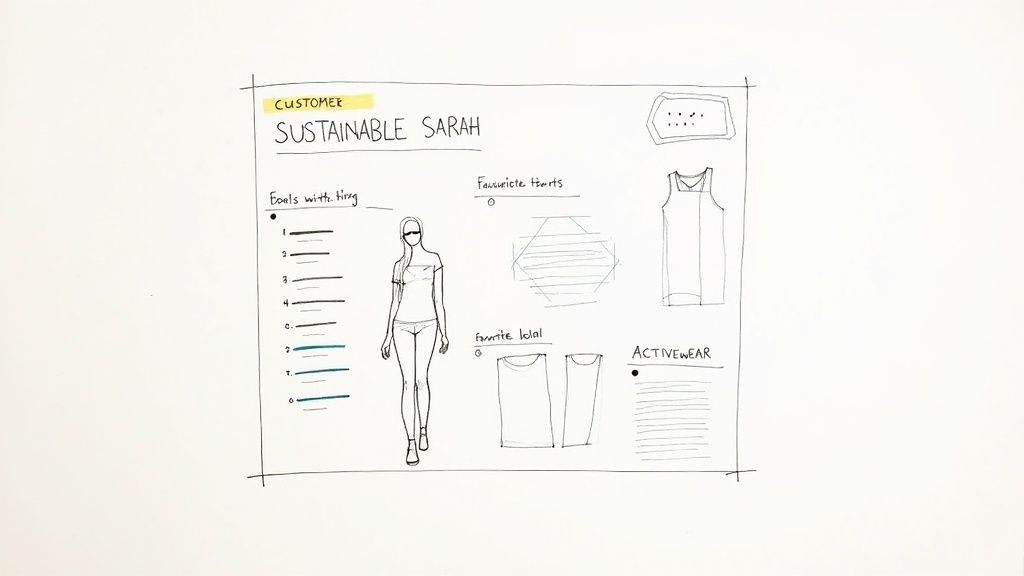
Alright, now it’s time to take all that abstract data and give it a human face. This is where we build a customer persona—a semi-fictional character who represents your ideal customer. Don’t just fill out a generic template; the real goal is to create a relatable guide that your entire team can get behind.
Think of it as turning numbers into a story. Instead of trying to connect with a vague segment like "urban-dwelling women," you're now designing for a specific person with real goals, frustrations, and motivations. This human-centered approach is a cornerstone of the design thinking process because it keeps you focused on solving actual problems for actual people.
Meet Sustainable Sarah: A Persona Example
Let's imagine we're that eco-friendly activewear brand again. Here's who we're building for. Meet Sustainable Sarah.
- Who She Is: A 32-year-old graphic designer living in Austin, Texas. She's passionate about wellness, her local community, and making a positive environmental impact.
- Her Goals: She's working toward a senior designer role, training for a half-marathon, and trying to reduce her carbon footprint by supporting ethical brands.
- Her Frustrations: It's a constant struggle to find high-performance activewear that truly aligns with her sustainable values. She's fed up with brands that just "greenwash" their products without any real commitment.
- Her Digital Life: Sarah is a visual person. You can find her scrolling through Pinterest for home decor inspiration and following her favorite fitness influencers on Instagram for workout ideas. She listens to podcasts like "How I Built This" on her commute.
- Actionable Insight: Based on this persona, the brand should create Instagram content featuring real athletes (not just models), partner with eco-conscious influencers, and run Pinterest ads showcasing the product's design and sustainable materials.
To get inside her head, an interview quote might sound something like this: "I want to feel good about the brands I support. It’s not just about the quality of the product, but the integrity of the company behind it."
With a detailed profile like this, it becomes incredibly clear how to define your target audience in a way that informs every single decision—from the visuals in your next ad campaign to the features you build into your product.
It’s also smart to keep an eye on generational trends, as younger consumers often lead the way. Gen Z's spending, for instance, is growing at twice the rate of previous generations and is on track to surpass baby boomer spending by 2029. Brands that genuinely connect with their values of authenticity and digital fluency are the ones that will win over this critical market.
Testing and Refining Your Audience Definition
Your work isn't done just because you’ve defined your audience. Far from it. Think of your initial audience definition and personas as a really solid hypothesis—an educated guess about who will love your product. Now it’s time to put that hypothesis to the test in the real world.
Markets change, people’s needs evolve, and new trends pop up constantly. Your understanding of your audience has to adapt right along with them. This is where you shift from theory to practice, using hard data to sharpen your focus.
Validate Assumptions with Live Data
So, how do you know if you got it right? You run experiments. Small, targeted tests are your best friend here, and you don’t need a massive budget. Social media ad platforms are perfect for this.
Let's say you're launching an eco-friendly activewear line. You can create a couple of nearly identical ads but aim them at slightly different groups to see who bites.
- Ad A: Target your main persona, "Sustainable Sarah." You'd focus on interests like yoga, ethical fashion, and organic food. The ad copy might be: "Performance gear that's kind to the planet."
- Ad B: Target a different hunch—maybe women who are into high-intensity interval training (HIIT) and meal prep. They're health-conscious, but is sustainability their top priority? The ad copy here could be: "Dominate your workout with gear built to last."
Keep a close eye on the metrics: engagement, click-through rates (CTR), and cost per lead. The numbers will tell a clear story about which group connects more with your brand. This kind of lean, experimental approach is crucial, and it’s a great way to validate a business idea before you go all-in.
Your audience definition is only as good as the data that backs it up. Continuously testing your assumptions with live campaigns is the only way to ensure you’re not marketing in an echo chamber.
Another fantastic way to get answers is to just ask. Go straight to the source! Use tools like Instagram polls, Typeform surveys, or even just direct conversations with potential customers. Actionable Insight: Create a simple 3-question survey and offer a 10% discount for completing it. Ask: 1) What's the biggest challenge you face when shopping for [your product category]? 2) What other brands do you love? 3) What's most important to you: Price, Quality, or Sustainability? This direct feedback is pure gold.
Lingering Questions & Common Pitfalls
Even with a solid plan, a few tricky questions always pop up when you're trying to nail down your target audience. Let's walk through some of the most common hurdles I've seen teams face and how to clear them.
What if I Have More Than One Audience?
This one comes up all the time. Your product might genuinely serve a few different groups, so what do you do? Resist the urge to mash them all together. That just waters down your message for everyone.
The best move is to pinpoint your primary target audience. This is your core group—the most profitable, most engaged, and the people who get the most value from what you offer. Once you’ve defined them, you can identify one or two secondary audiences.
Actionable Example: A project management tool's primary audience could be fast-moving tech startups. A secondary audience? Marketing agencies. This focus allows the company to pour 80% of its marketing budget into speaking directly to startups (e.g., sponsoring tech podcasts) while using the remaining 20% for tailored content for agencies (e.g., a blog post on "How to Manage 10 Clients Without Losing Your Mind").
How Often Should I Revisit My Audience Profiles?
Defining your audience isn't a "set it and forget it" task. Markets shift, and people change. I always recommend a formal review of your audience profiles at least once a year.
You should also plan a review anytime you see a major change in your market or your customer data. Actionable Trigger: Did a new competitor just launch? Did your analytics show a surprising new demographic engaging with your content? These are clear signals that it's time for a refresh.
Don't let your audience personas become dusty relics. Treat them as living documents that evolve with your customers. If your analytics show a new demographic engaging with your content, it’s time for a refresh.
What Are the Biggest Mistakes to Avoid?
I’ve seen a few common mistakes trip people up. Watch out for these:
- Being too generic: "Men and women aged 20-50" is not a target audience. It's just a crowd. You have to dig into the psychographics and behaviors to find what really connects them.
- Relying on assumptions: Gut feelings can be a starting point, but every truly great persona is built on a foundation of real data, not just what you think you know. Actionable Tip: For every assumption you make about your audience, write down how you can validate it (e.g., "I think they value customer service." Validation: Check online reviews for mentions of service).
- Ignoring negative personas: Sometimes, knowing who you don't want to attract is just as valuable as knowing who you do. Actionable Example: A premium B2B software company might create a negative persona for "Freelance Frank," who is always looking for free plans and has a high churn rate. This helps them filter out low-quality leads.
By thinking through these common sticking points ahead of time, you can keep your audience definition process sharp, accurate, and truly effective.
Bringing a digital product to life requires more than just a great idea—it needs a clear audience and flawless execution. At Pixel One, we specialize in turning complex challenges into scalable digital products. See how we can help you build and launch your vision at https://www.pixelonelabs.com.